

ICAA Rome Drawing Tour 2018
Cecilia Metella, watercolor by Cindy, 2018
The practice of architecture, in its essence, is describing an idea that eventually becomes an assembly of real objects and volumes. Most architects are not also builders; only in very rare cases do architects actually become the hands-on makers of their designs. So, good work will come from inspired thinking and accurate representation. The primary way we achieve this is through drawing, and generally, better drawings yield better buildings.
The benefits of this practice led me and Rick to attend the ICAA Rome Drawing Tour together in 2018. The focus on this tour was toward plein air perspective drawing in sanguine pencil and measured drawings of architectural details.
Day 1: Fundamentals of Form in Light
Our first day of drawing began with a walk down the via Appia, Rome’s ancient boulevard, toward the ruin of Cecilia Metella and passing through the Arch of Drusus along the way. Drawing these ruins presented a whole new sort of challenge - how to capture the comprehensive form of the original structure and representing the interesting texture of decay.

ICAA Rome Drawing Tour - sketching the Arch of Drusus along the via Appia
Instructor David Mayernik led us through the basic steps of composing the page, drawing in perspective, and creating the illusion of depth through diagonal shading. In the final drawing, lines are used not to outline the form, but underline the shadows.

Arch of Drusus, sanguine pencil sketch by Cindy, 2018
Day 2: Measured Drawing and Perspective
We began the next day at Villa Farnesina, a handsome 16th century Renaissance building designed by Baldassarre Peruzzi. The rich interior decoration boasts frescos by great masters such as Raphael, Sebastiano del Piombo, Sodoma, and Peruzzi himself. Our assignment was to study the window surrounds and pediment details through measured drawings, led by our instructor George Samaurez Smith, a leading classical architect in England.


Measured drawing by Rick, 2018
After a delicious lunch in Trastevere, we ambled over to the Cancellaria, Rome’s seat of government and a fine example of early Renaissance built between 1489–1513. We sketched the beautiful courtyard of the palazzo, noting the repeating array of patera (circular rose stamps) between the columns of the double-height loggia. The sun gradually made its way toward the west which created a dramatic shading affect across the south-facing facade.

Cancellaria courtyard, pencil & sanguine sketch by Cindy, 2018
Day 3: Measured Drawing
The next day was focused on Bramante’s Tempietto, a brilliant miniature temple believed to mark the place where St. Peter was crucified, set in the courtyard of San Pietro church. Instructor George led us through another measured drawing exercise with the direction to use 1/2” or 1” architectural scale to apply the dimensions to page. I found the pattern on the floor and corresponding interior columns really interesting, and started out with a few assumptions in a sketch.

measuring and drawing at the Tempietto at San Pietro in Montorio, Rome, 2018
Measuring the space revealed a highly rigorous mathematical structure that resolved down to the smallest mosaic tile. We needed about 8 more hours on site to document the details, but alas, we had to move on.
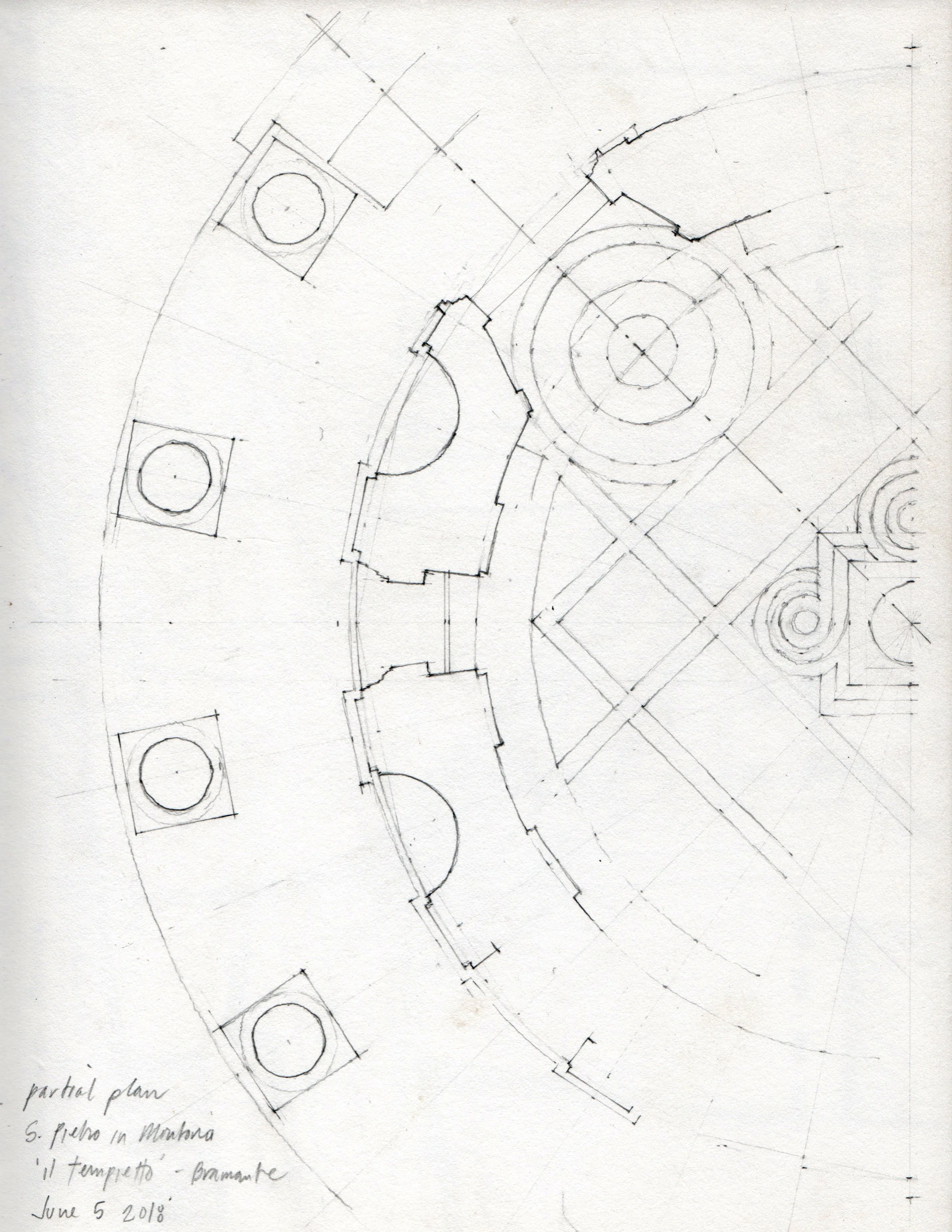
Tempietto at San Pietro in Montorio, Rome, measured drawing by Rick, 2018

Tempietto at San Pietro in Montorio, Rome, measured drawing by Cindy, 2018
We returned to the site of the Tempietto that afternoon to capture the elegant building in perspective - a challenge exercise given its repeating circular structure and close proximity.

Tempietto, sanguine sketch by Cindy, 2018
Day 4: Architecture of the Renaissance Villa Gate; Perspectival Space
We walked to the Vignola gate entrance to the Palatine to practice watercolor, led by instructor Richard Piccolo. Richard taught us how to achieve the proper color tones of shadows, and how the underside of a surface will have a lighter shade from the reflection of the ground.

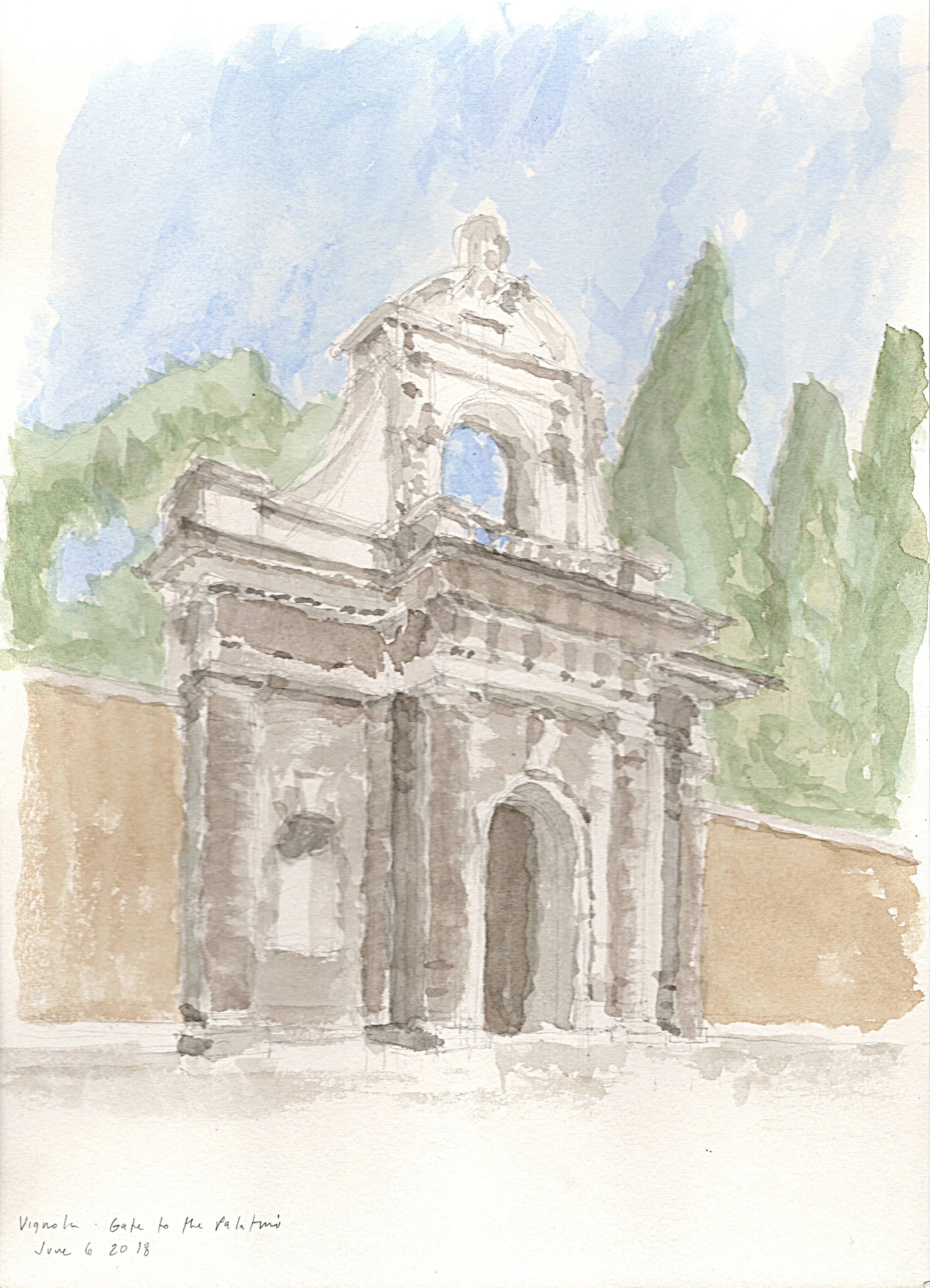
Vignola Gate at the Palatine, watercolor by Rick, 2018
That afternoon we visited the Atrium of San Clemente or S. Gregorio Magno and drew in pencil and white Gouache.

Atrium of Gregorio Magno, goache and pencil sketch by Cindy, 2018
Day 5: Figural Building and Figural Space
We traveled to the countryside to explore the Castelli Romani, the towns of the Alban Hills that overlook the valley of Rome. In ancient times, the hills provided a respite of fresh air from the valley and were believed to be favored by the gods. We followed in the tradition of escaping to the villages and traveled to Ariccia to see Bernini’s Church of Santa Maria Assunta.
Our instructor, David Mayernik, guided us up along the ascent through a forest trail and into the hillside town - this pilgrimage offered us the opportunity to see Bernini’s dome and bell tower framed by the narrow streets of Ariccia. Bernini designed the church as well as the surrounding buildings to form both the building and space around the curved form. The result is a powerful object that composes the space of Piazza della Repubblica, with a view of the hills beyond, and at the same time has a delicate integration with the context of the village buildings. We spent time drawing in the piazza and enjoying a coffee before heading out.

Bernini’s Church of Santa Maria Assunta, pen & marker sketch by Cindy, 2018
Villa Aldobrandini commands a view like no other - it sits high above the piazza of Frascati below, with a view of Rome beyond that.

Villa Aldobrandini, pen & ink sketch by Cindy, 2018
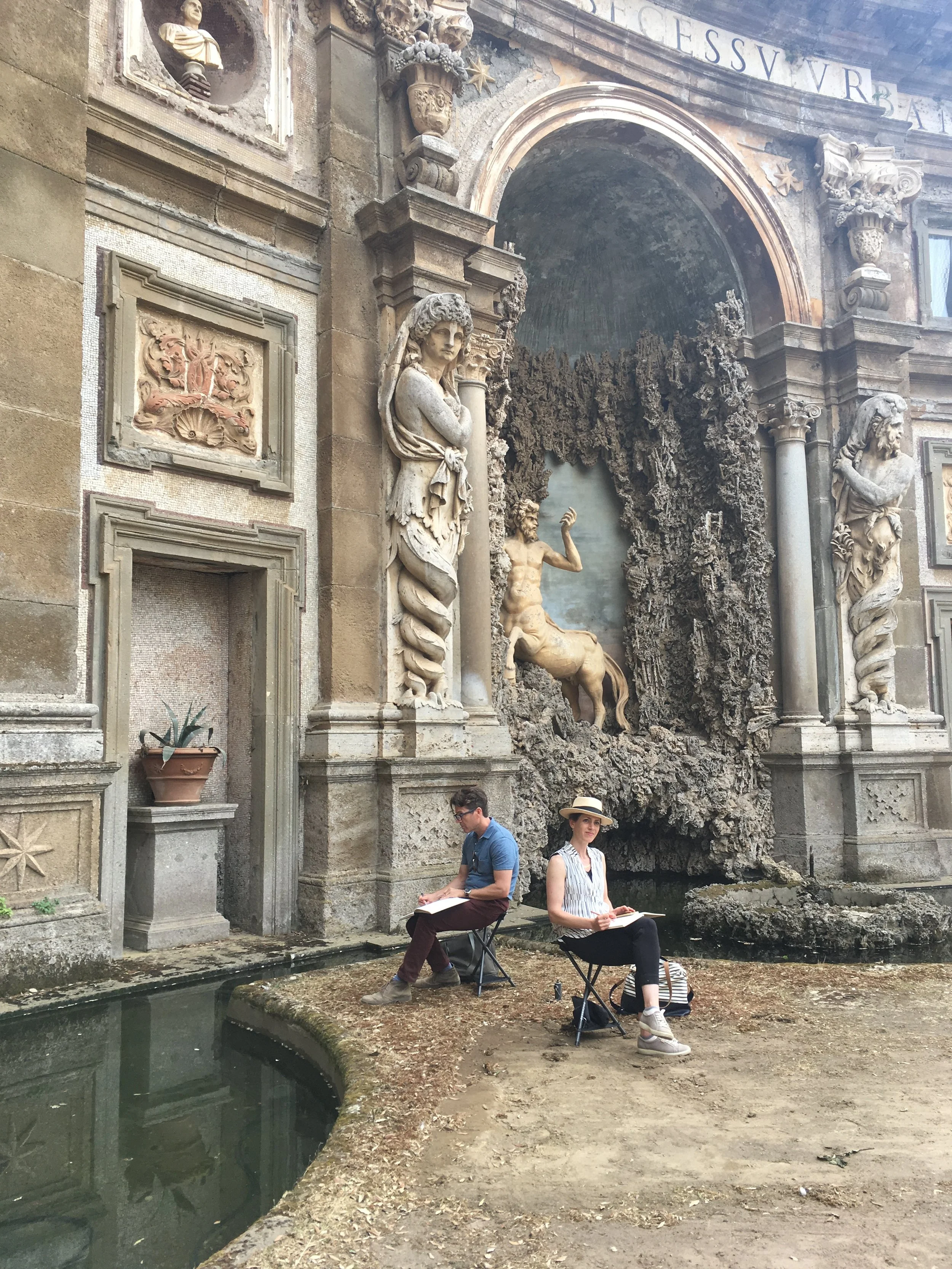
The focus of our visit, however, was in the back of this building to see the gardens and fountain. The Teatro d'Acqua, designed by Carlo Moderno, is a wonderfully elaborate fountain with the central focus being a depiction of Atlas bearing the world on his shoulders. This sculpture represents the battle between reason and passion, and certainly challenged our sketching abilities with its abundant figural detail.
Day 6: Triumphal Arches and the Roman Forum: Type and Variation
We visited the Forum to capture in drawing the three triumphal arches; Septimius Severus, Titus, and Constantine. David Mayernik explained to us how the base of the Septimius Severus was buried beneath layers of sediment before it was uncovered by archaeologists. It was interesting thinking about this fact while drawing the details and proportions.
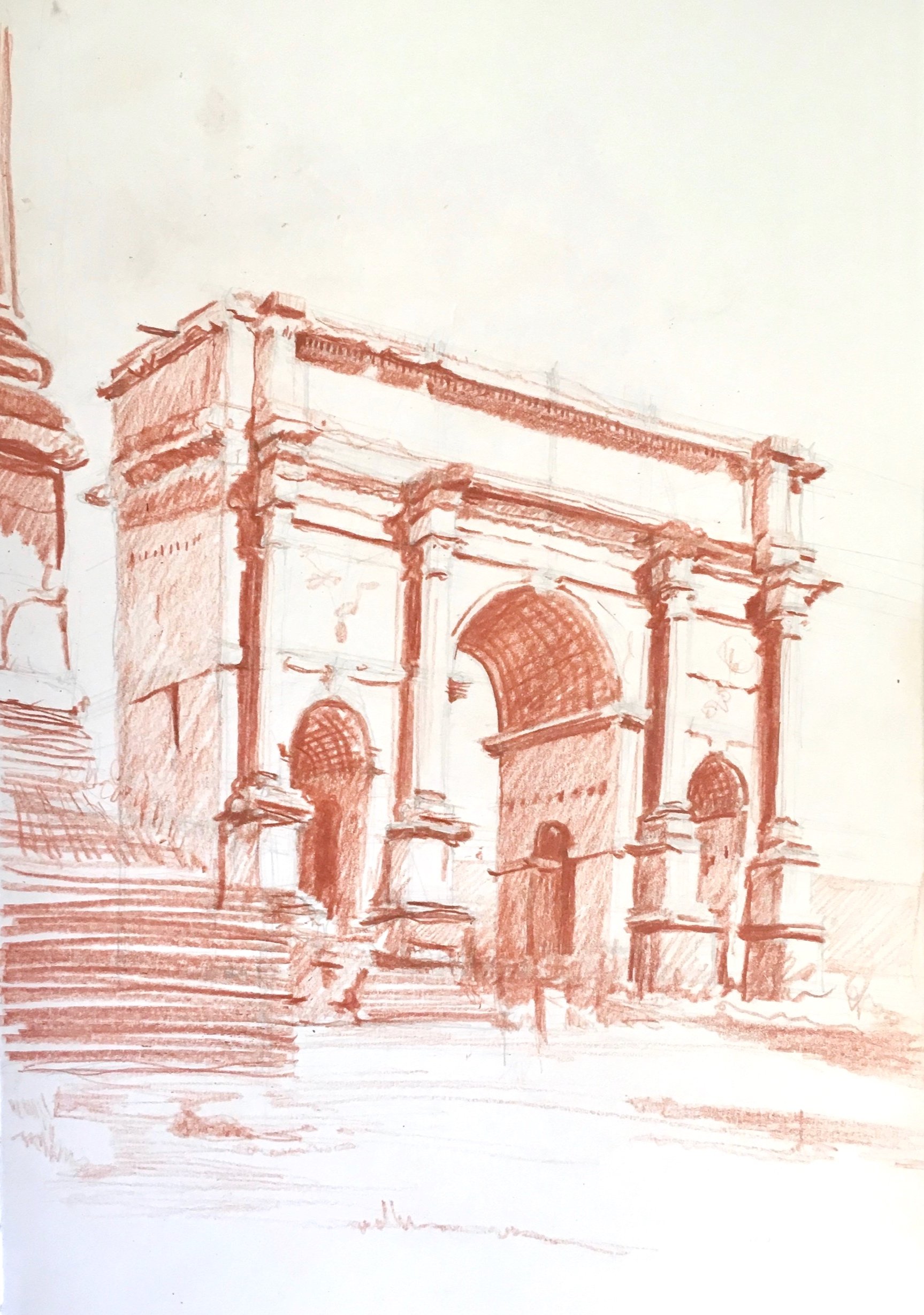
Arch of Septimius Severus, sanguine sketch by Cindy, 2018
After lunch, we painted the Arch of Constantine, where Instructor Richard Piccolo reminded us to observe the vivid effects of light on form. We sought to capture the play of warm and cool colors in light and shadow.
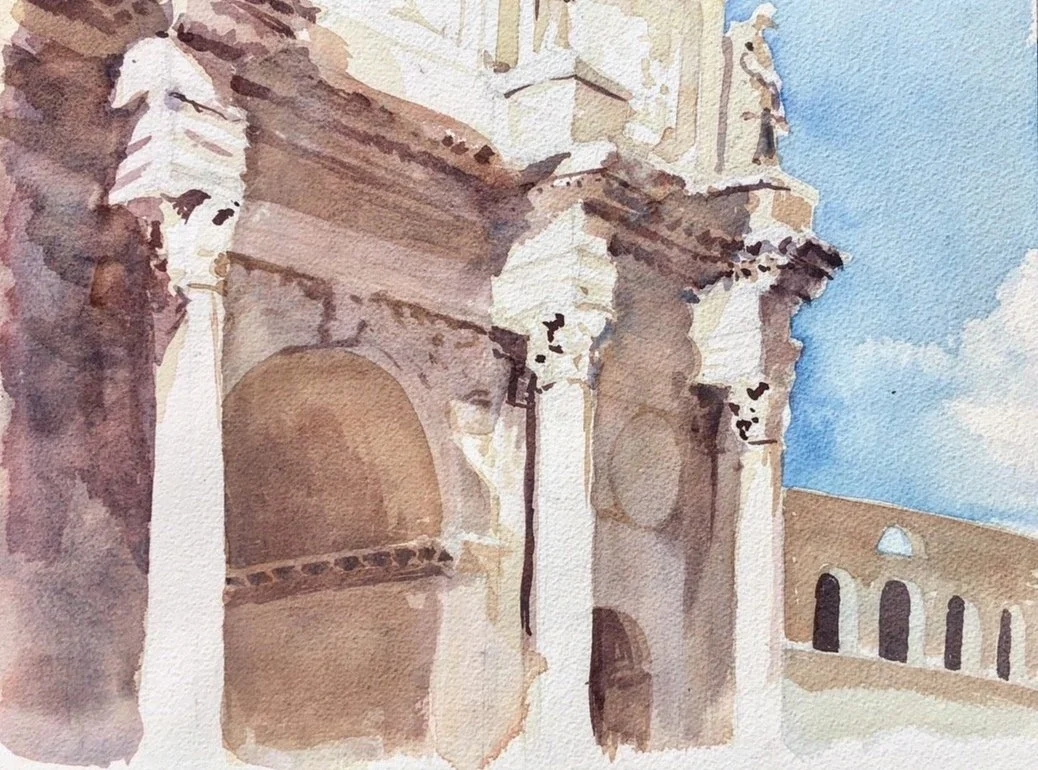
Arch of Constantine, watercolor by Cindy, 2018
Day 7: The Classical Building in the Landscape
We’d returned to the onetime bustling cattle market of the Forum Borarium to study the round Temple of Hercules Victor. This drawing session in sanguine pencil built on the week’s education in light and form, while also adding a new focus, rendering trees. Framed by picturesque umbrella pines, the temple served as a focal point against the trees’ darker range of values in the background.
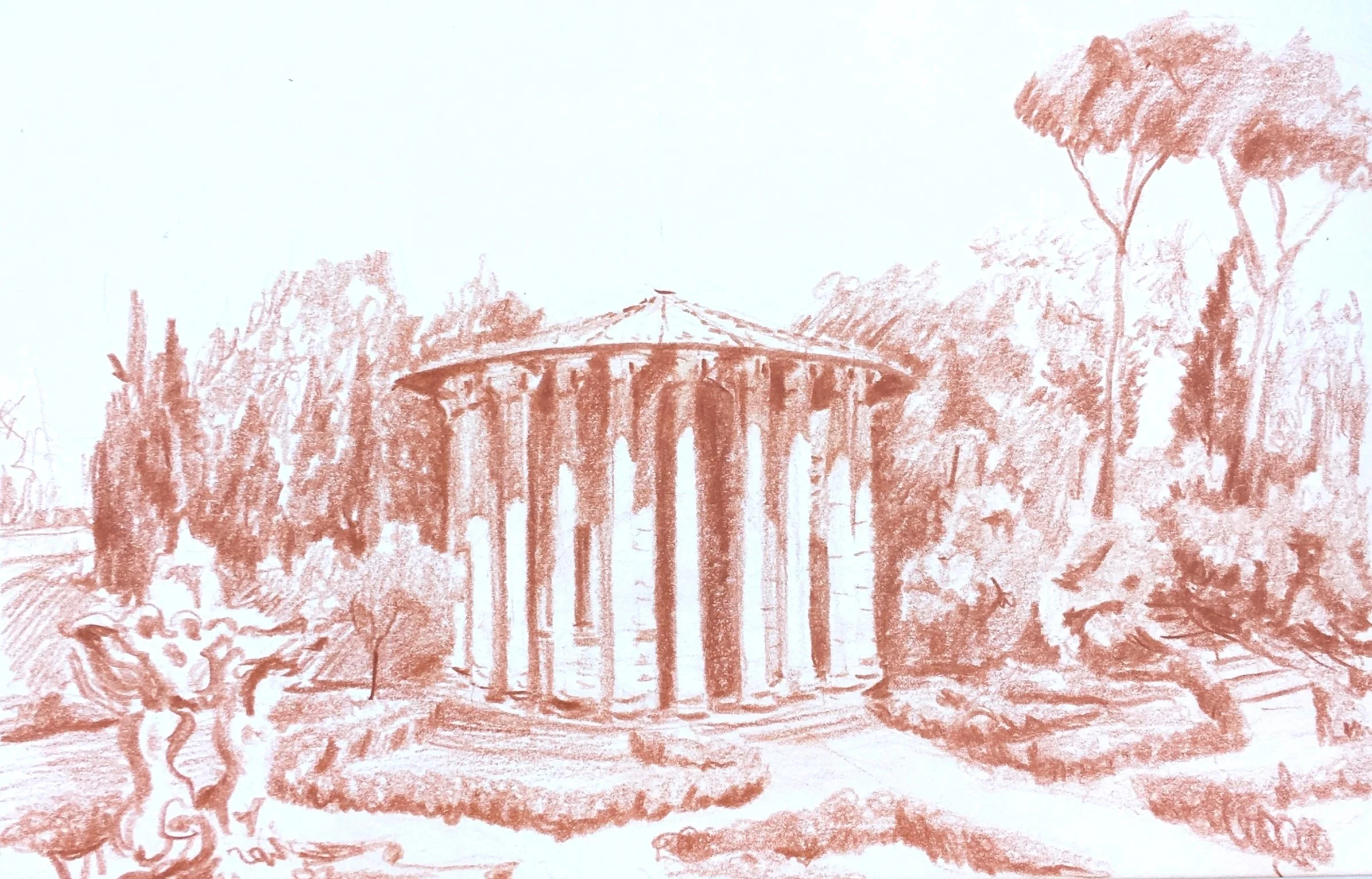
Temple Hercules, sanguine sketch by Cindy, 2018
The drawing tour concluded with a sitting at the terrace adjacent to the Campidoglio, overlooking the whole of Rome with its domes, tile roofs and hillsides beyond. This was just a pure joy to paint under the bright beautiful Italian sun.

watercolor of Rome from the Campidoglio, by Cindy 2018
After the tour concluded, Rick and I ventured on to Tivoli to see the famous fountains at Villa d’Este. The garden proved to be a perfect setting for watercolor… this one below was painted using water from the fountain itself!

fountains at Villa d’Este, watercolor by Cindy, 2018
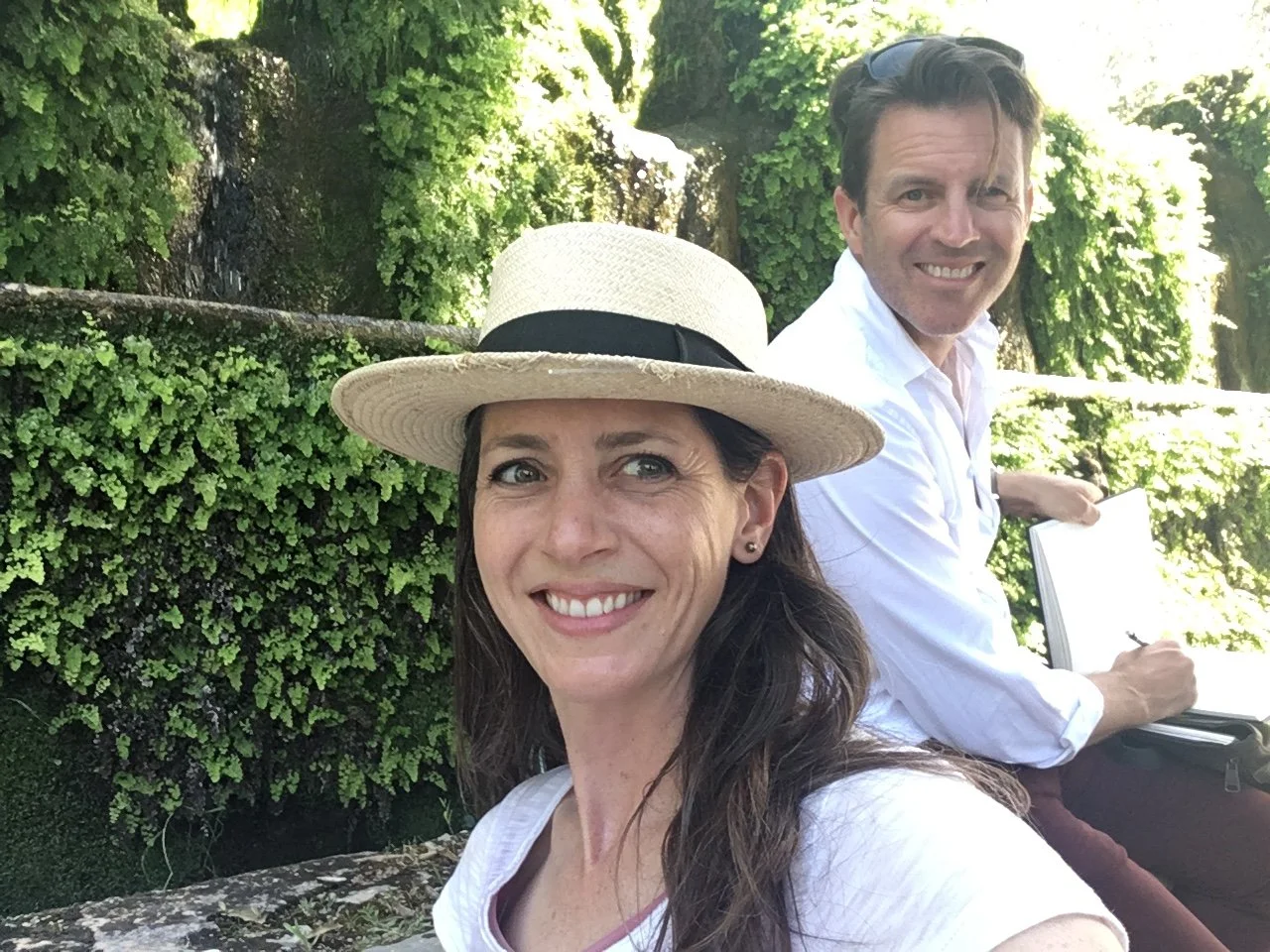
at Villa d’Este in Tivoli