


Classical Texas
a visual journal of classical terminology, discovered in Texas architecture
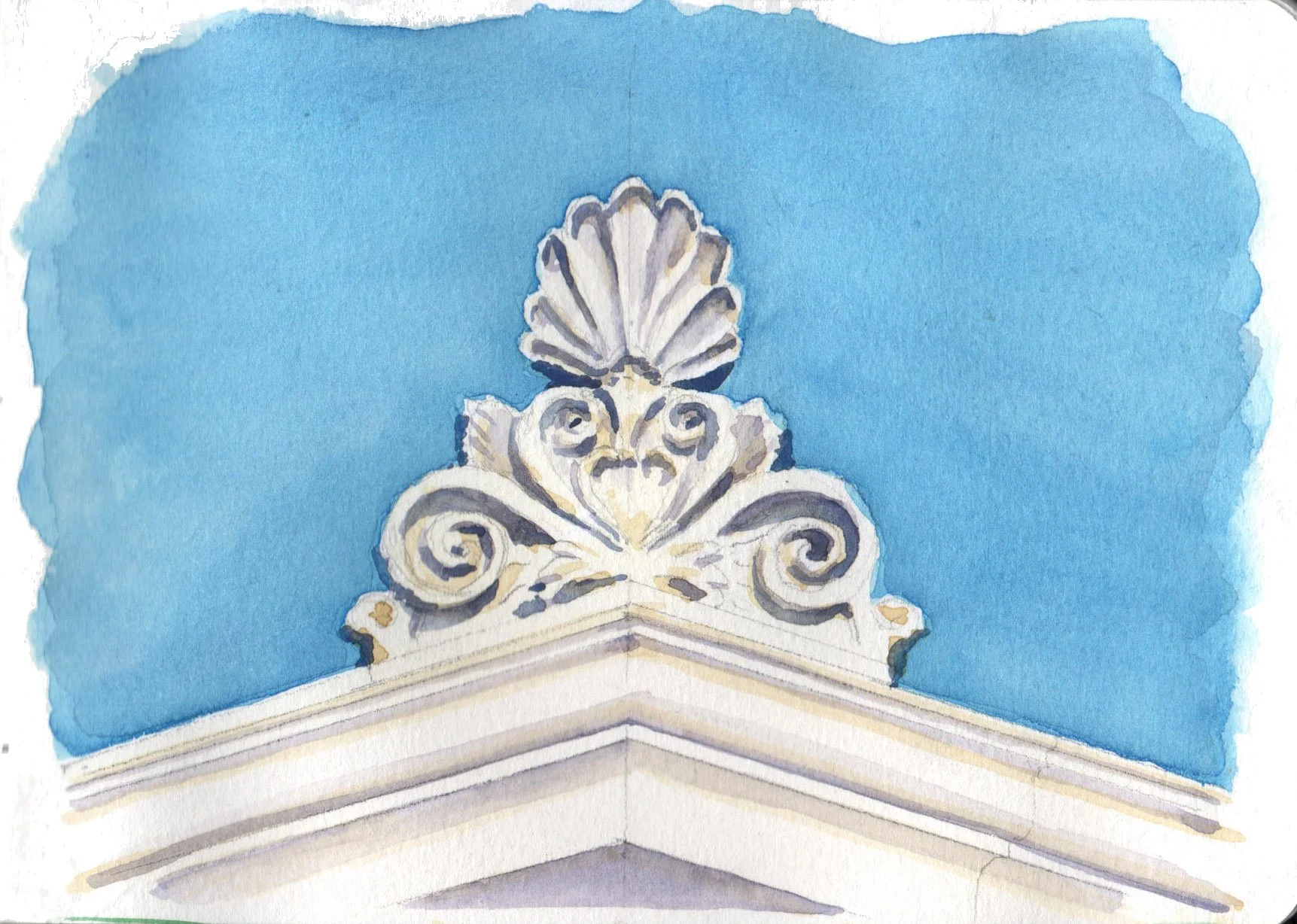
acroterion; First United Methodist Church, Austin, TX
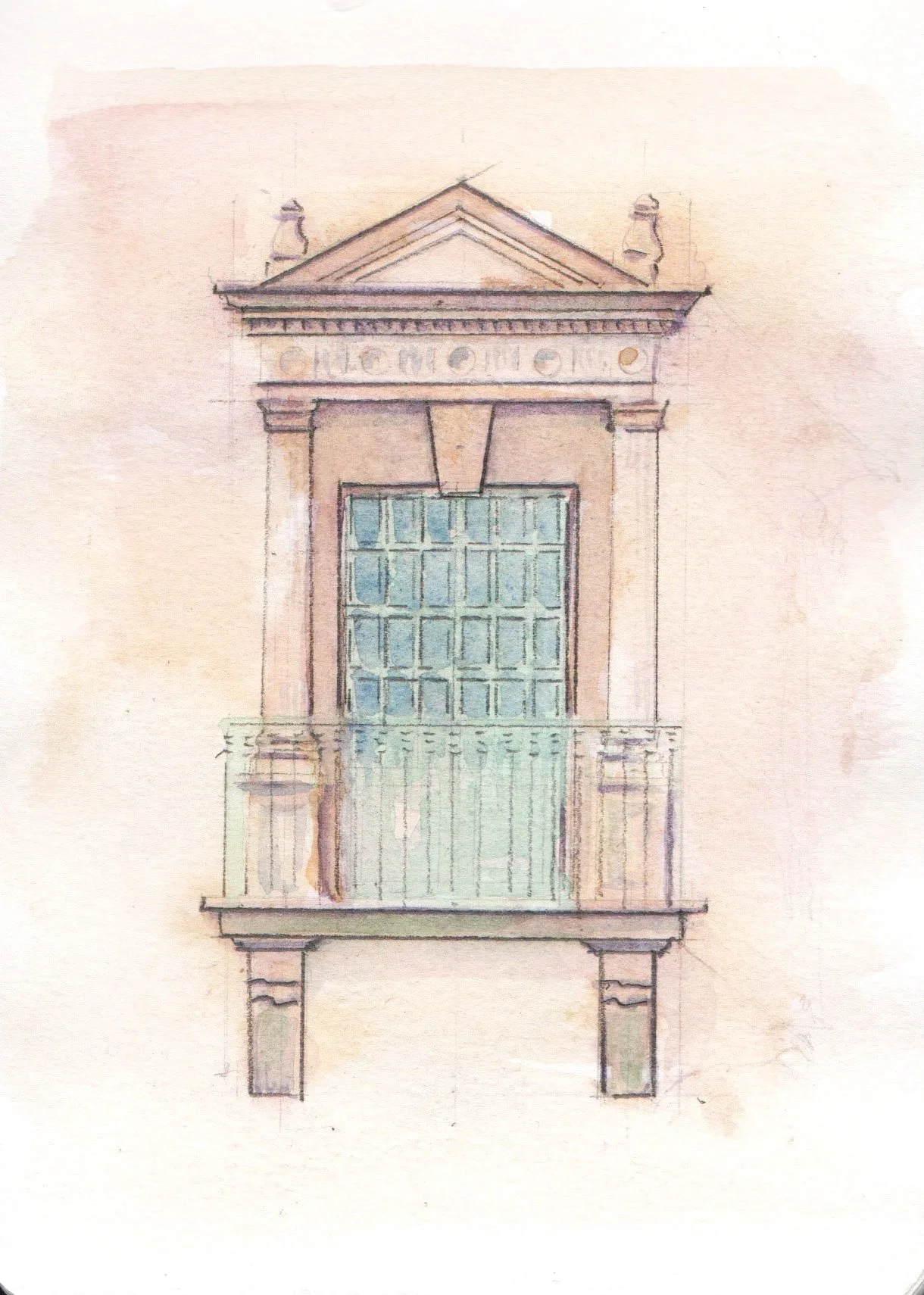
aedicule; Goldsmith Hall, School of Architecture at the University of Texas at Austin

antefix; Museum of Fine Arts, Houston
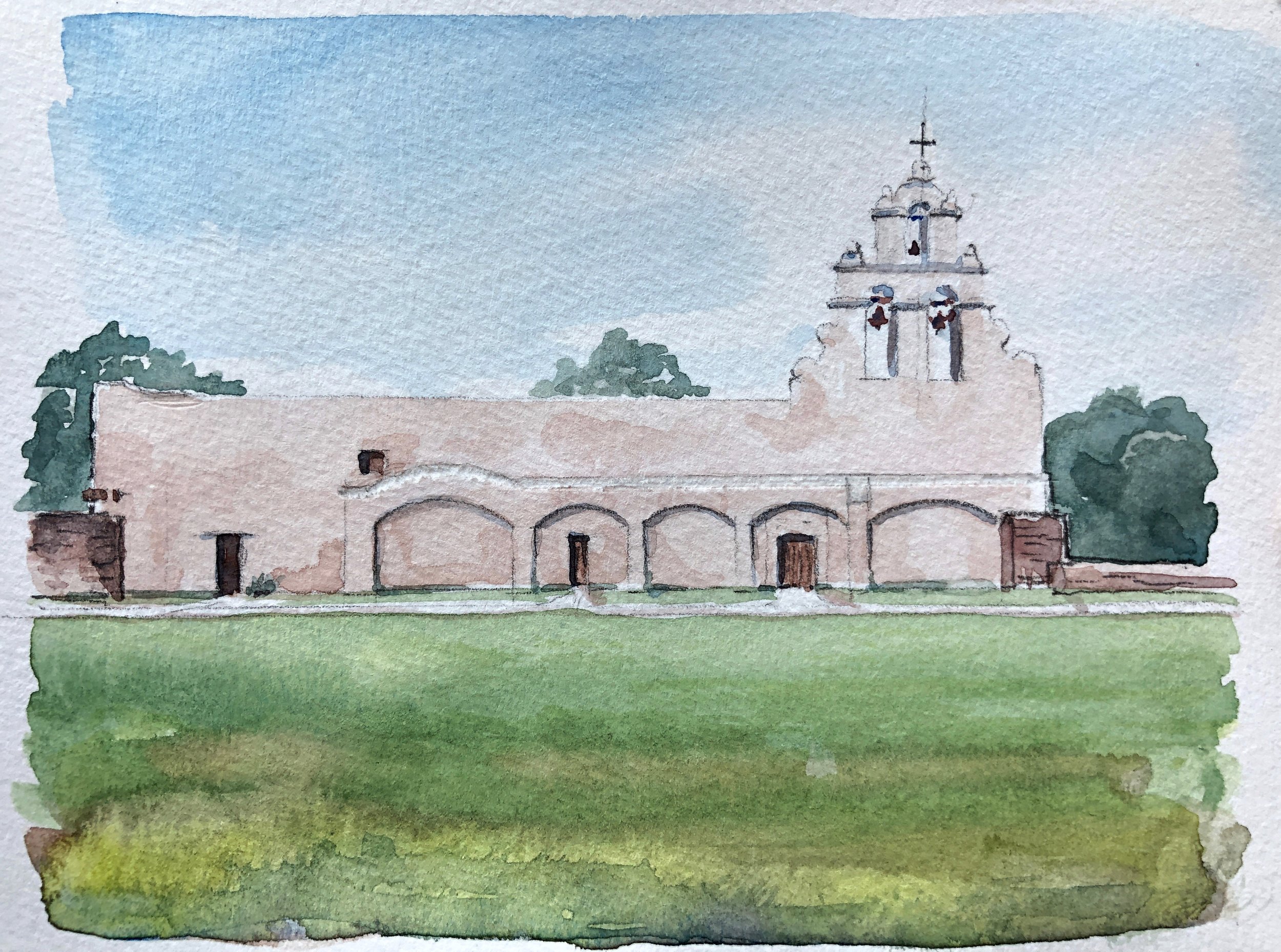
blind arcade; Mission San Juan Capistrano, San Antonio
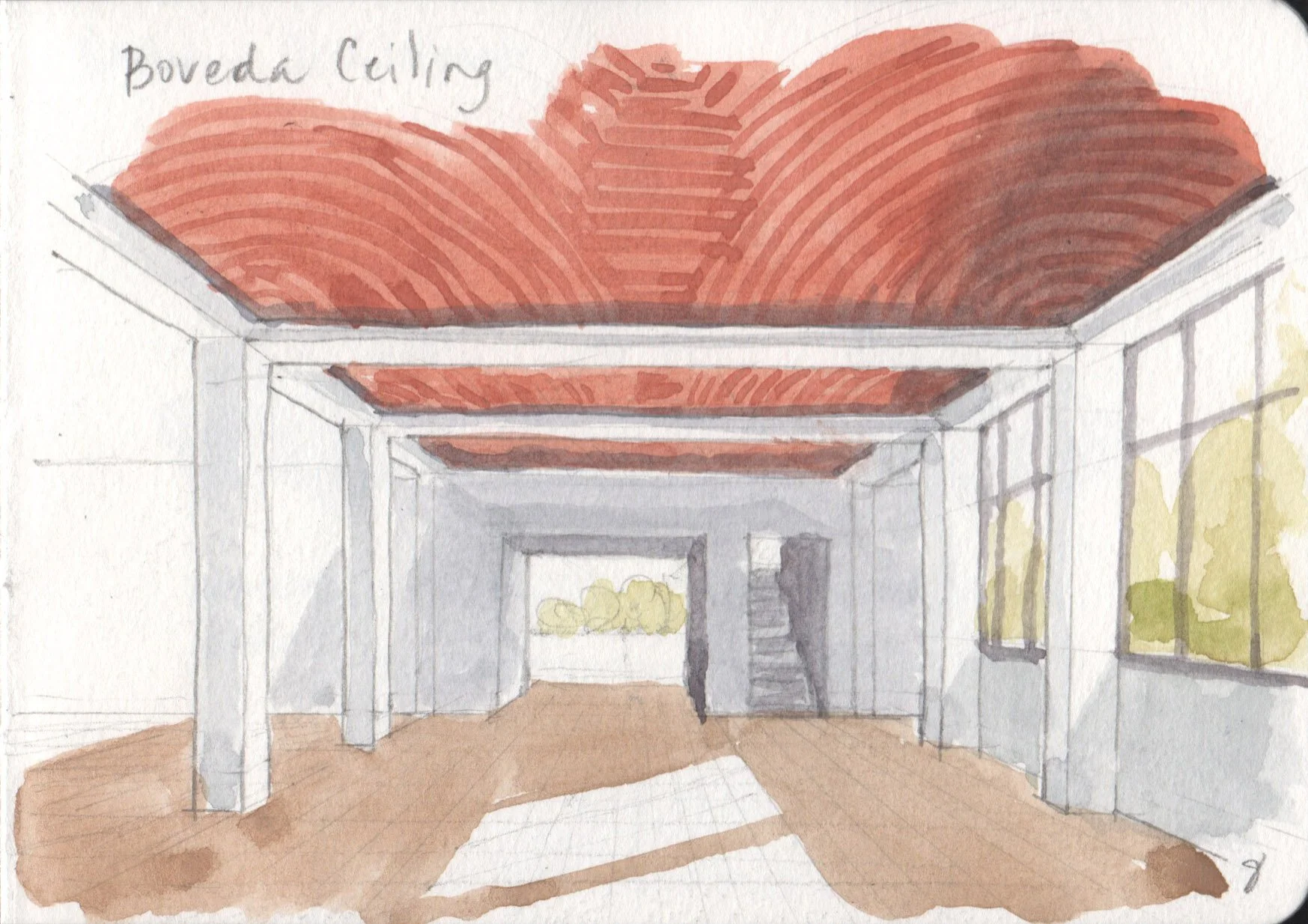
boveda; Museum of Western Art, Kerrville
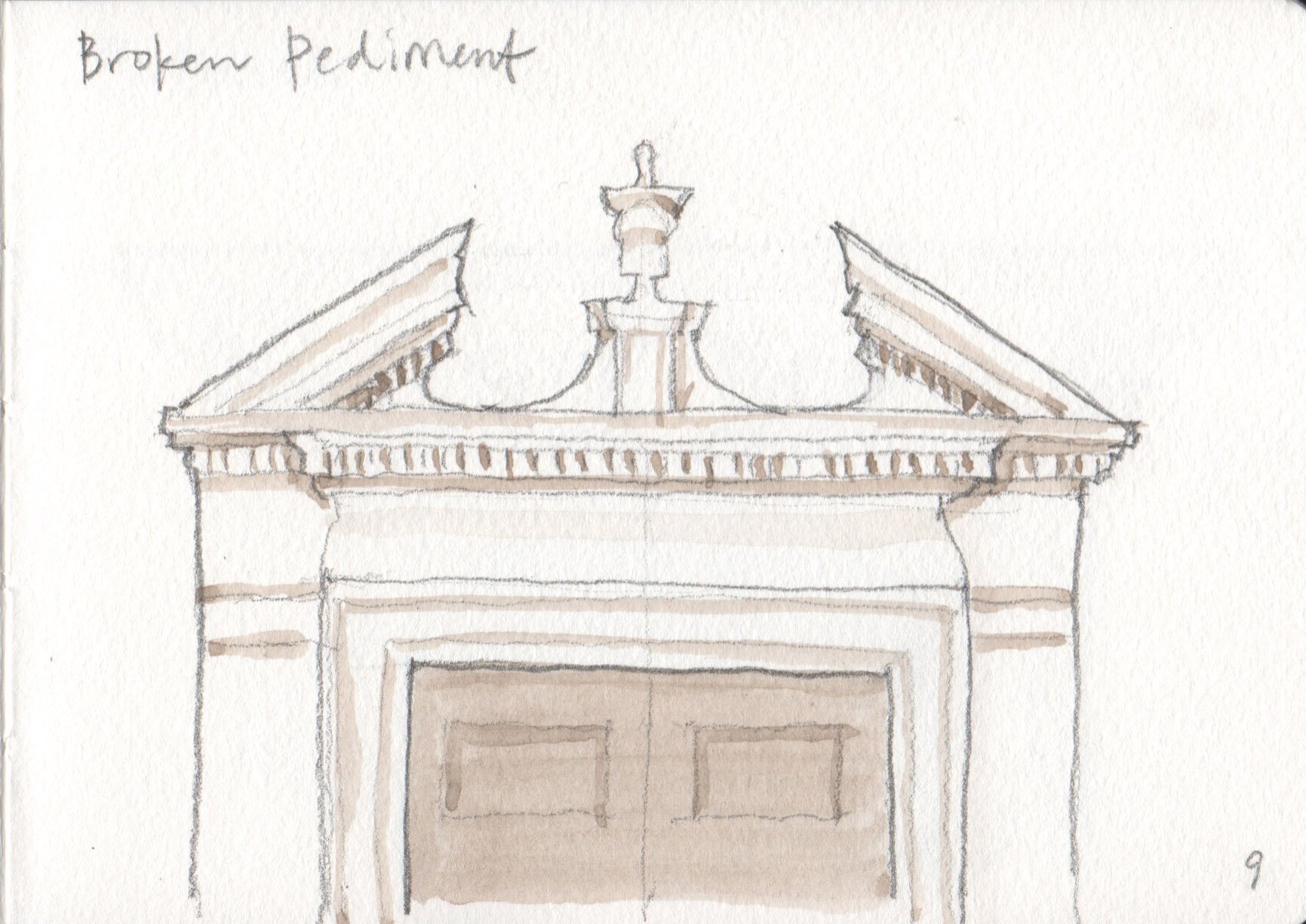
broken pediment; Perkins Hall, Southern Methodist University, Dallas
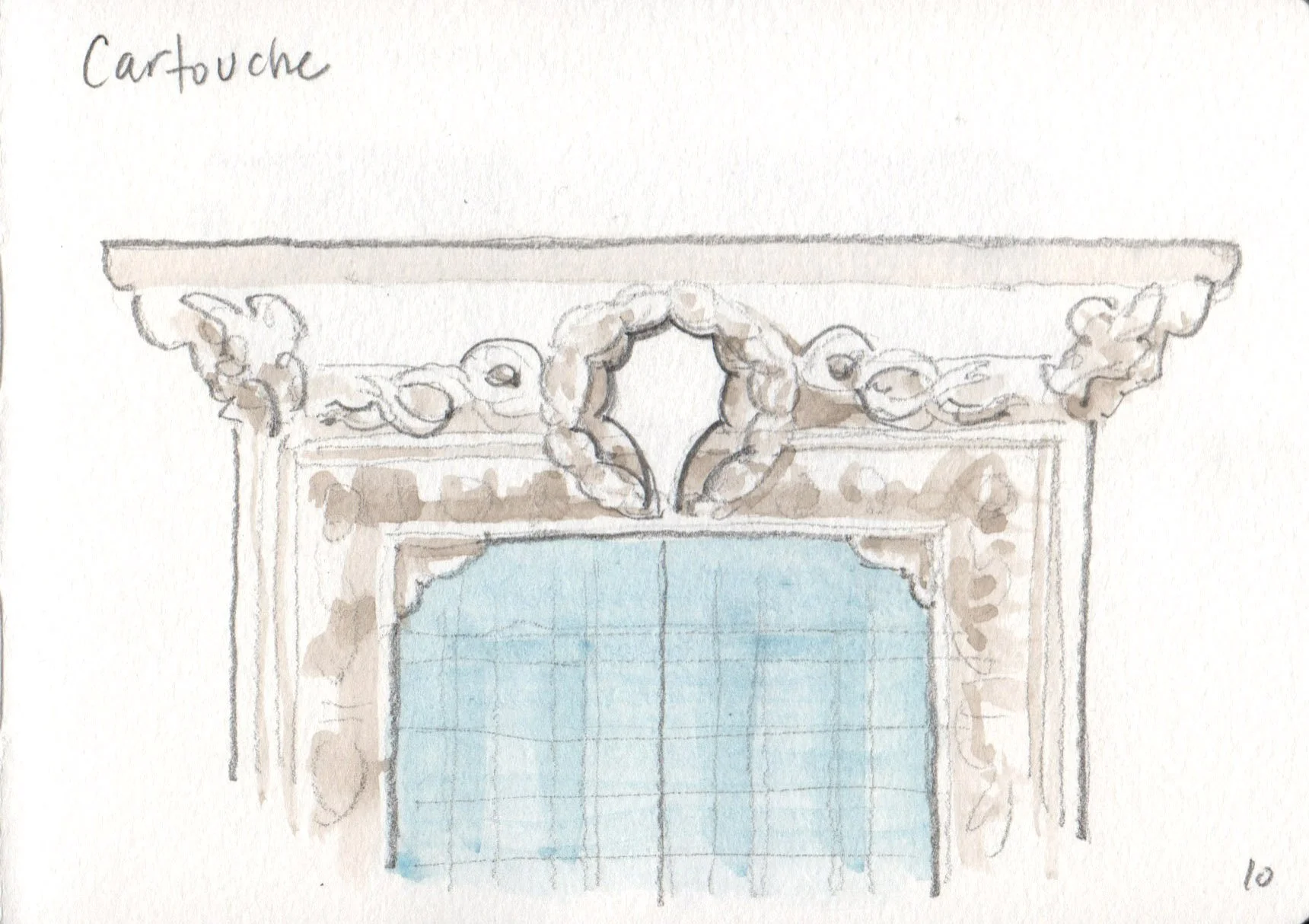
cartouche; Battle Hall, University of Texas at Austin
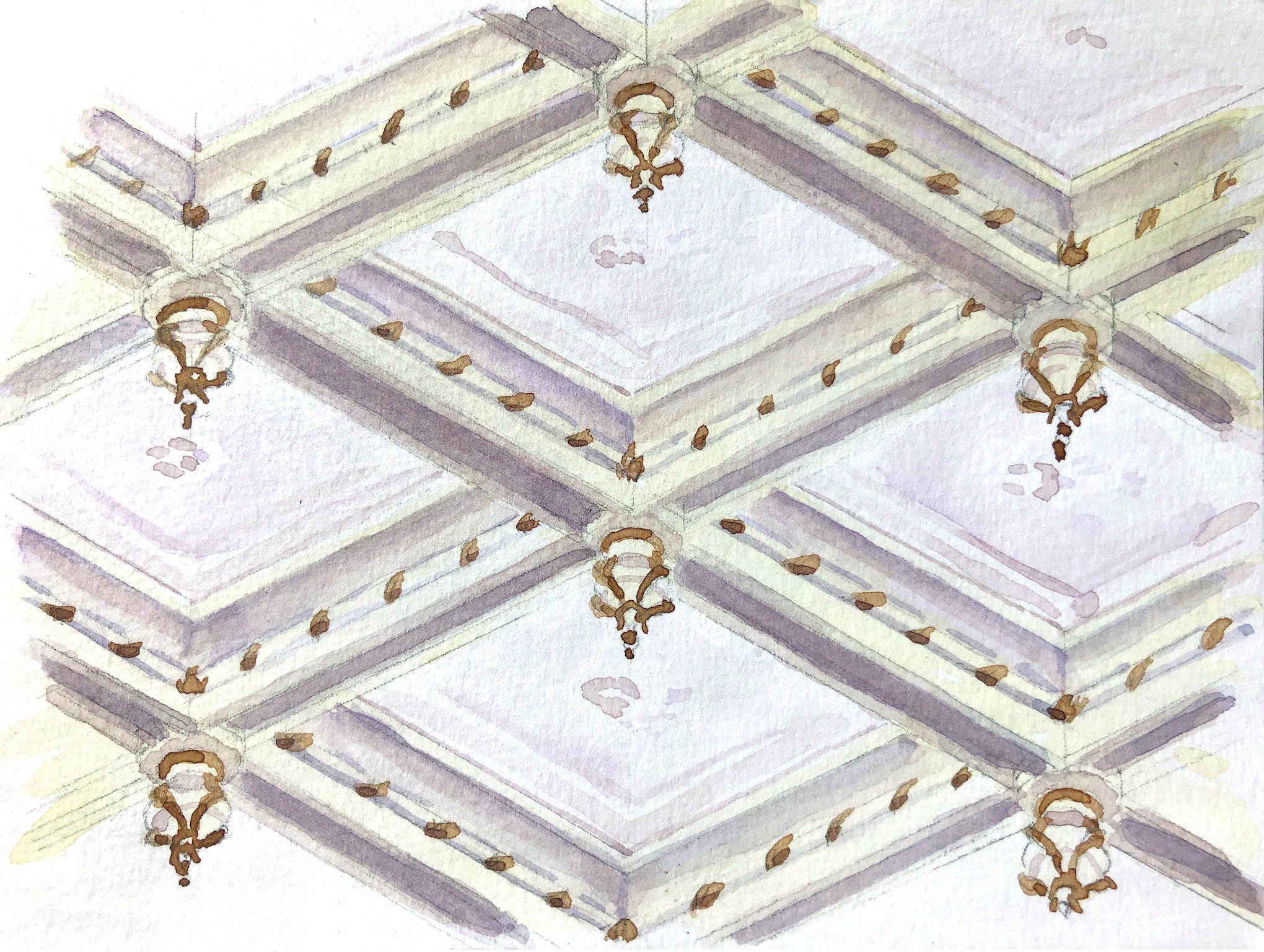
coffered ceiling; Texas State Capitol Building, Austin
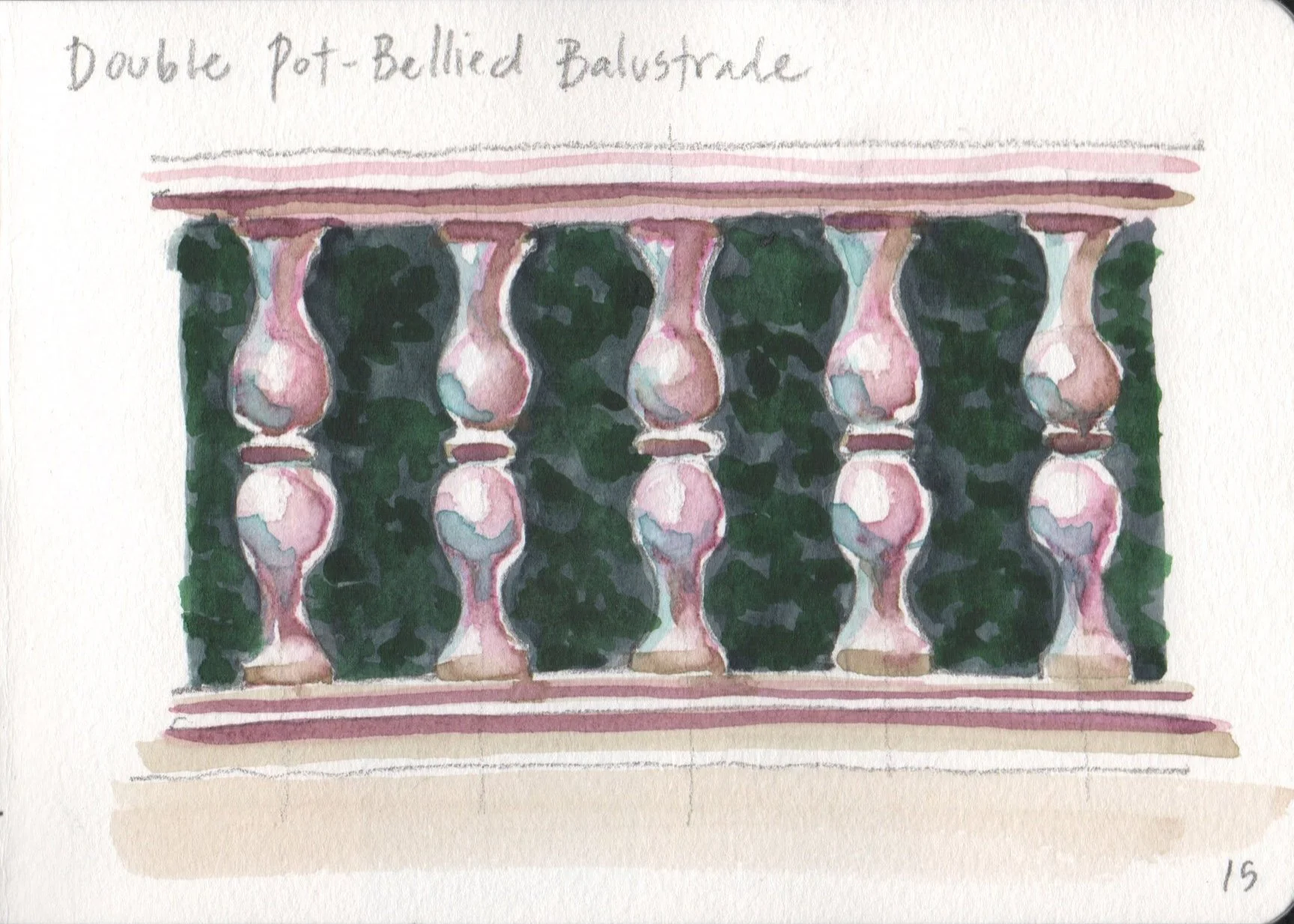
double pot-bellied balustrade; Muse Residence, Dallas
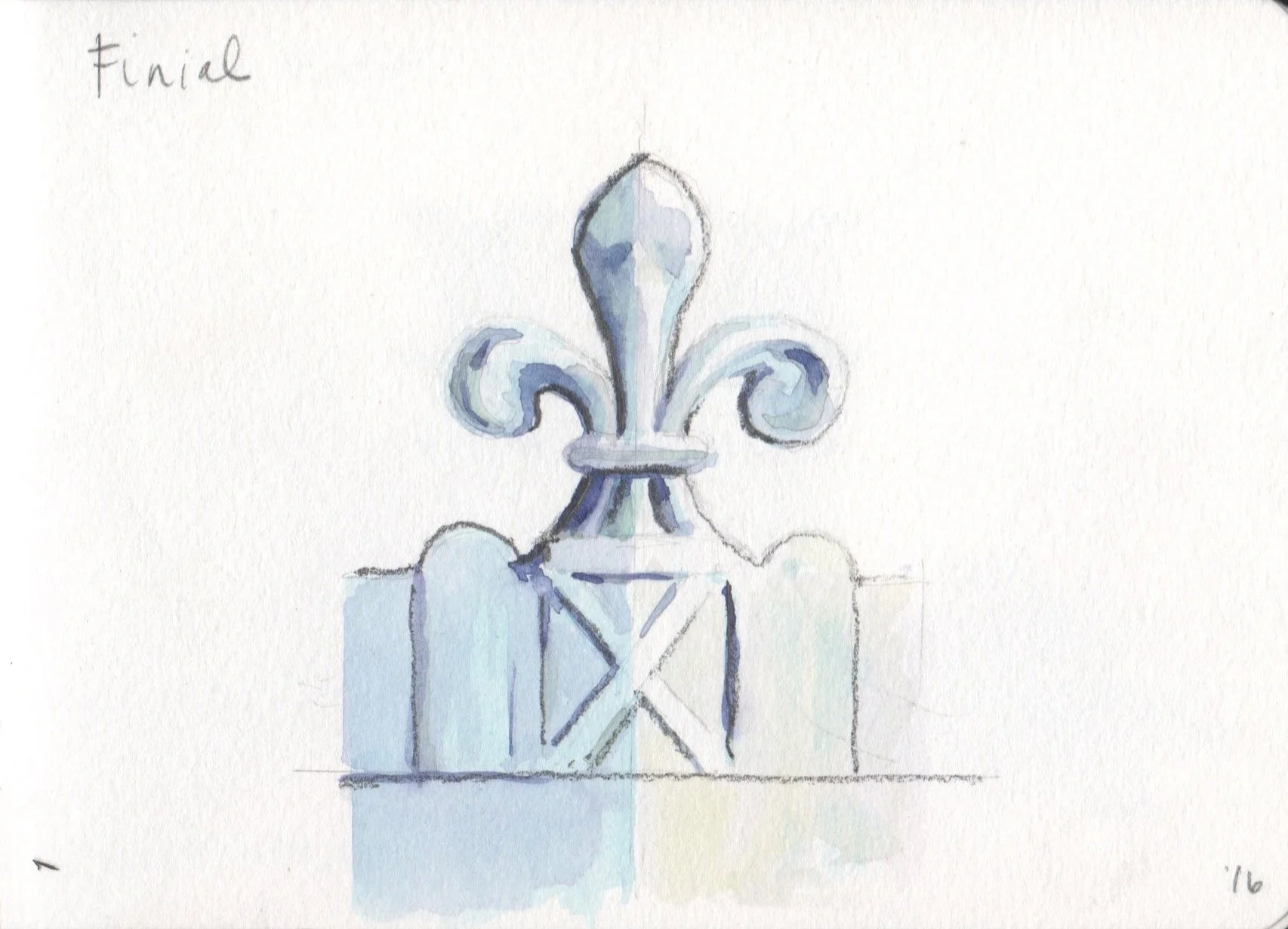
finial; Sacred Heart Catholic Church, Galveston
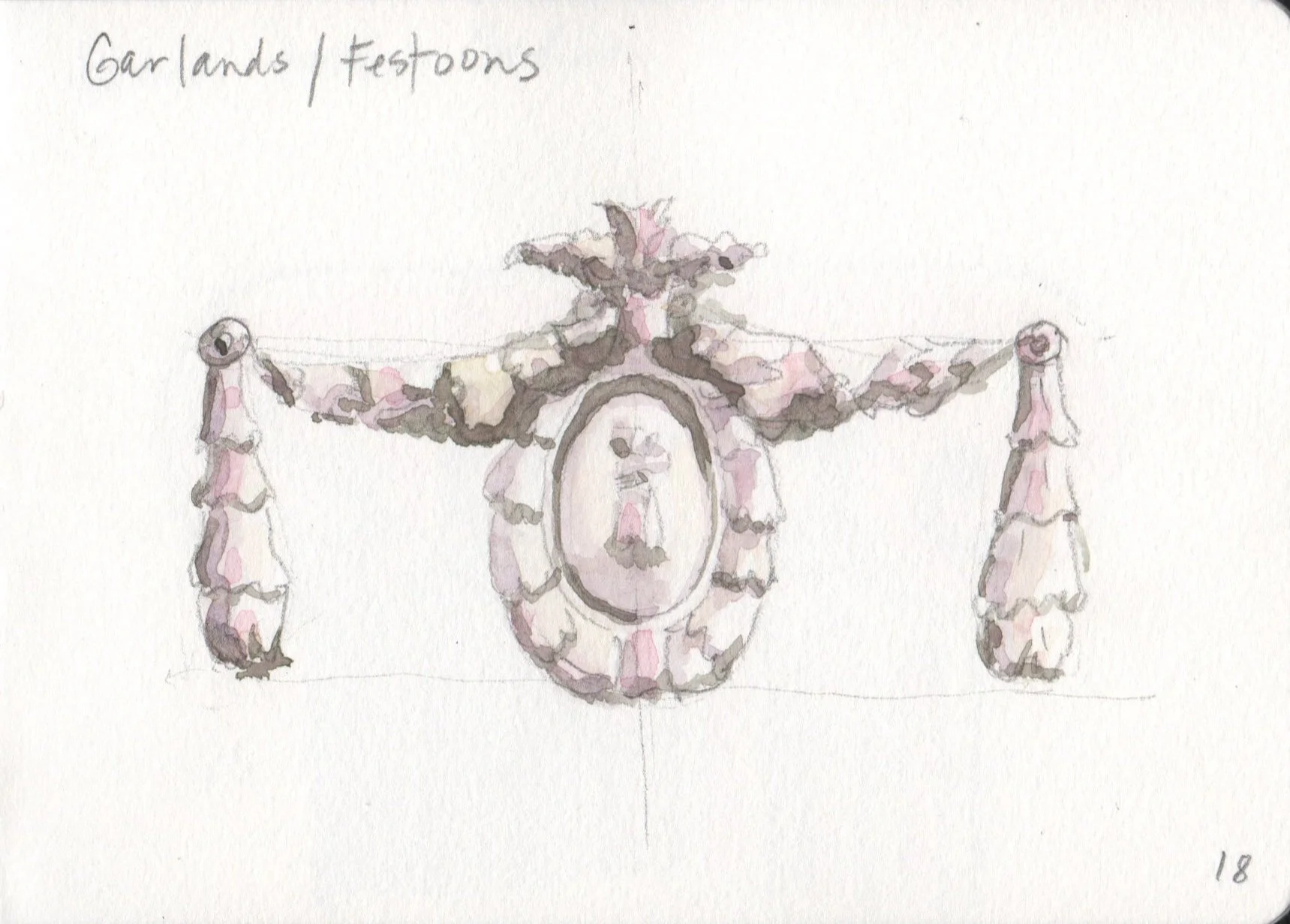
garlands & festoons; Denton County National Bank
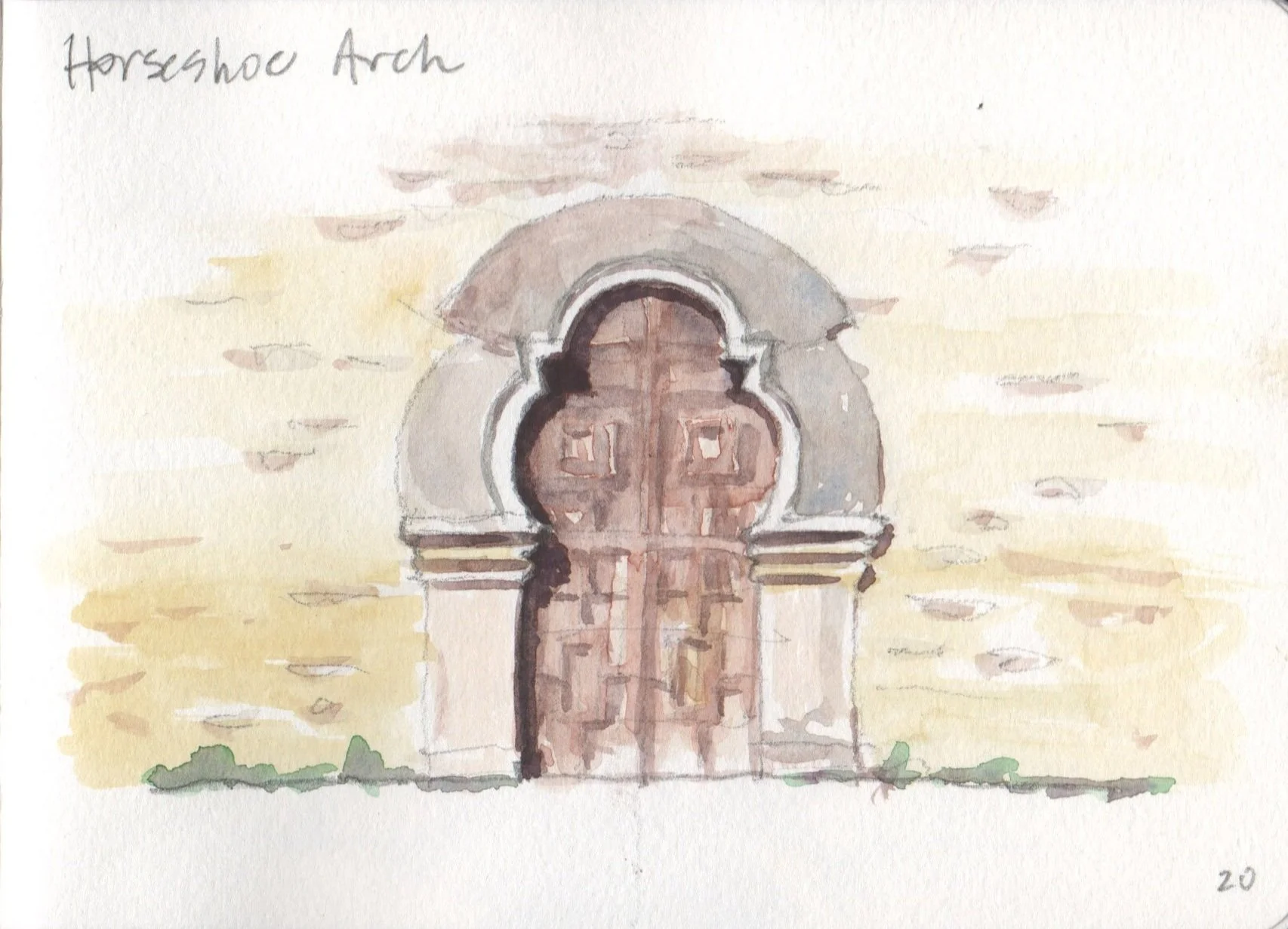
horseshoe arch; Mission San Francisco, San Antonio
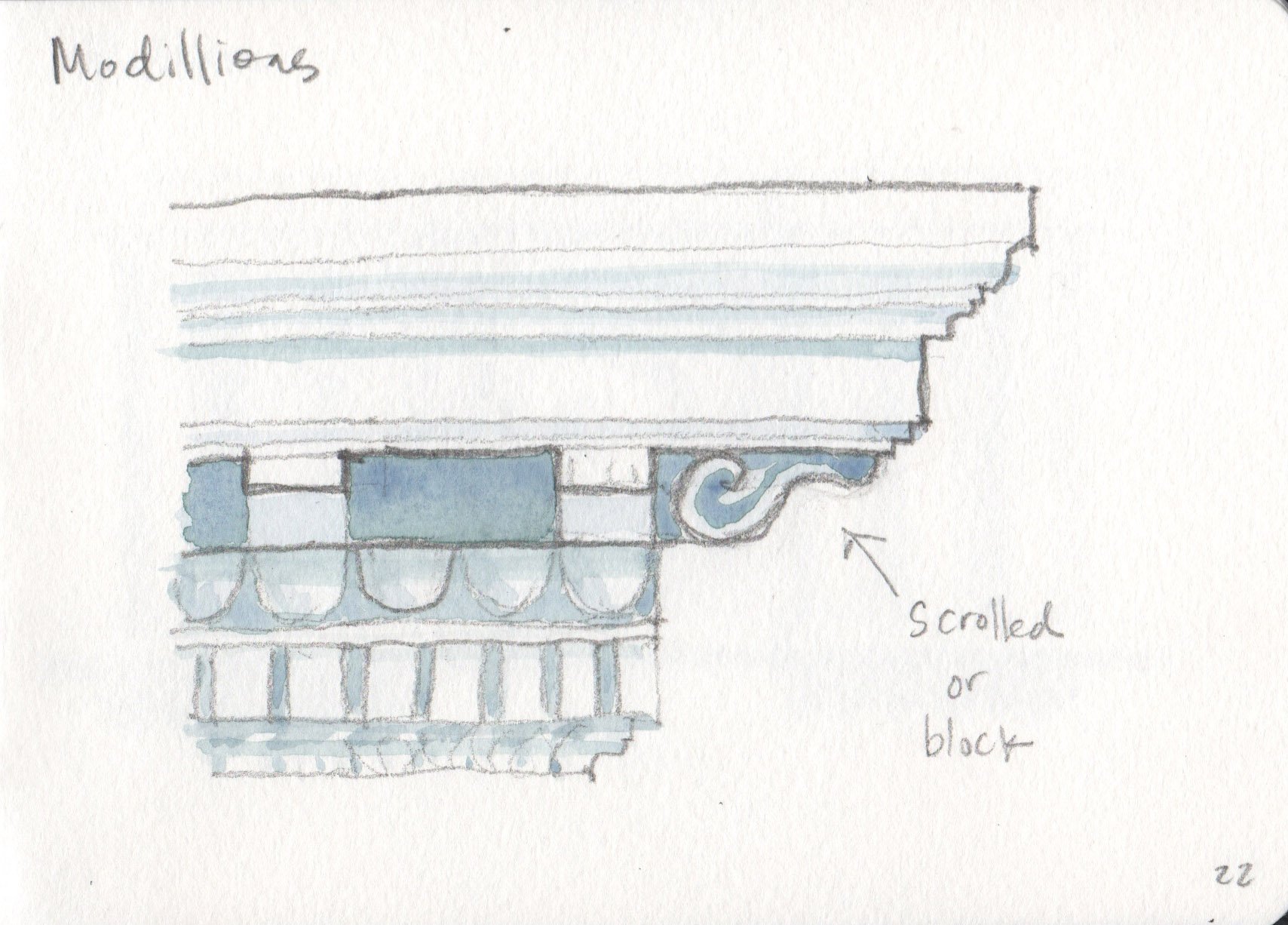
modillions; Dallas Hall, Southern Methodist University, Dallas
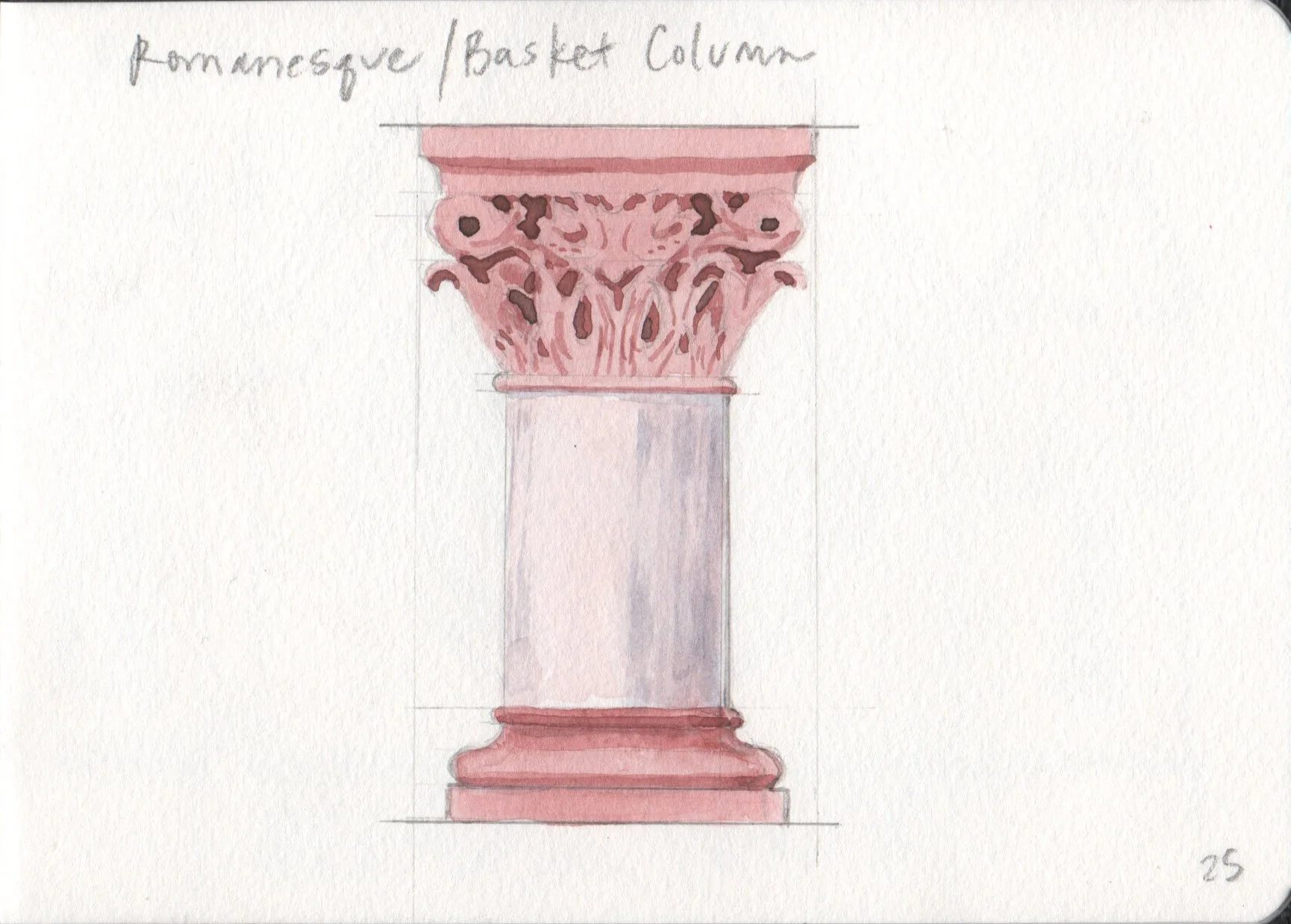
romanesque basket column; Denton Courthouse on the Square, Denton
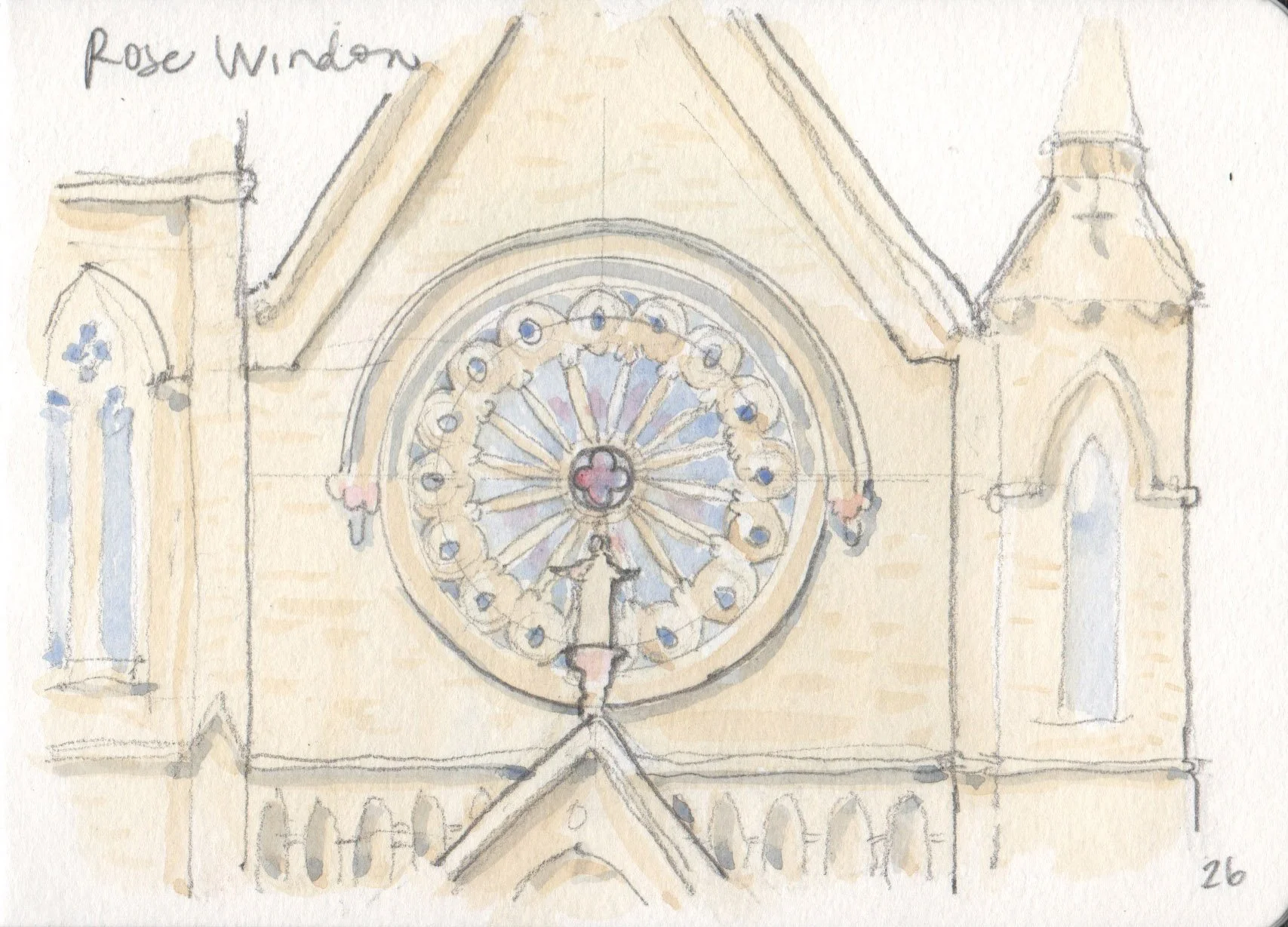
rose window; Saint Mary Cathedral, Austin
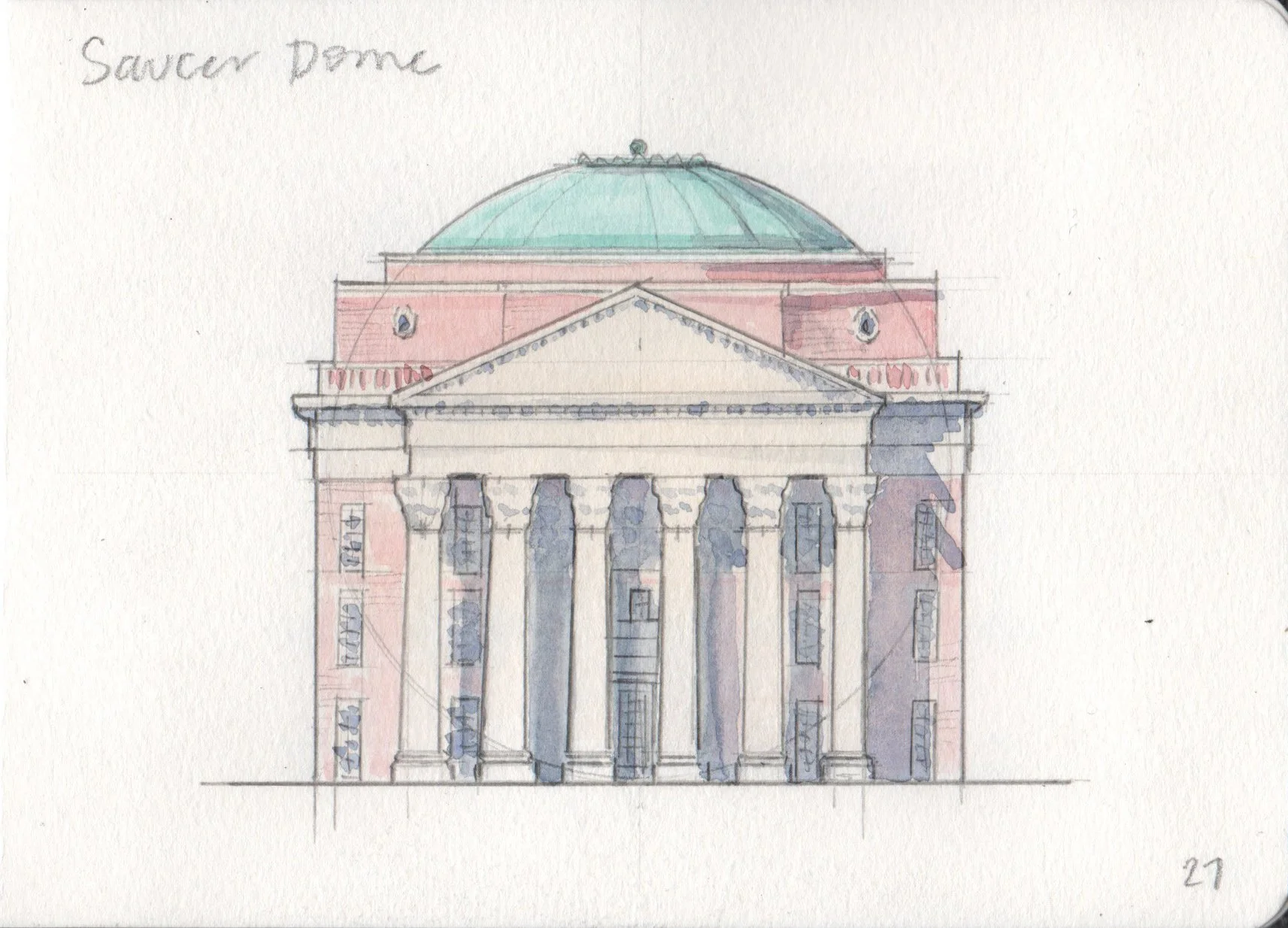
saucer dome; Dallas Hall, Southern Methodist University, Dallas
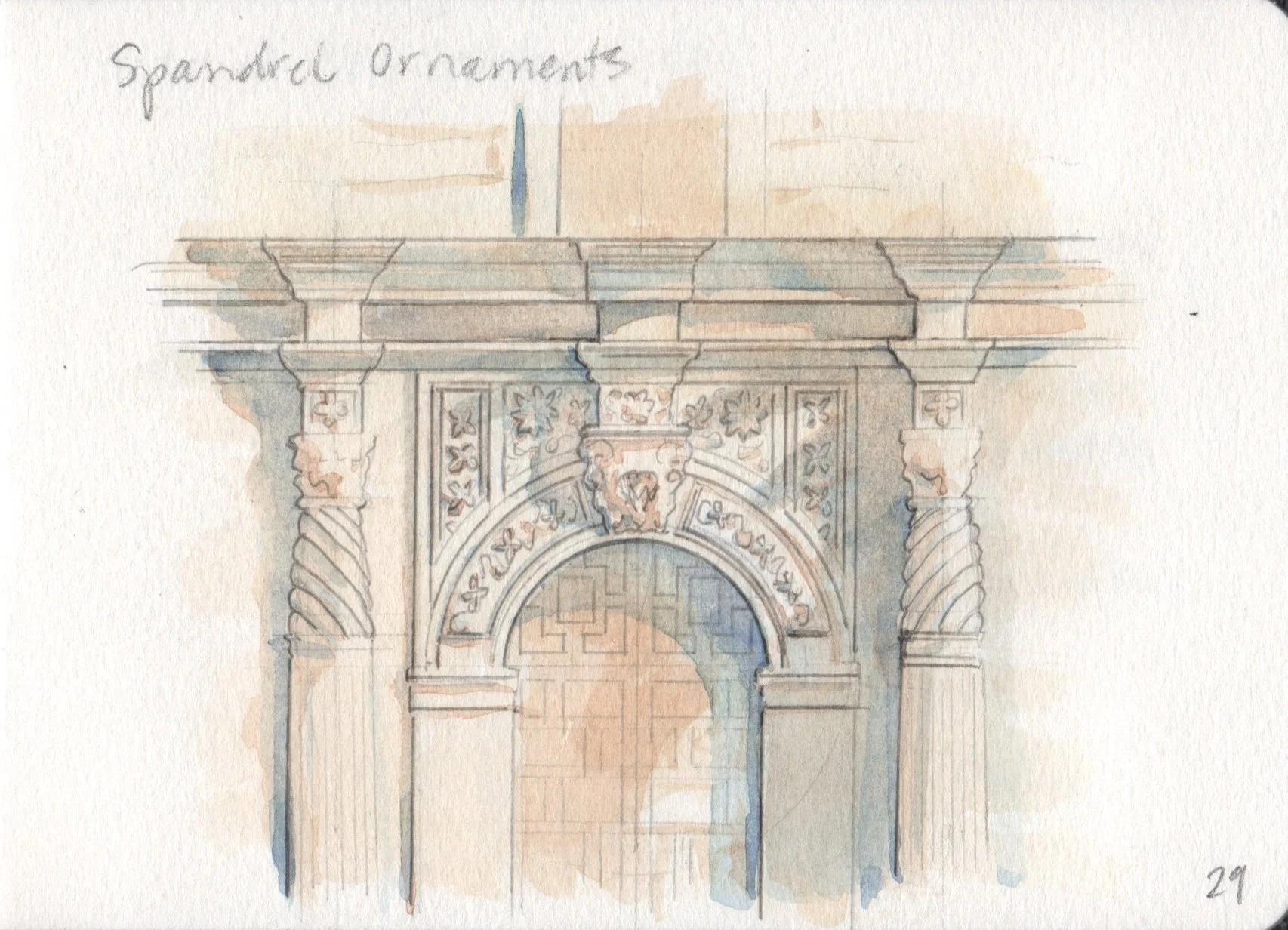
spandrel ornaments; The Alamo, San Antonio
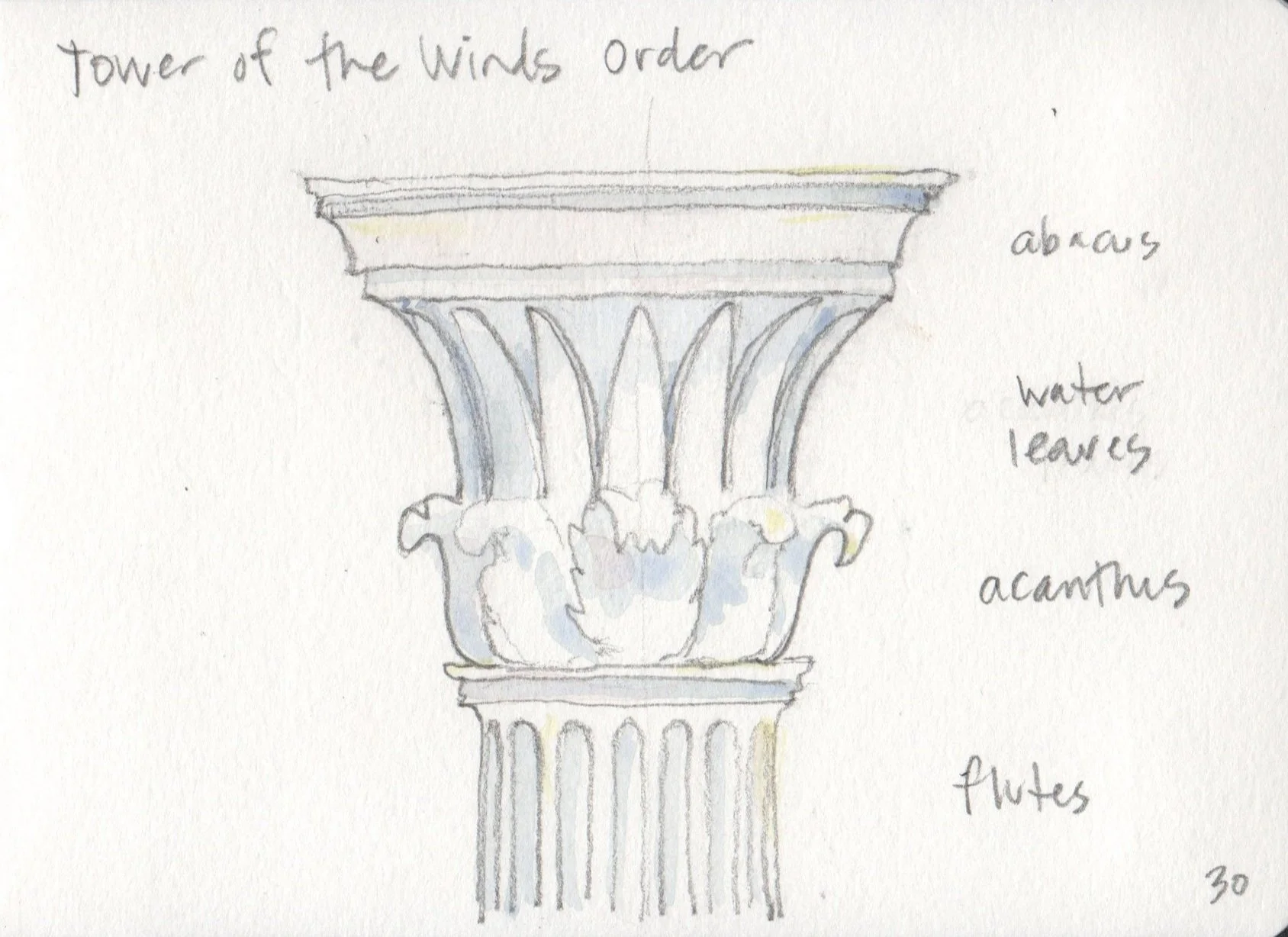
tower of the winds; 1400 West Ave, Austin

hill country home
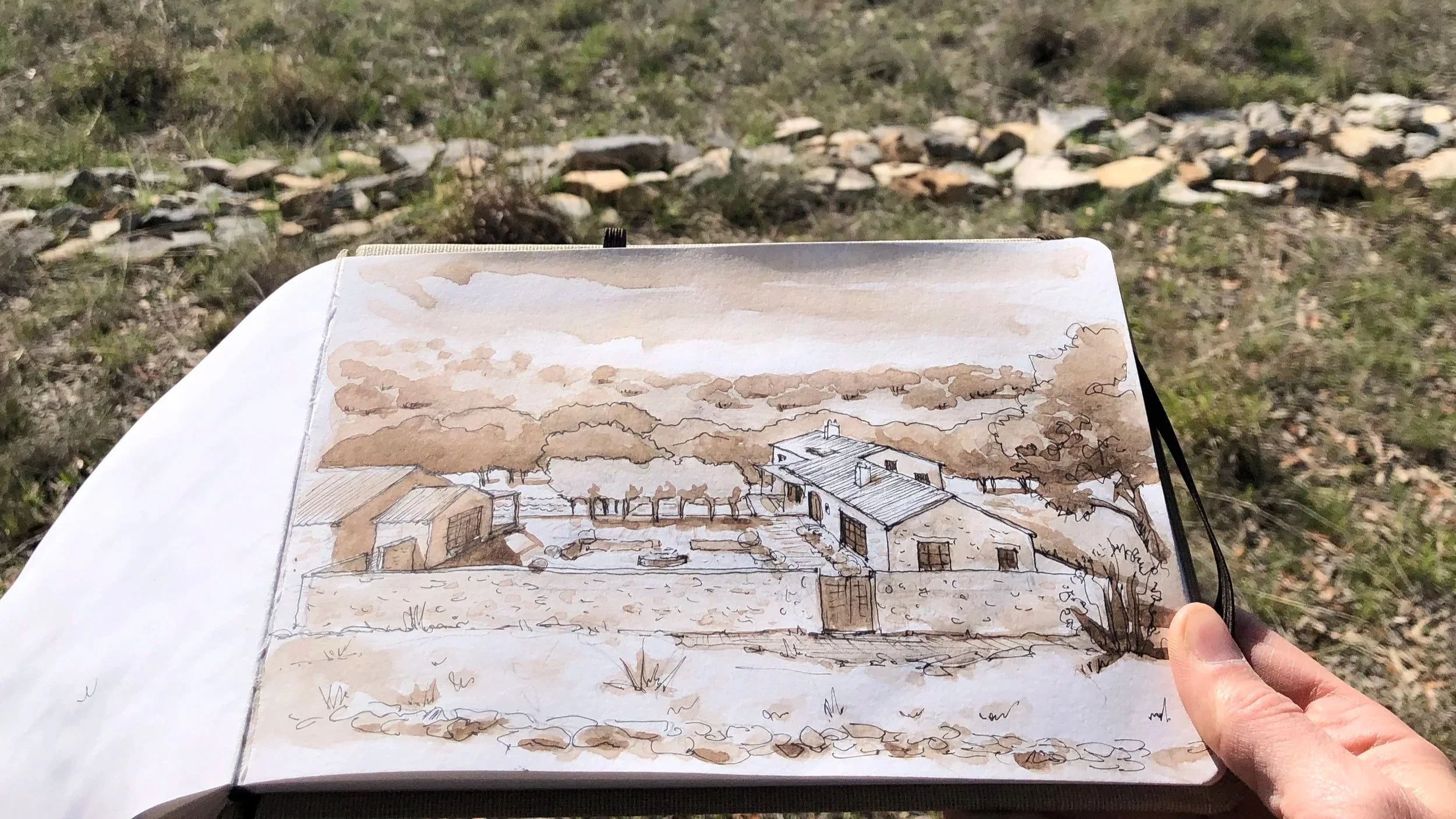
watercolor concept sketch of a hill country residence
In 2023, we began construction on a 7-acre property at the Preserve at Walnut Springs in the rural lands outside Johnson City. The landscape provides a bigger canvas for gardening, family life and animals - the Preserve hosts a herd of longhorn, horses and wildlife.
Our design process began with a site analysis that would help shape the future build: landscape, trees and topography, view corridors, water and power source, wind direction, solar orientation, and historical context. With these valuable observations we can create informed site plans, building models and sketches.
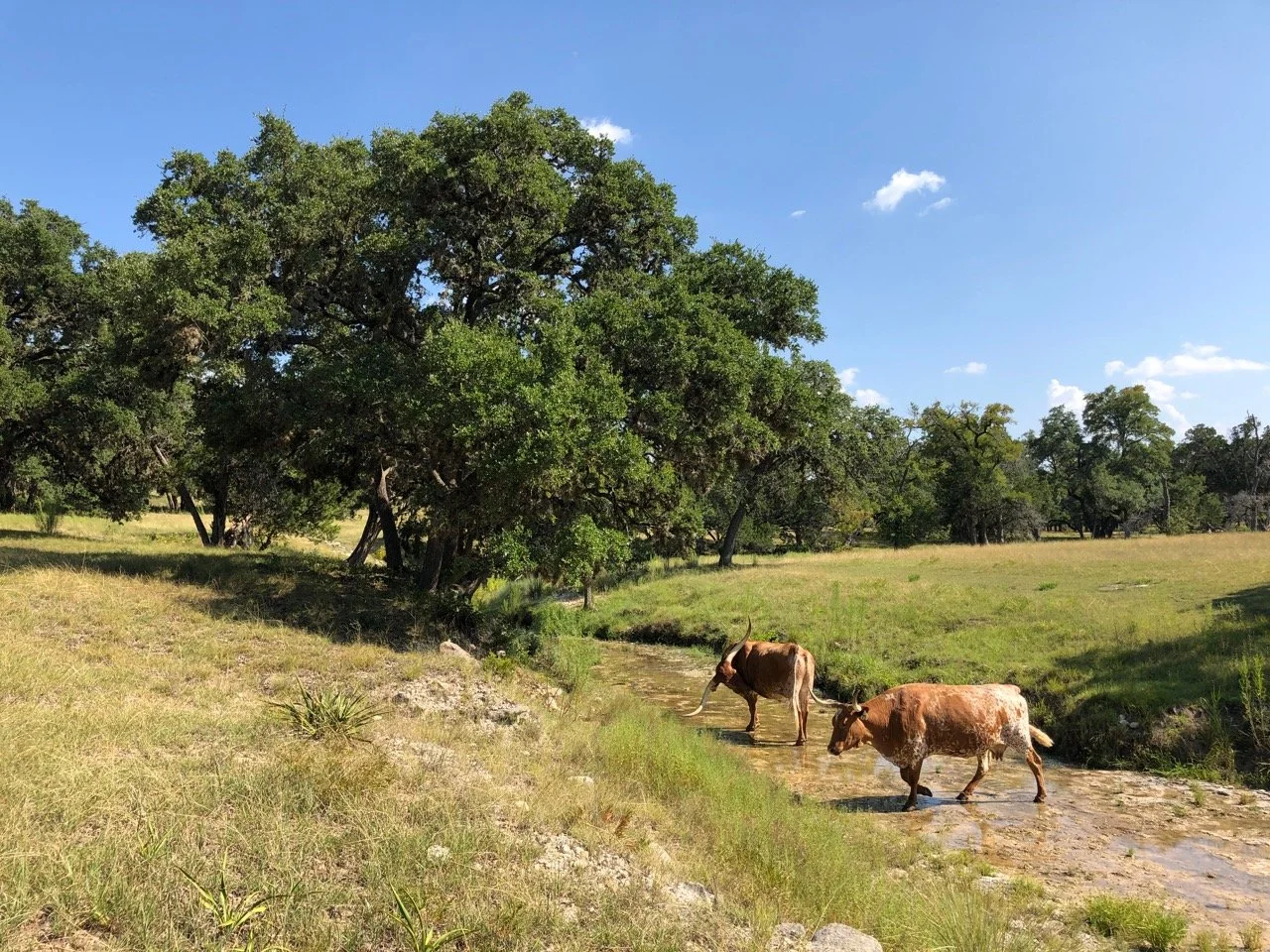
LANDSCAPE PAINTINGS AND SKETCHES
We gain a general impression of the landscape through plein air watercolor, which is the best way to discover the color spectrum on a site and views across the land. This plein air watercolor captures the oak trees clumped like cotton balls across the landscape of Walnut Springs. The sun casts long shadows in early morning or late evening, so views looking northwest or southeast at a hillside will make for a dynamic composition.
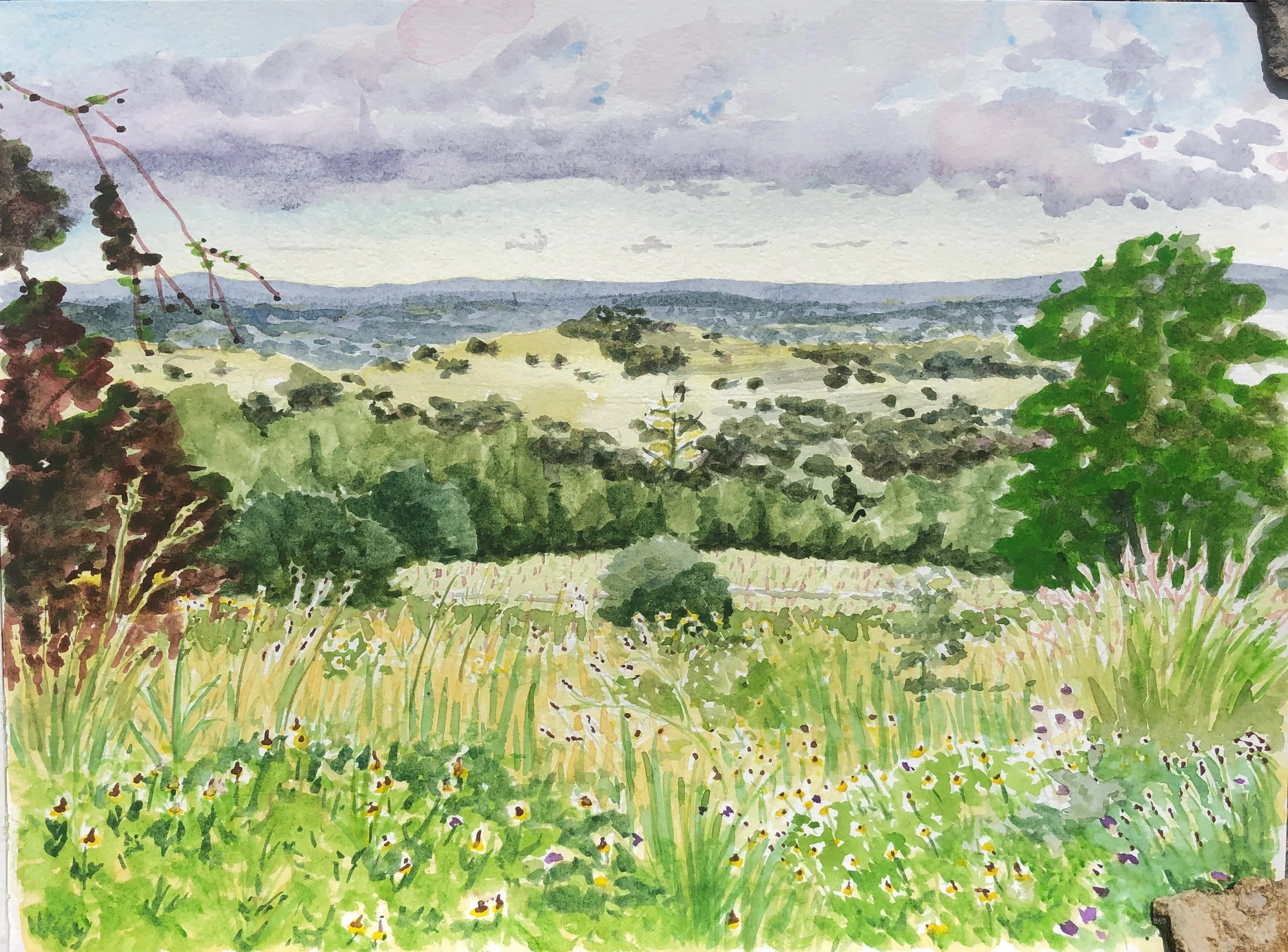
TREES & TOPOGRAPHY
One of the first priorities in our site analysis is tree documentation and health. We consult with Heritage Tree Care to review not only the health of the mature trees but native plants, erosion patterns, groundwater and soil observations and a maintenance plan. Live oaks are beautiful but they are currently a mono-culture on many hill country sites. It’s important to plan for tree diversity by introducing new native species that will thrive along with the oaks and promote wildlife diversity.
Surveyors will provide tree and topography (slope) information, but when possible we like to measured document each tree ourselves. It’s important to be aware of the shape of each tree, since critical limbs can extend surprisingly far in one direction and sometimes vertically. Cindy sketched and documented the trees on our site:
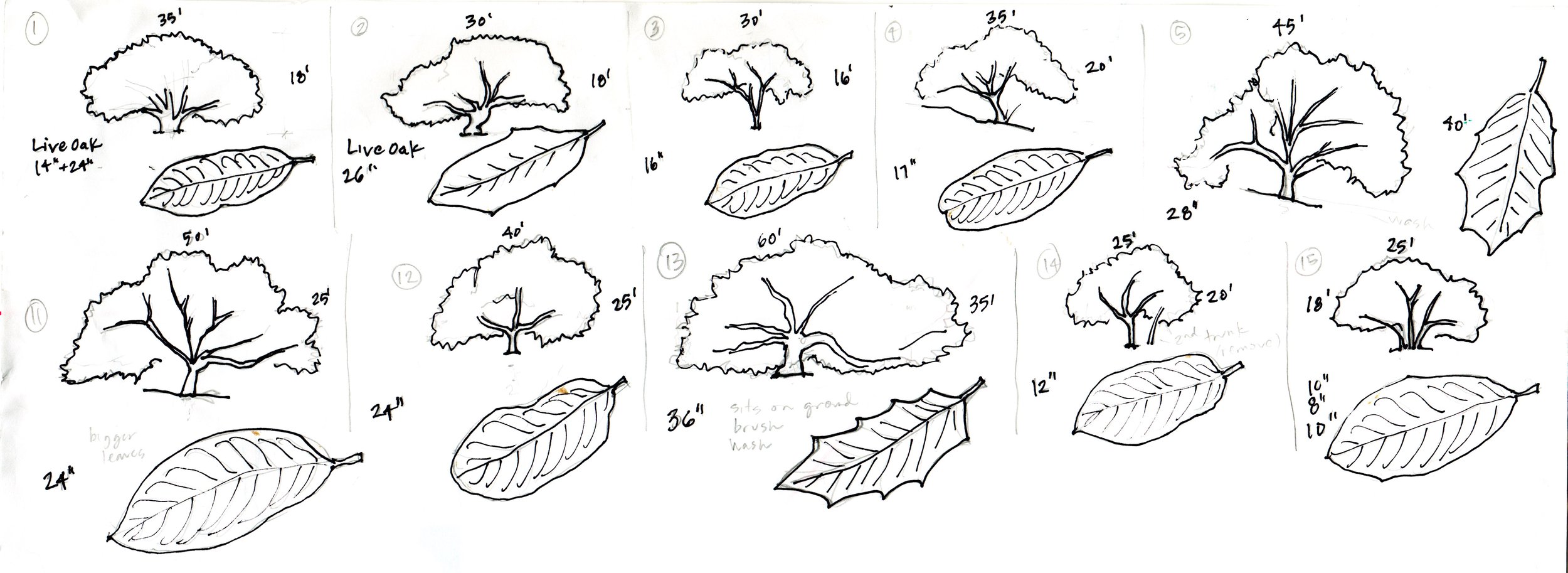
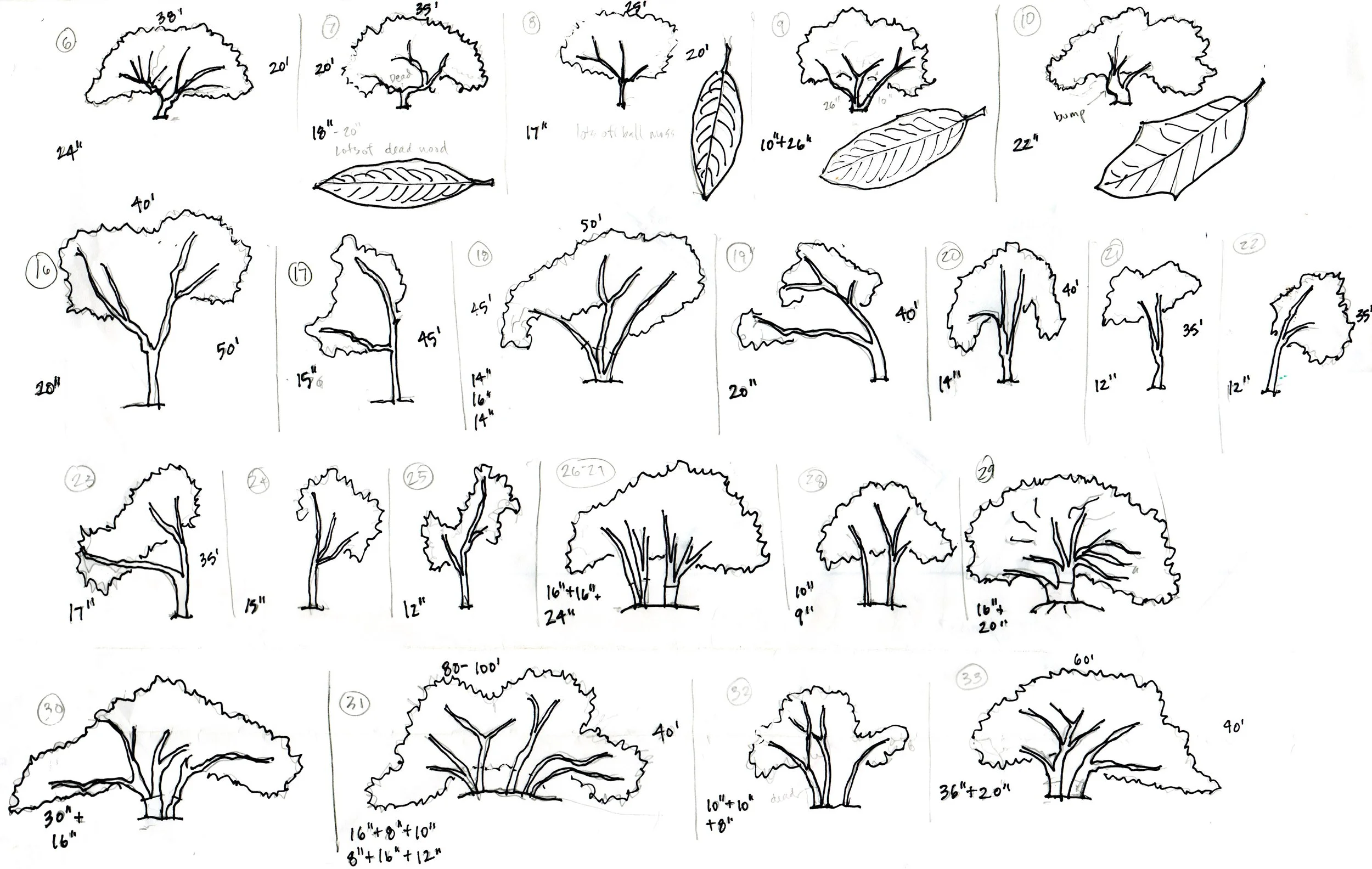
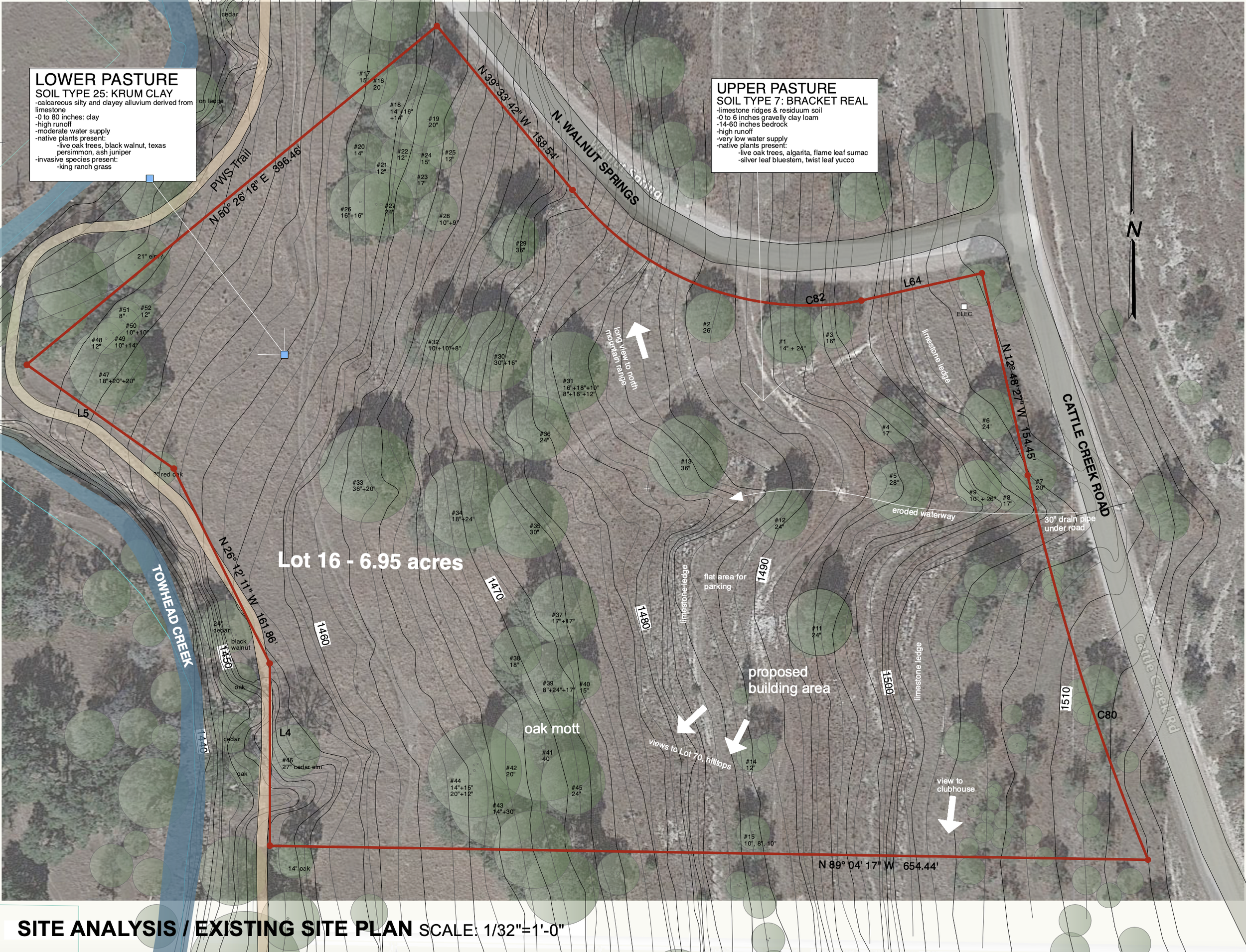
After these initial drawings and extensive walks on the site, we create an existing site plan. Texas A&M Forestry mapping services provides aerial maps with nice contrast between ground and tree, which allows for the most accurate canopy documentation. It also provides 50-foot contours, flood zone and watershed information. We can cross reference that with USGS topographical map data which provides 2-foot contours of any site.
Landscape planning and foundation engineering will be well served by understanding the soil composition. Typically the Hill Country is composed of Bracket real (limestone shelf), but often the soil changes near creek beds. This data is mapped on USDA Natural Resources Conservation Site / Web Soil Survey.
WATER AND POWER SOURCE
Blanco and Gillespie counties are served by the Ellenberger-San Saba aquifer. Historically many ranches relied on well water, but it is more common now to install rainwater catchment systems for higher quality drinking water. However, rainfall is an obvious concern. The LCRA Hydromet shows rainfall data, stream flow, and soil moisture all along the Colorado River basin in Texas.
Even when water is scarce, there are effective means of capturing rainwater. Placement and sizing of the rain tank and catchment system is a critical part of the site design. We consulted with Innovative Water Solutions provides rainwater consulting for the Hill Country, and researched erosion control and rainwater harvesting that we will integrate with the landscape design. Our site is near the dam that holds water along Towhead Creek, which is a beautiful feature to discover after a hike down our small trail system.
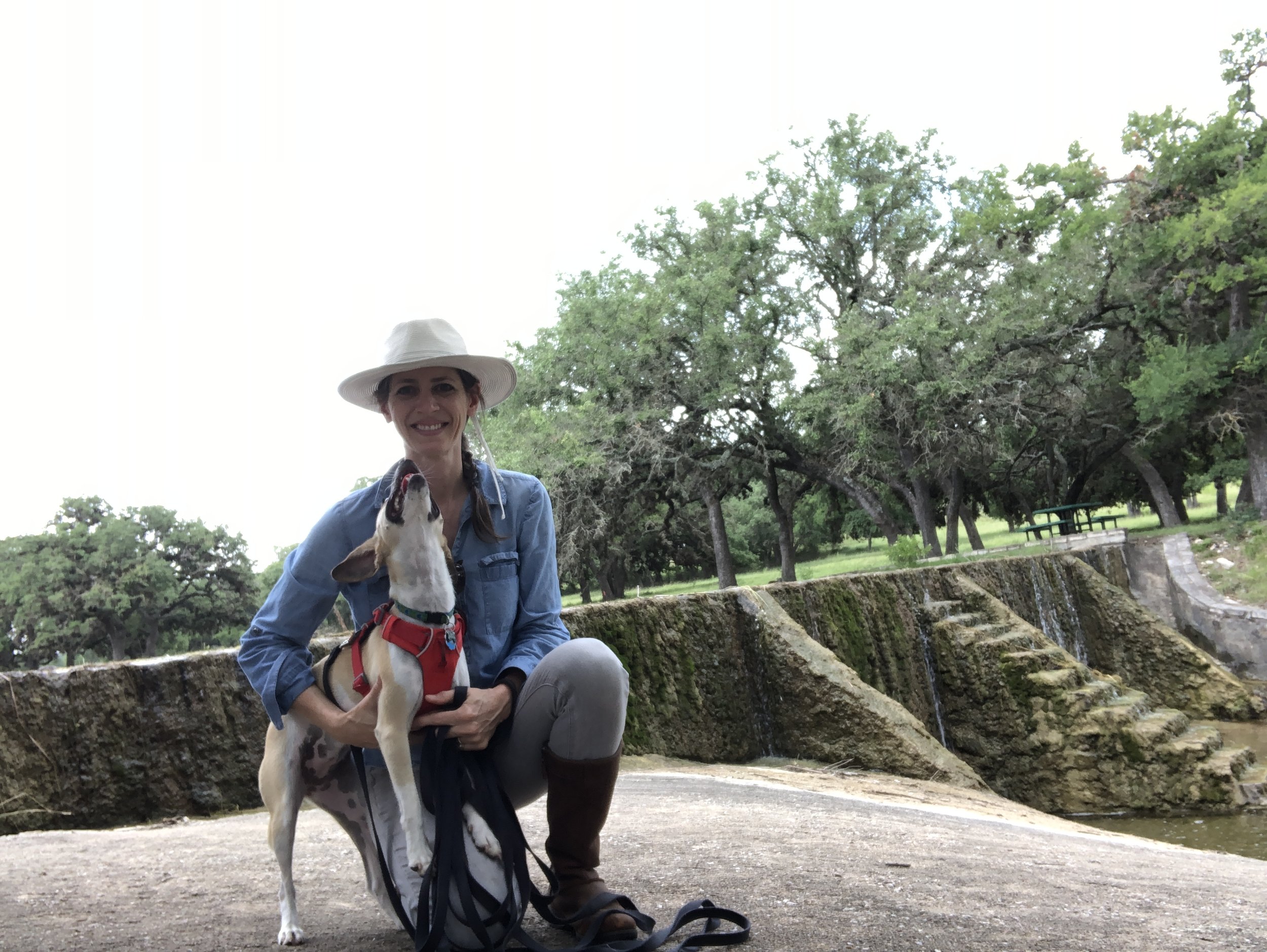
Cindy & Nancy
SCHEMATIC SITE PLAN
The drawing below was created to explore the approach to the site, outdoor spaces, building scale, roof design and rainwater collection. The pathway upon arrival, or being able to see a car coming, is fun to think about. The forms of the building, garden walls and terraces are shaped to frame the view. The building is sited within proximity to mature trees to benefit from shade but not feel crowded.

MODELS
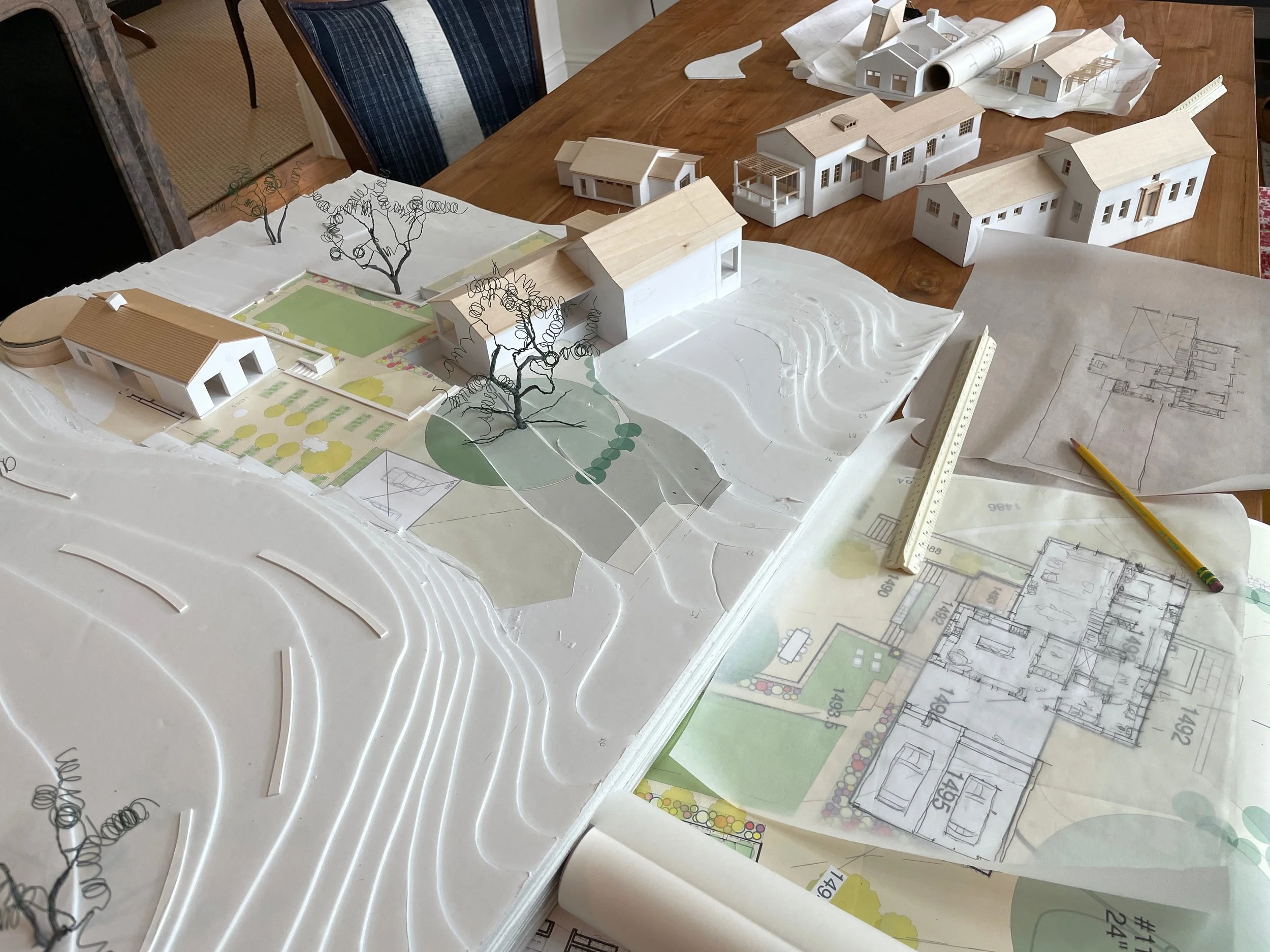
With the site plan and floor plan in development, we build scale models to allow us to explore the three dimensional aspects of design: scale and shape of the roof, openings and light exposure, the way the building fits within the contours of the site. Sometimes this comes with surprises, such as how many steps it can take to get down to the next level. We changed the design completely after this scheme - the building height was growing too tall out of grade when oriented across the contours.
HISTORICAL CONTEXT
What is the look and feel of the place? This is a big question as we develop the character of the building and make decisions about roof pitch, window proportions, and materiality. We love the old stone buildings in Blanco and Gillespie County, characterized by the historic German heritage of Fredericksburg. We committed early on to building out of stone, and staying true to the visual language of masonry structures.
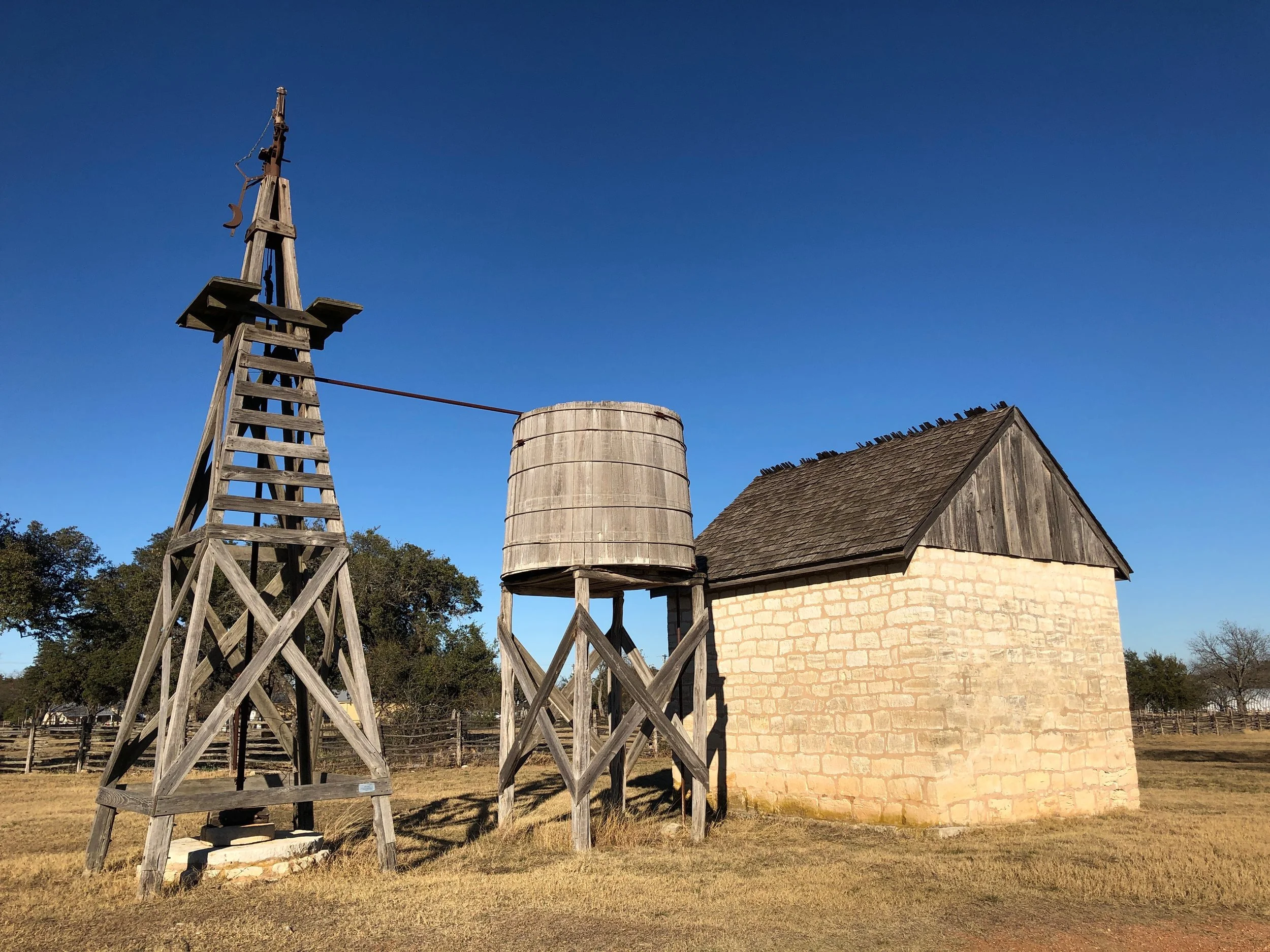
Windmill, cistern and granary at LBJ Settlement Ranch, Johnson City
ARCHITECTURE
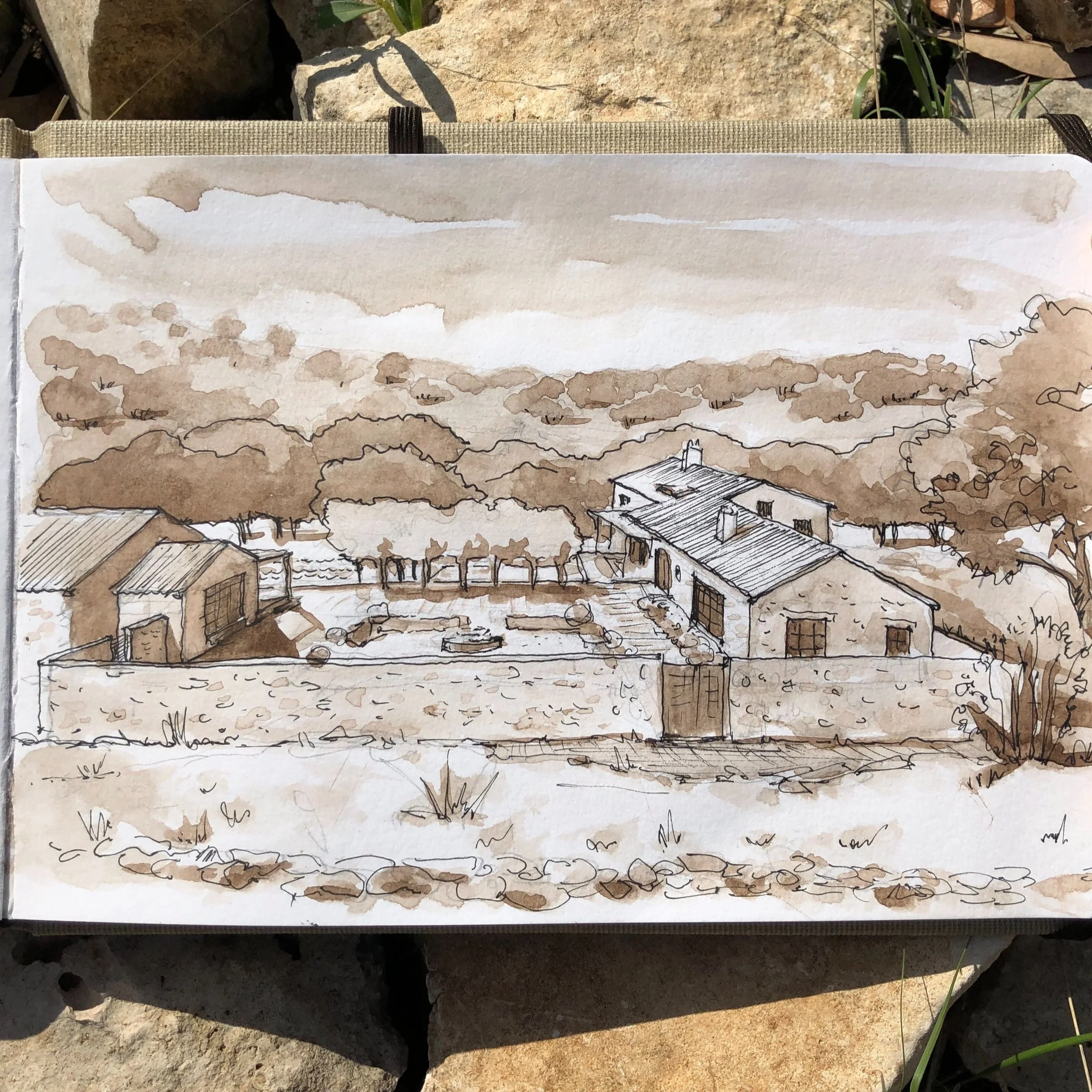
The vision of the place comes together slowly, awkwardly and with a lot of discarded ideas. However, some ideas stay in place from beginning to end - these are the things we know to be crucial to the place and guide our decision making. From the sketch below, we established a few critical concepts: the house is a simple, gable roof box; the view to the hills should be framed by the architecture; a stone wall or enclosure will define the garden; buildings will relate to each other across this garden.

ICAA Edinburgh Drawing Tour 2022
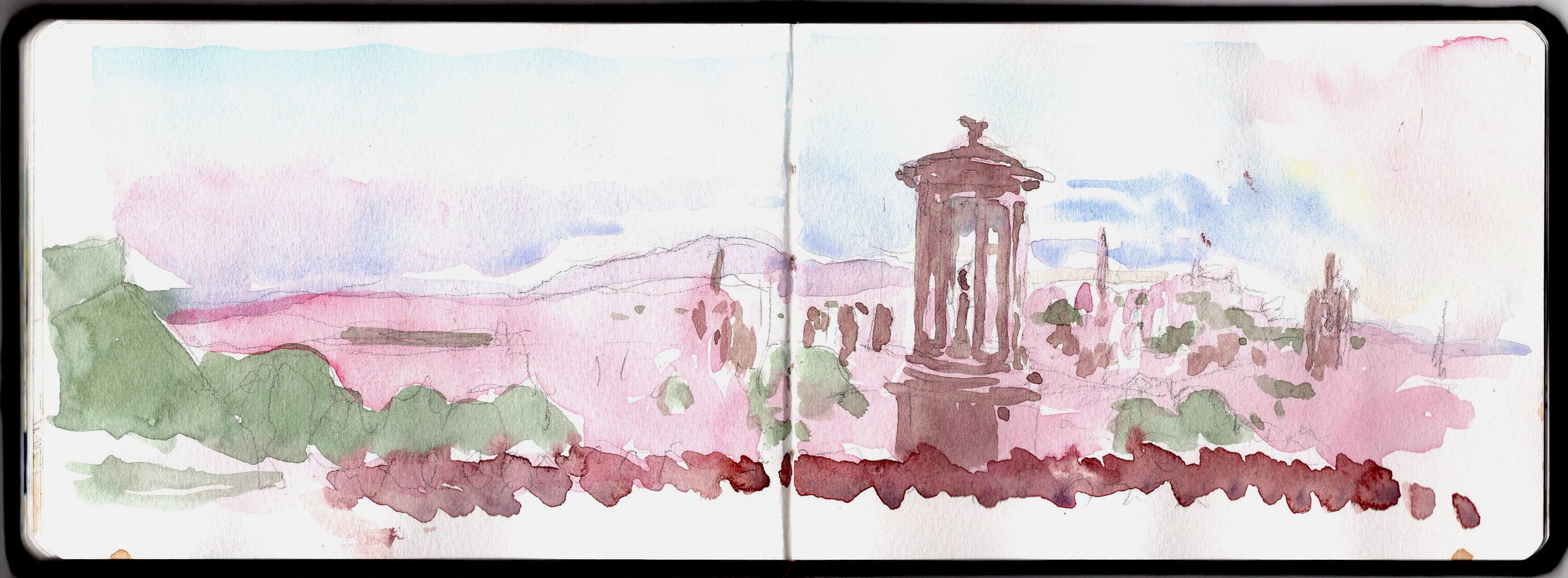
Dugald Stewart Monument, Calton Hill, watercolor 2022
After two incredible experiences with the ICAA Drawing Tours in Rome and Paris, I decided to join the Edinburgh Drawing Tour as a culmination of drawing studies abroad. The tour was designed and led by George Samaurez Smith, one of the leading classical architects practicing in England (who also co-taught the Rome Drawing Tour). George’s architectural education began at the University of Edinburgh, so he is an incredible resource of classical architecture in Scotland.
Our group met on a Saturday evening for introductions and a tour through the New Town. George narrated as we walked by St. Andrew’s Square, Queen Street, Hanover Street, George Street, Frederick Street, Rose Street, Charlotte Square, and the Royal Physician’s College, pictured below.
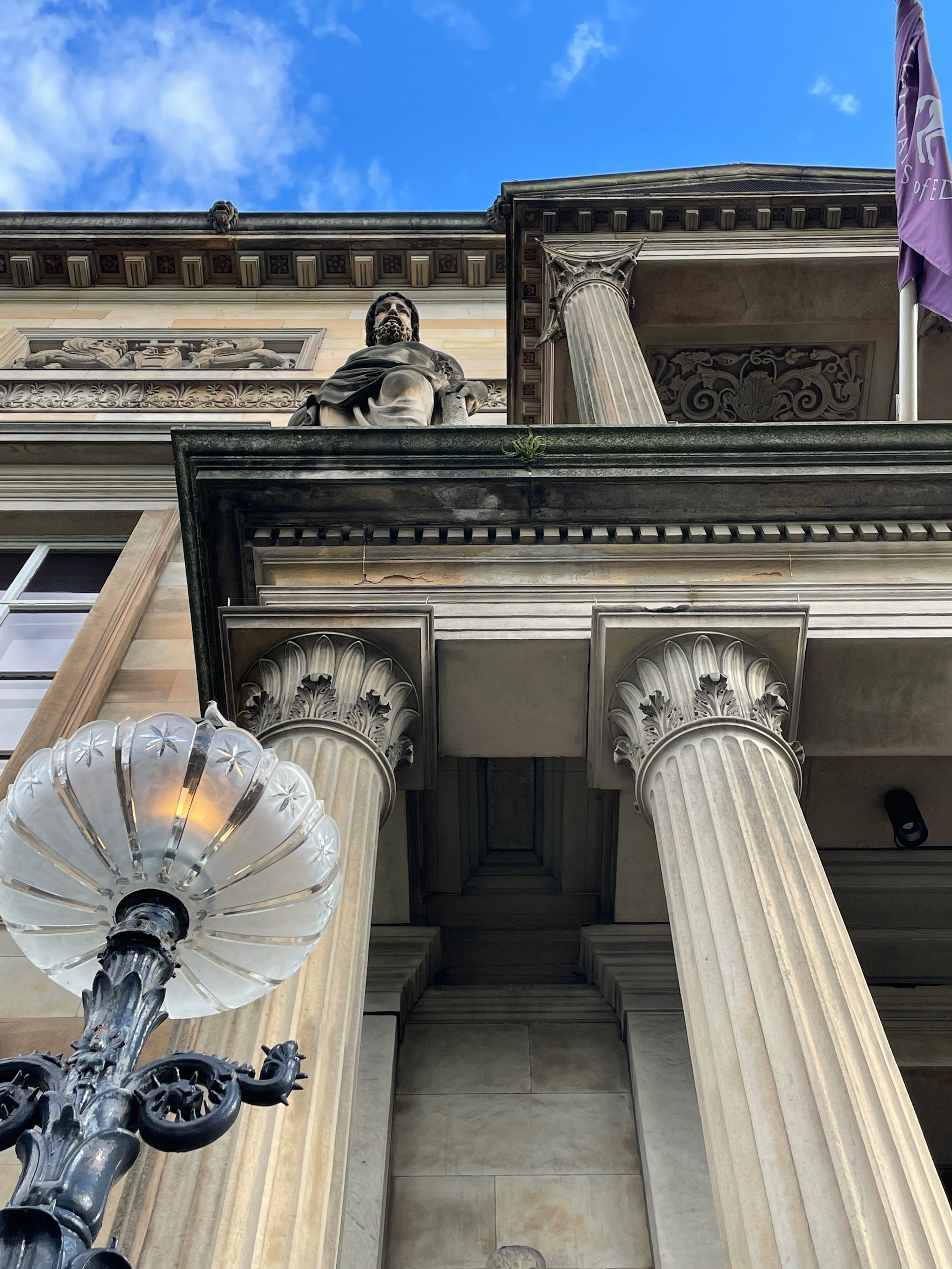
Royal Physician’s College, Edinburgh New Town, 2022
Day 1: Calton Hill / Calton Burial Ground
We begin the Drawing Tour on Calton Hill, the Acropolis of the ‘Athens of the North’. In the early 19th century, this was the site chosen for monuments of national importance and these were mainly based on Ancient Greek precedents. The most prominent of these was the National Monument, intended to commemorate the Napoleonic Wars and modelled on the Parthenon. Funds ran out after only twelve columns had been built and the monument has remained unfinished, leaving it with a more romantic appearance resembling a ruin.
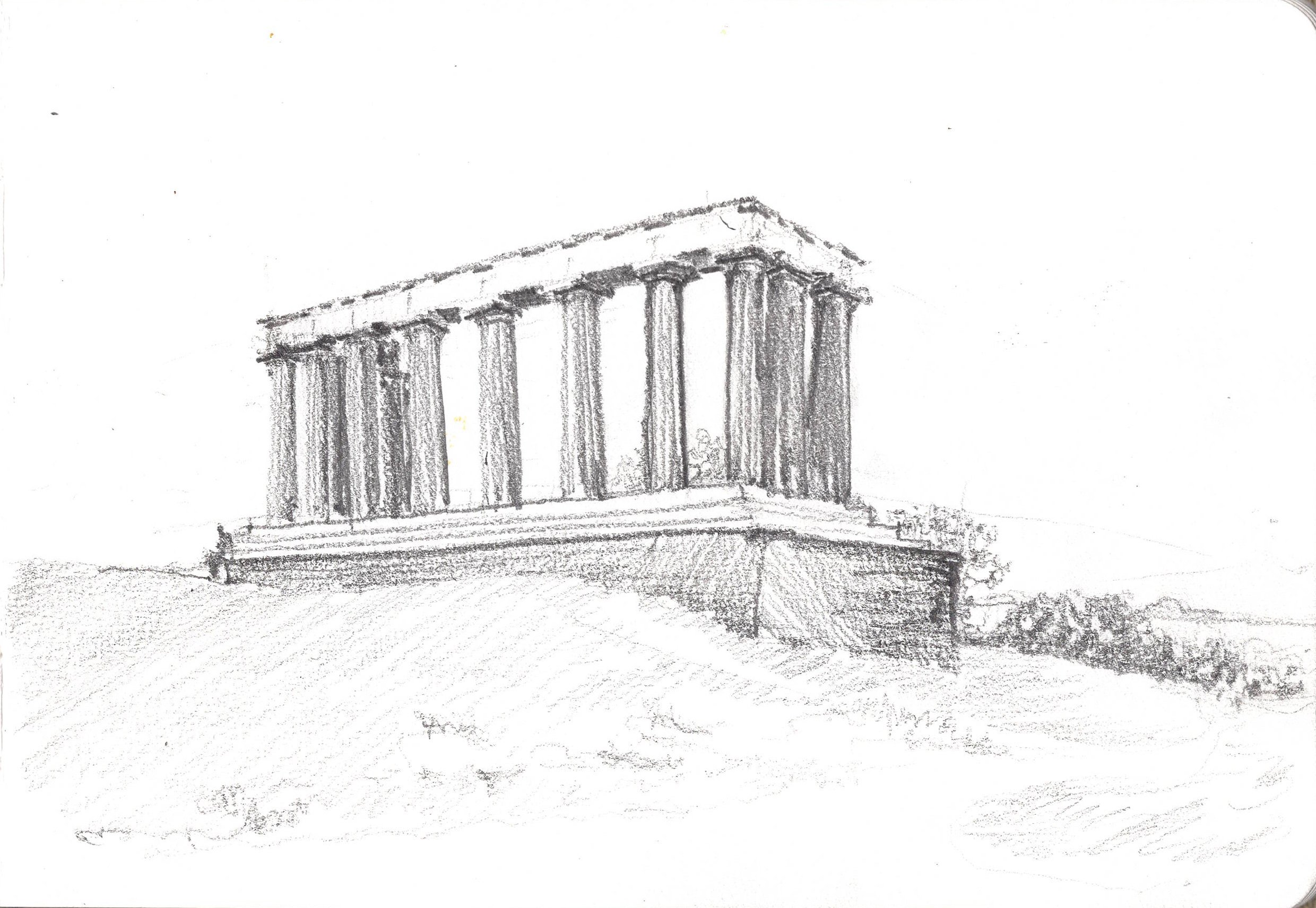
National Monument, pencil sketch 2022
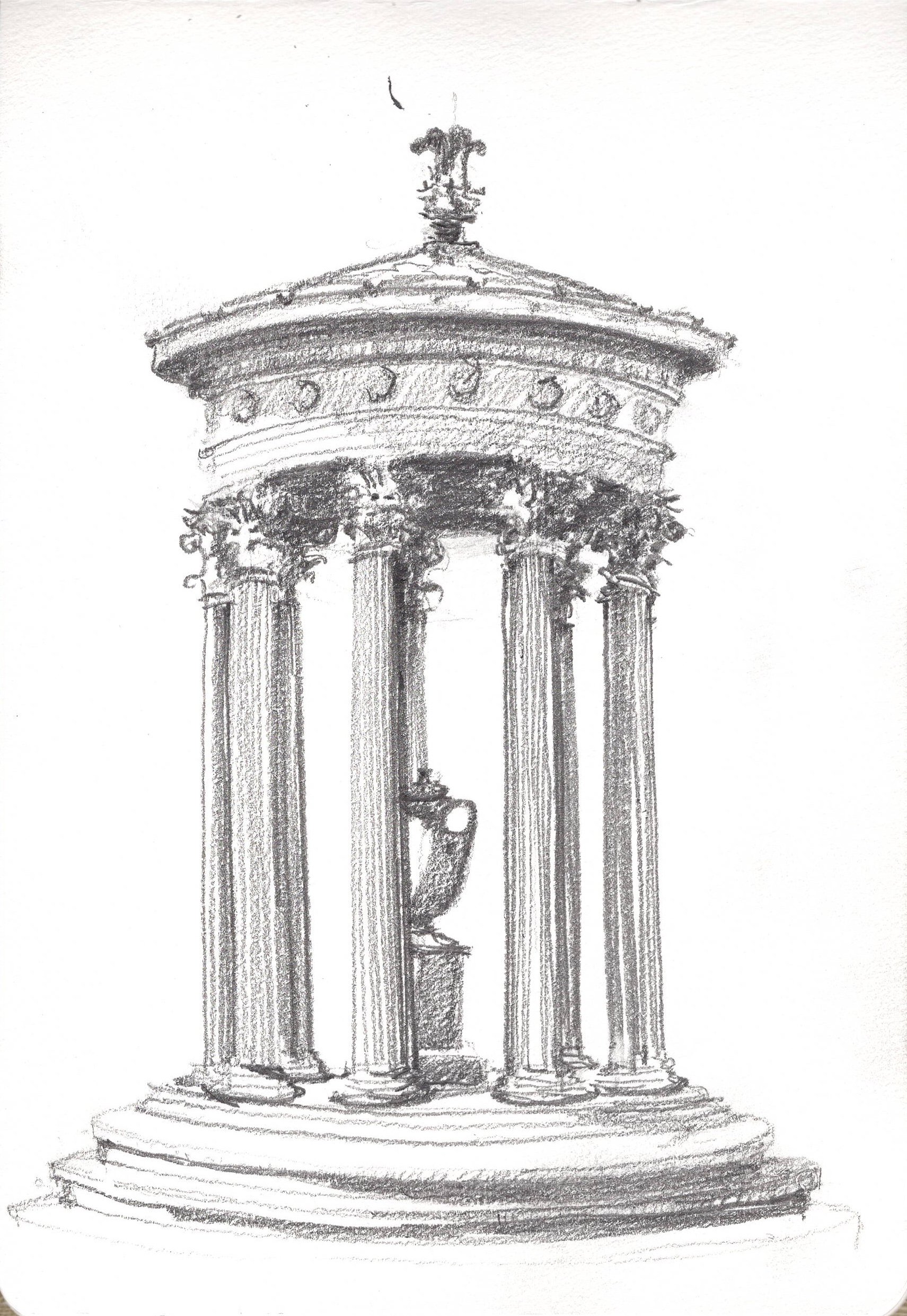
Dugald Stewart Monument, Calton Hill
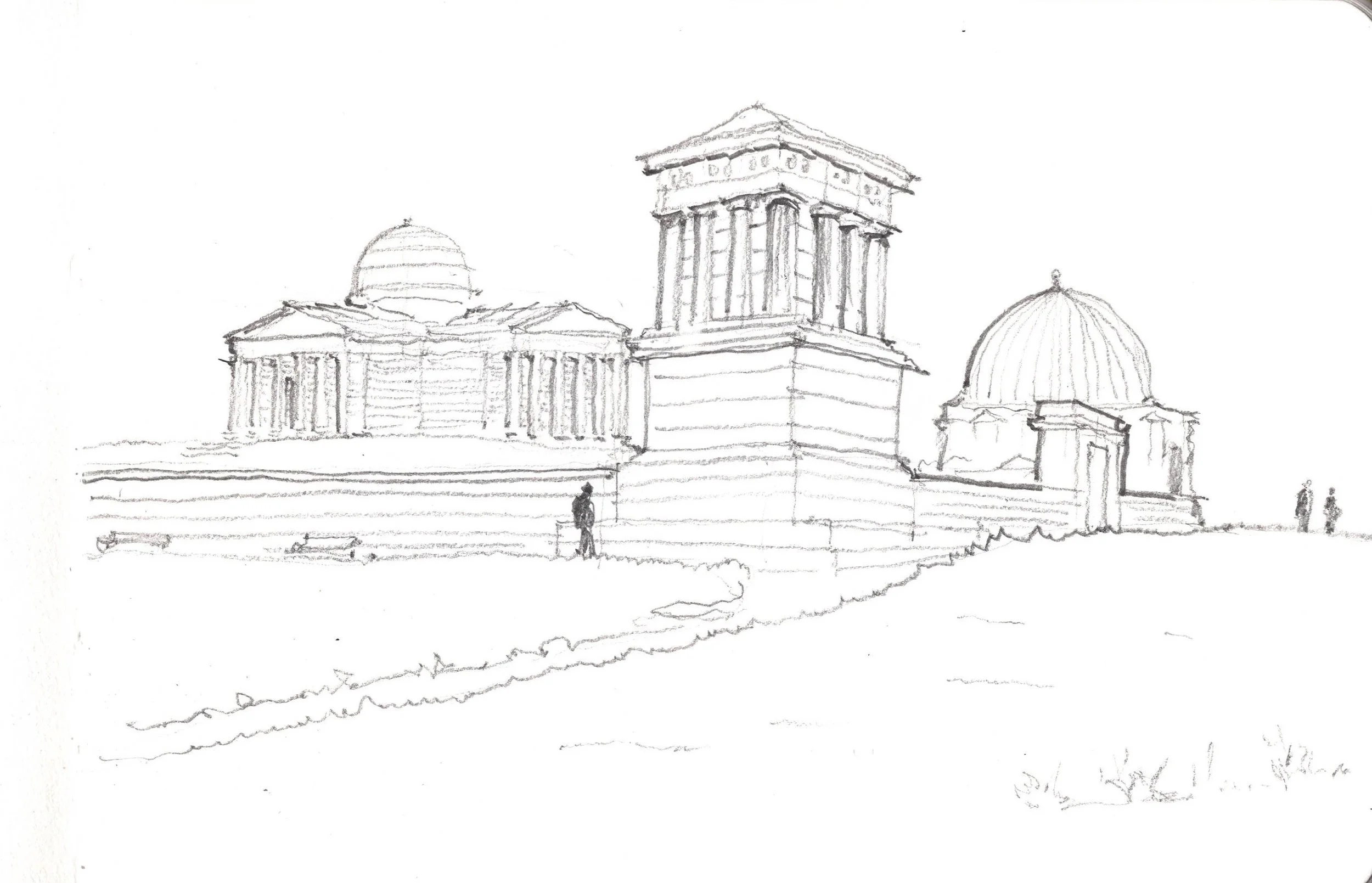
Calton Hill monuments, pencil sketch 2022
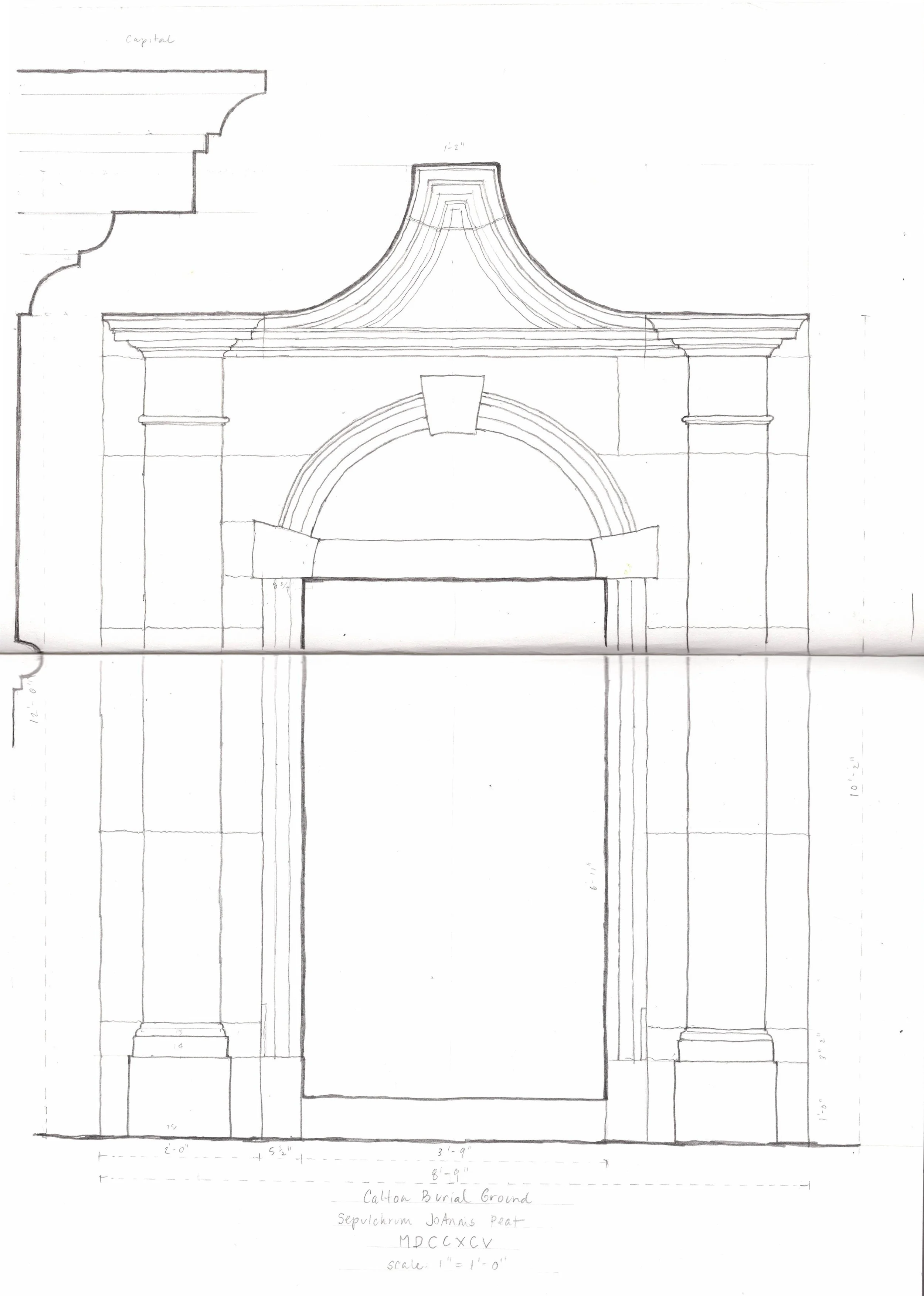
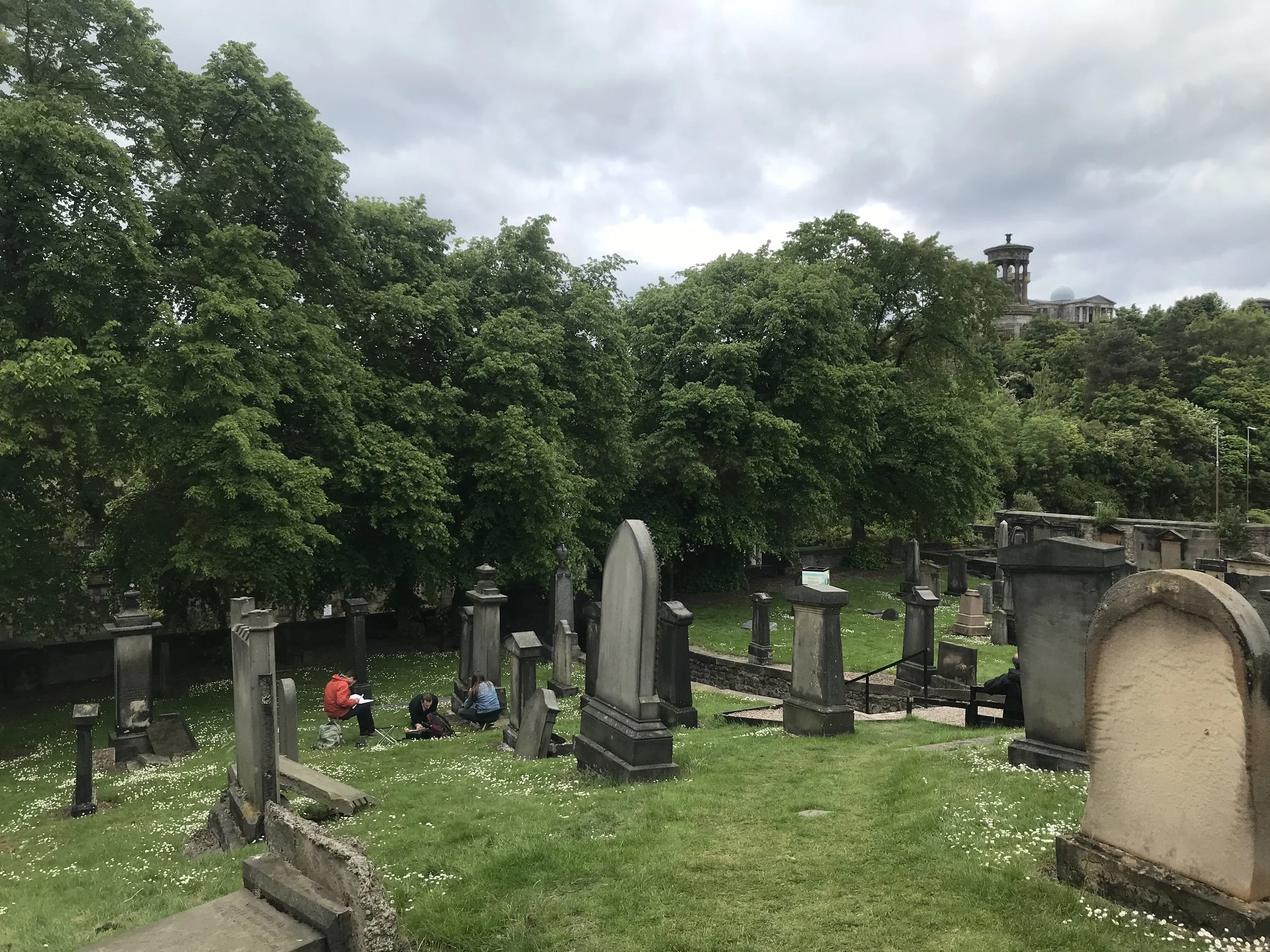
Sunday afternoon was spent at Calton Burial Ground to measure funerary monuments. George shared his measured-drawing sketchbook as an example of how to compose the page and draw straight lines freehand. His latest volume ‘Sketchbooks’ shows incredible artistry of measured drawing and draftsmanship.
Day 2 / Day 4: Signet / Playfair Libraries
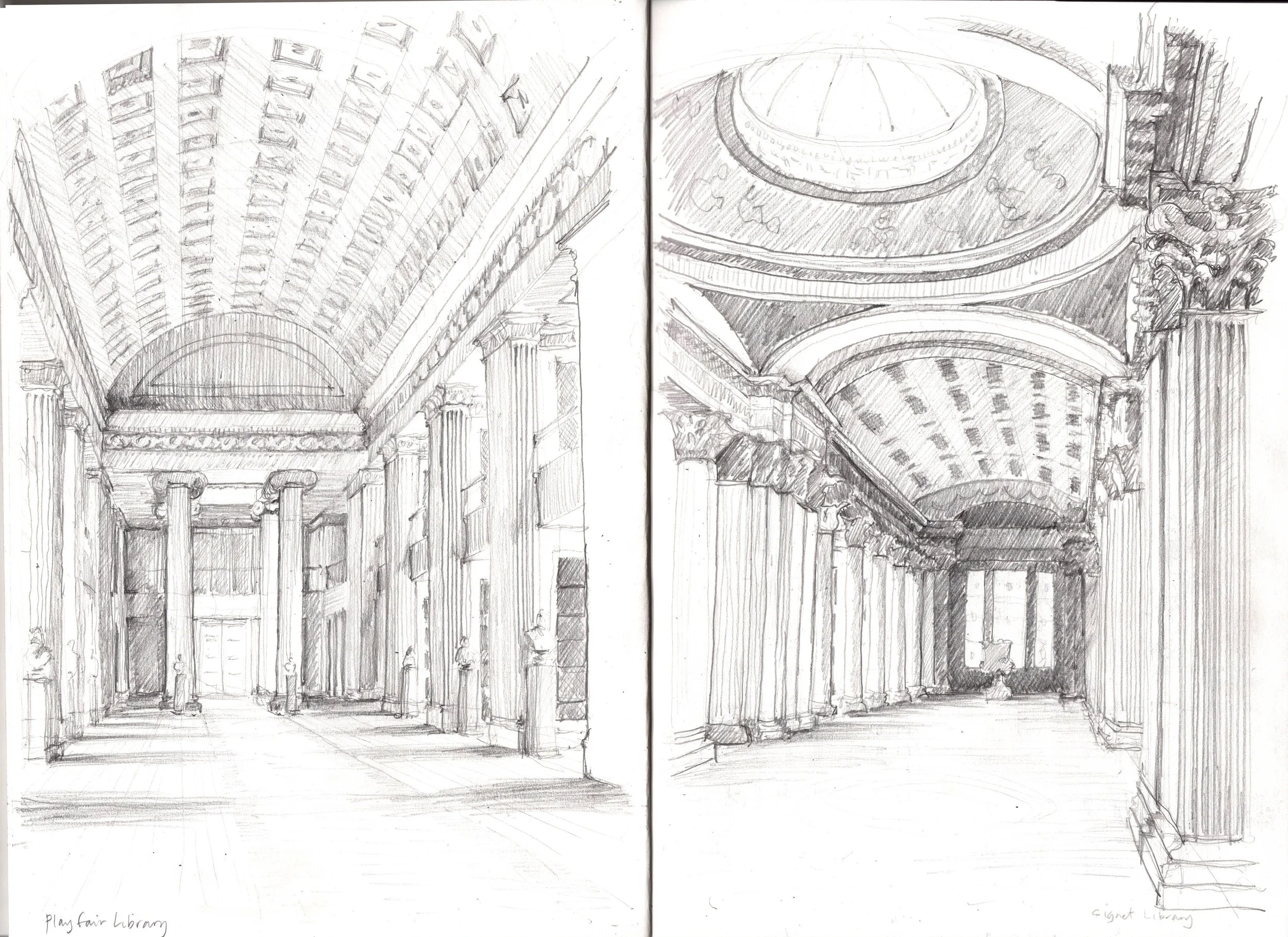
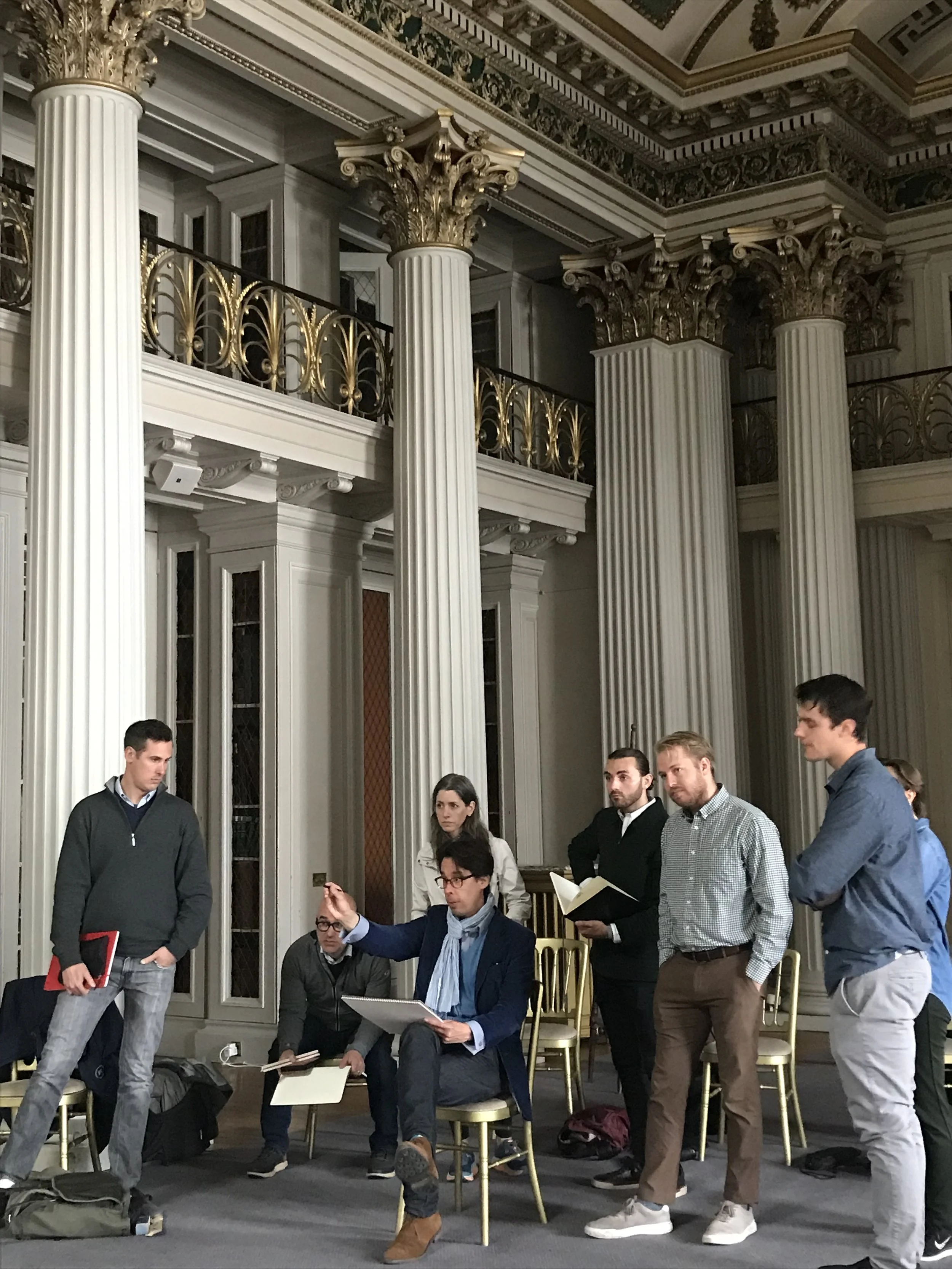
On separate mornings, we had special permission to see two of Edinburgh’s grandest classical interiors. The Playfair Library (left below), is one of the masterpieces of the architect William Playfair and one of Edinburgh’s greatest neo-classical interiors. The Signet Library (right below) was designed by the architect William Stark and completed in 1822. We drew one-point perspectives in pencil, composing the drawings on both sides of an open sketchbook to make a fine compositional pair. Capturing the Corinthian order and central dome of the Signet Library was particularly challenging.
Learning the art of the constructed perspective with George Samaurez Smith
Day 3: Ironwork at Circus and Moray Place / Old College
The focus on Day three was measured drawings, and our first stop was Moray Estate in New Town. The estate has a memorable sequence of urban space beginning with Randolph Crescent, opening into Ainslie Crescent and then to the twelve-sided Moray Place.
We took measurements and made sketches of the lampposts and railings along Circus Place and Moray Place, which then became composed drawings in our sketchbooks.
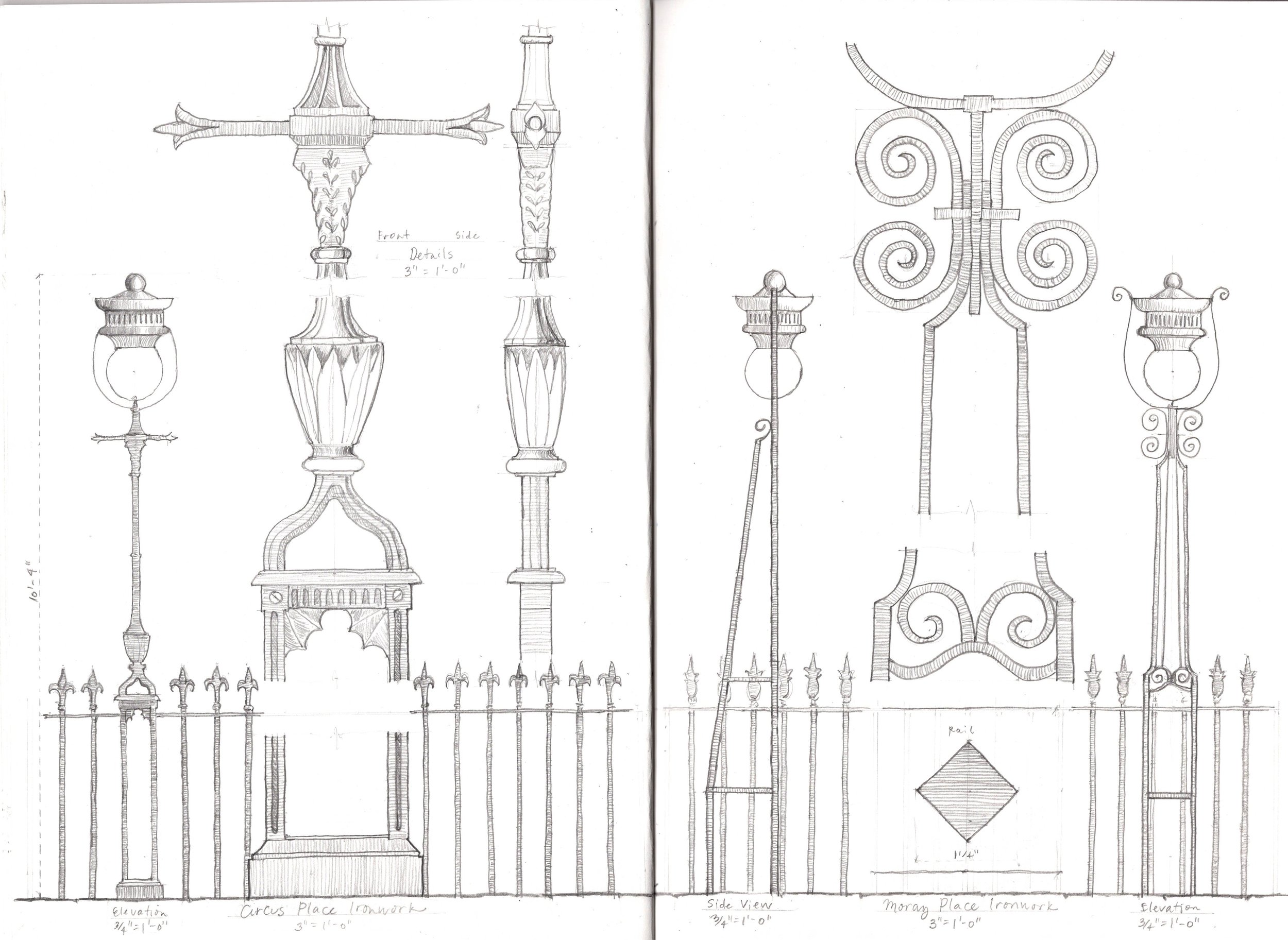
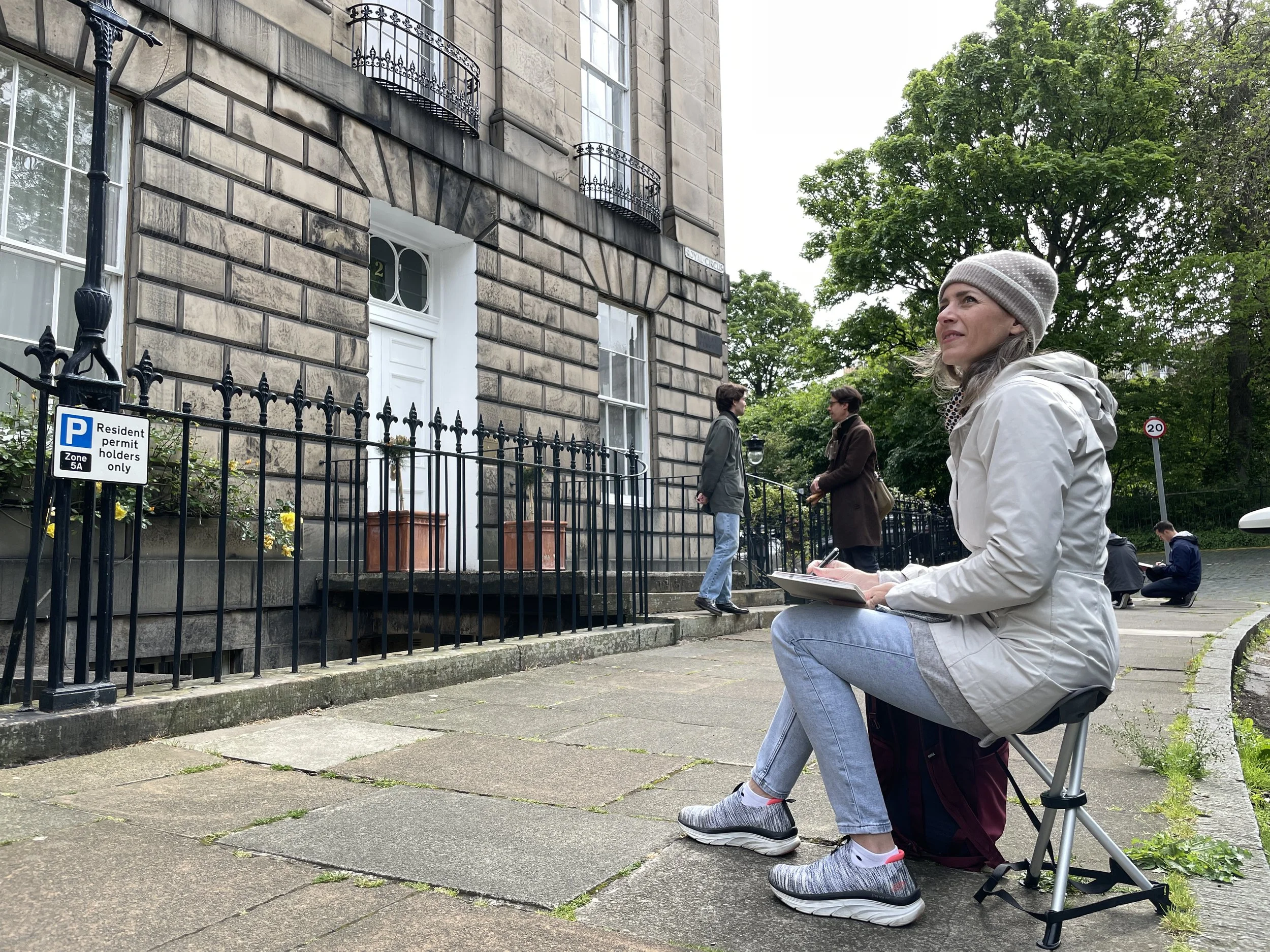
making observations of Circus Place lampposts on a chilly day in Edinburgh, 2022
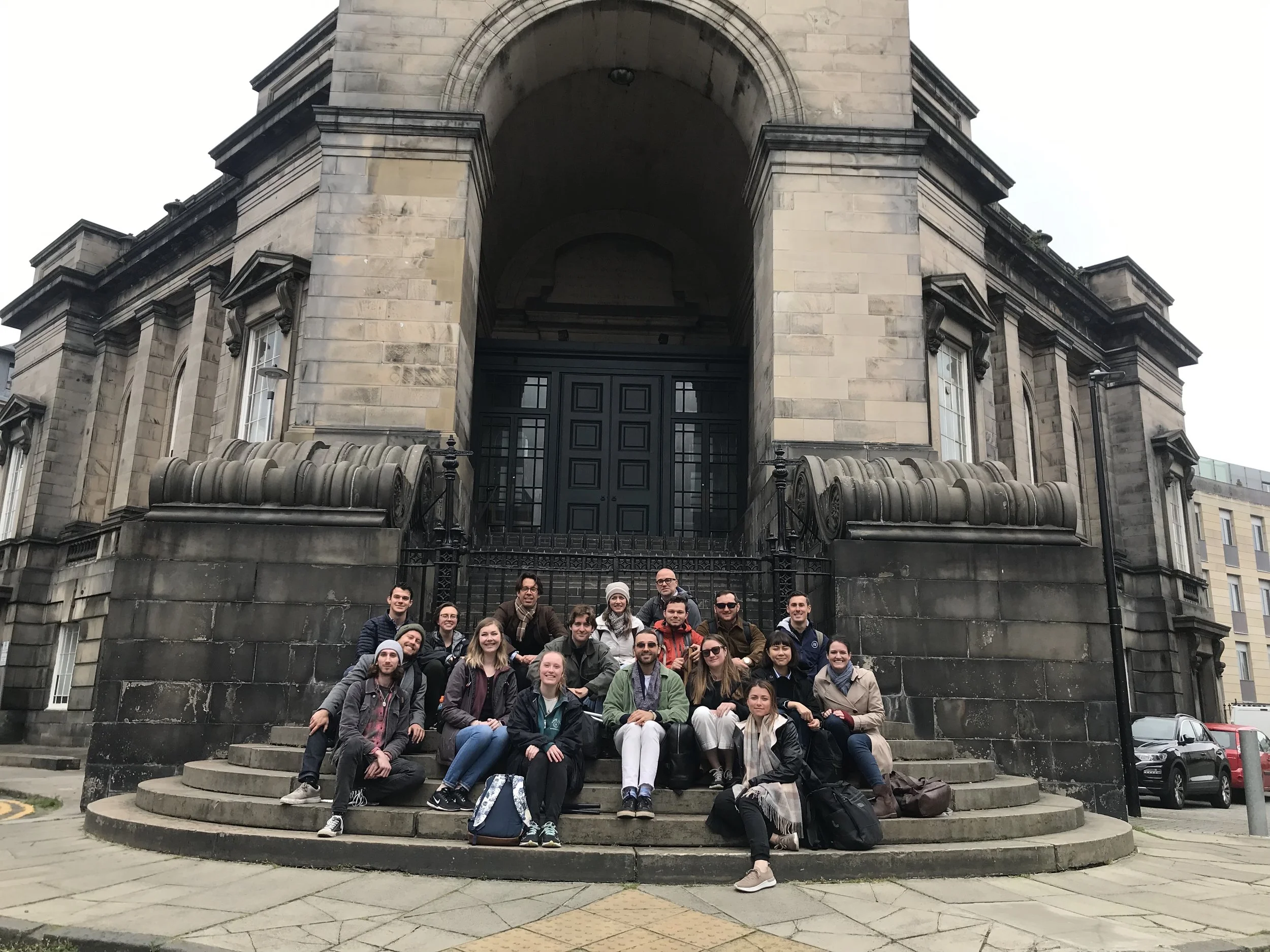
On a walk through New Town we stopped outside St. Stephen’s Church in St. Vincent Place. This grand building designed by William Playfair is notable for its gargantuan scrolls flanking the entrance.
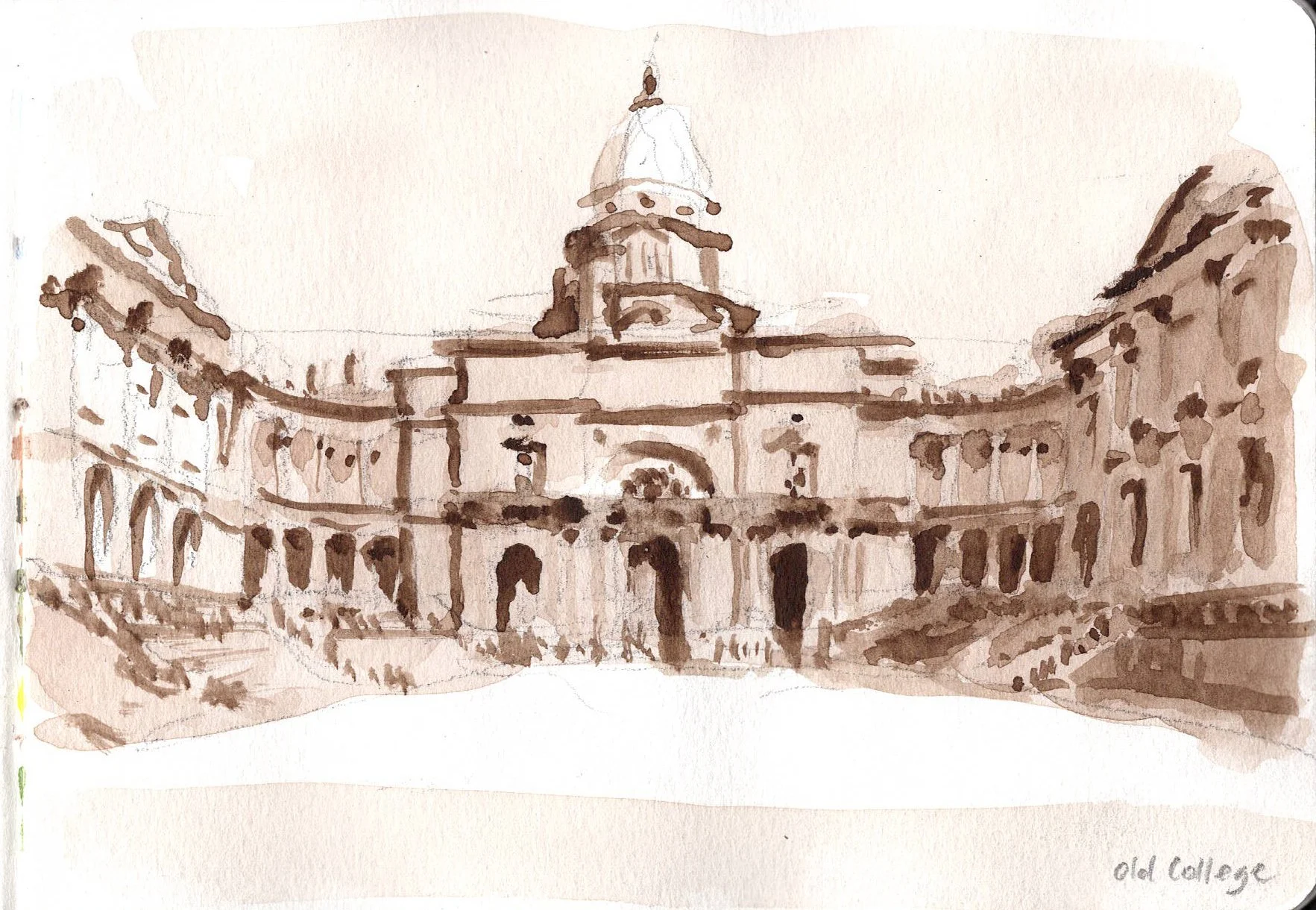
In the afternoon we walked across to Old Town to visit Old College, completed by Playfair after the initial phase of building designed by Robert Adam. It was a chilly afternoon in this stone clad courtyard, but this encouraged a quick, gestural sketch that became a foundation for a an impressionistic watercolor of this neoclassical facade.
After our drawing sessions we toured Blackett Place, a charming neighborhood full of Greek Revival villas.
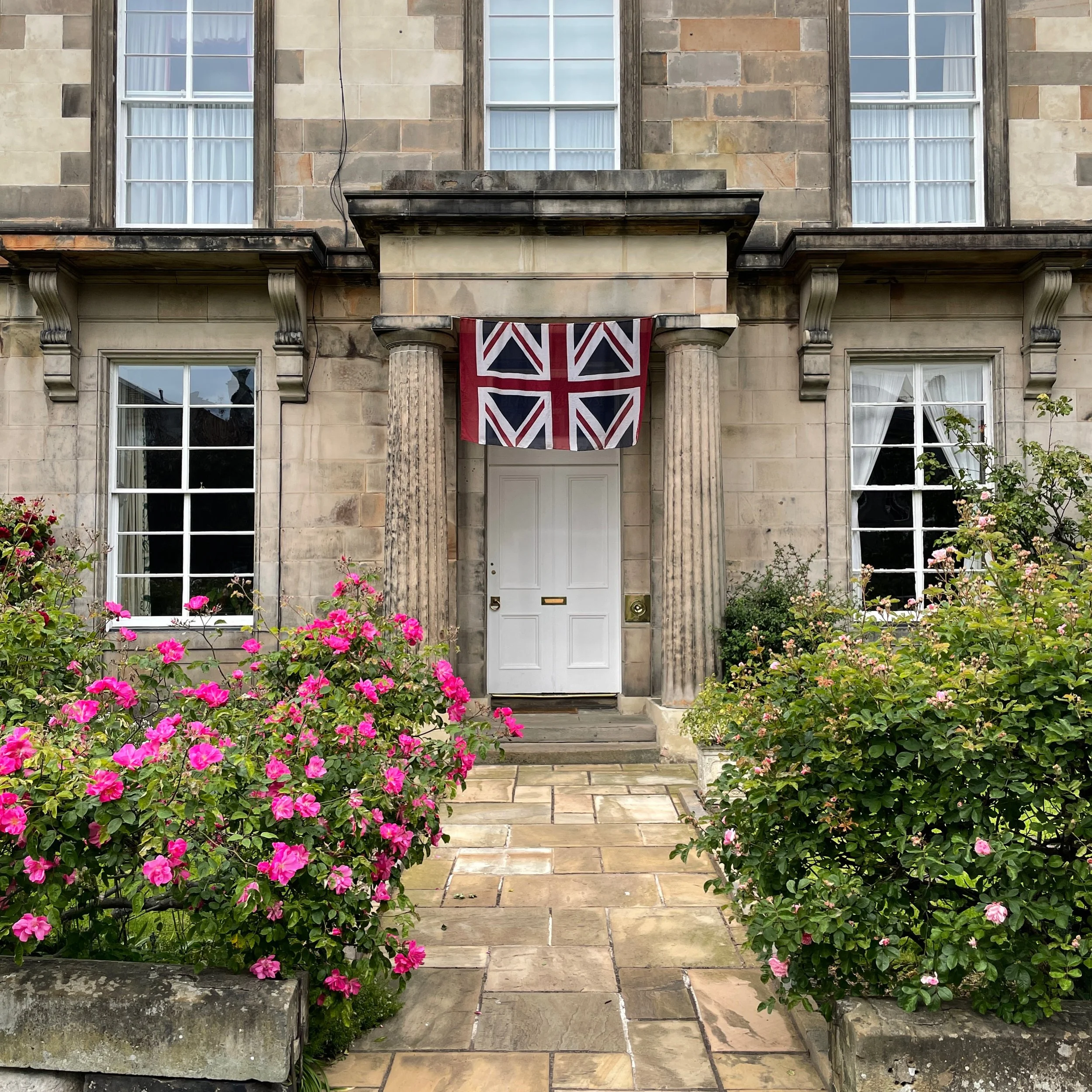
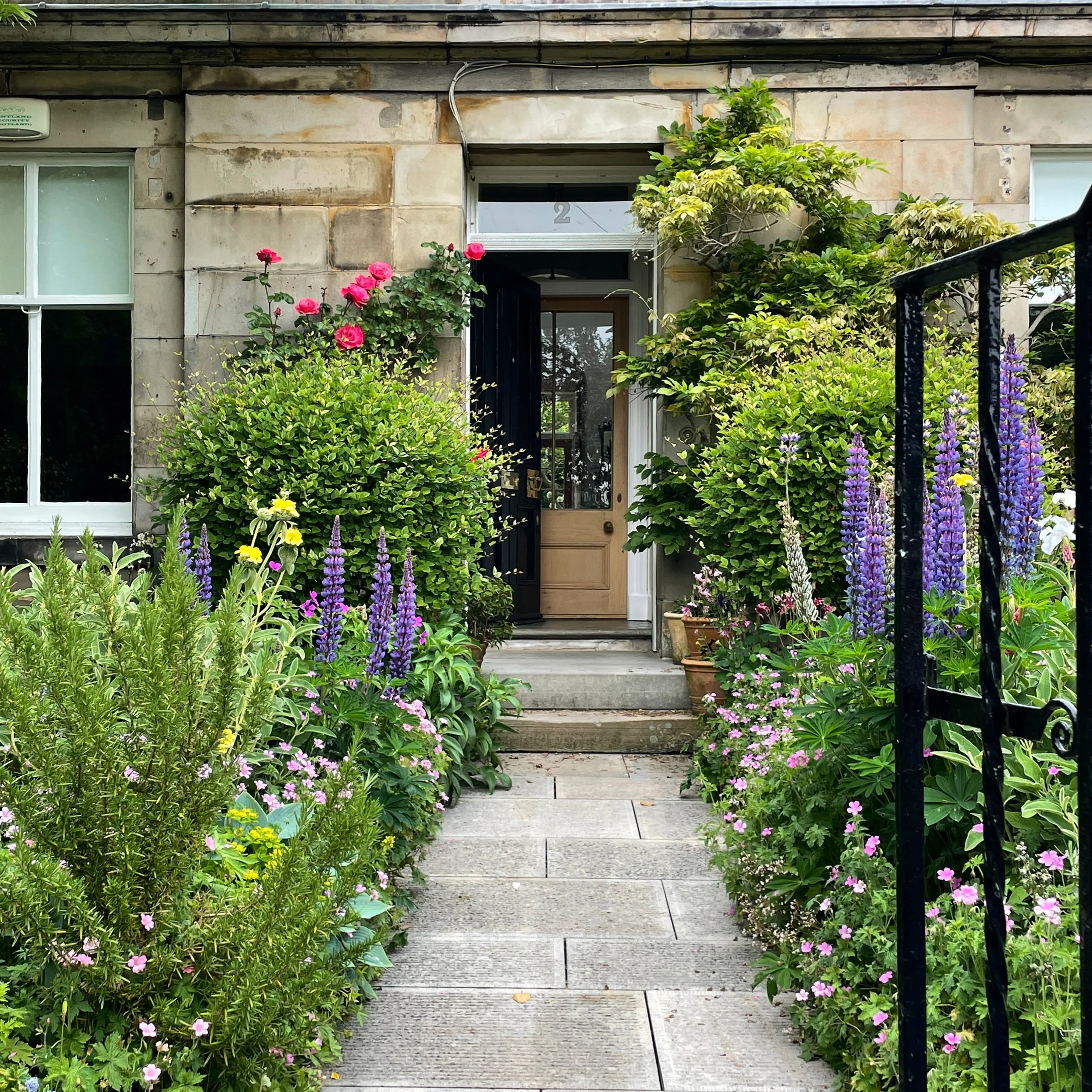
My stay at the Observatory House on Calton Hill allowed a private, after-hours experience of the grounds. Evenings were beautiful in the Edinburgh summer, and this watercolor sketch captured the bright colors blooming in the garden beneath the powerful monuments.
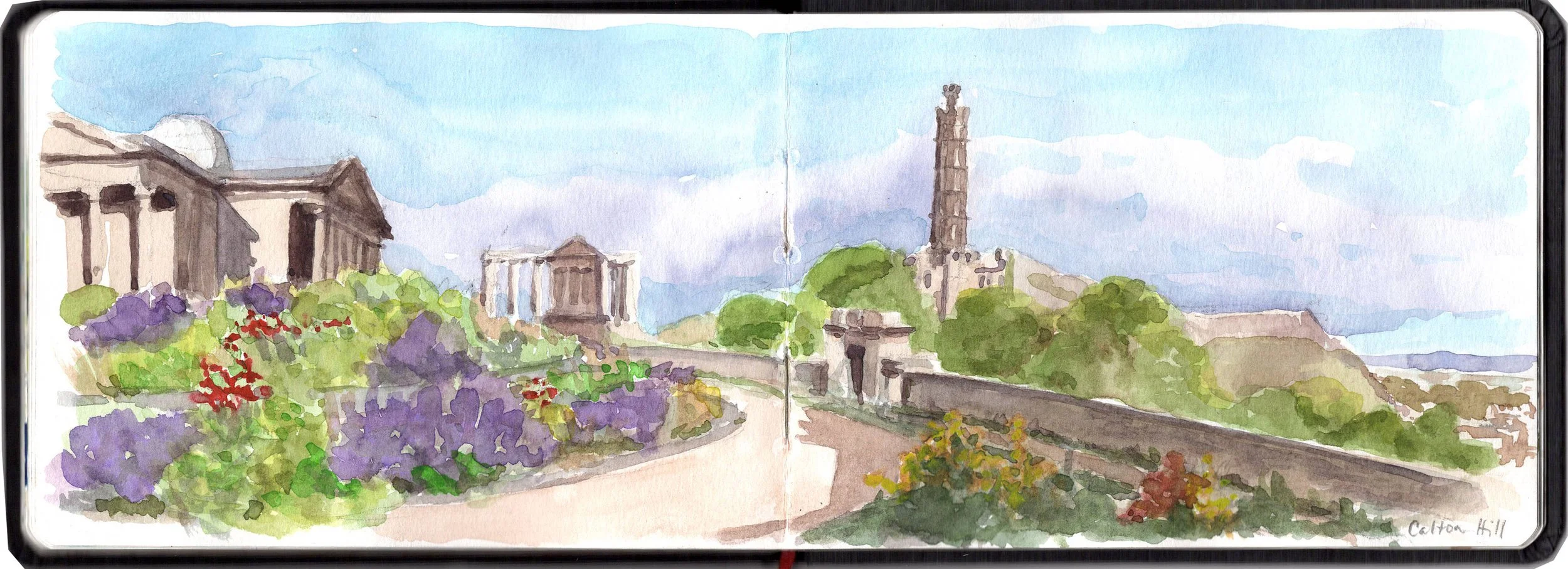
Calton Hill at Sunset, watercolor & pencil, 2022
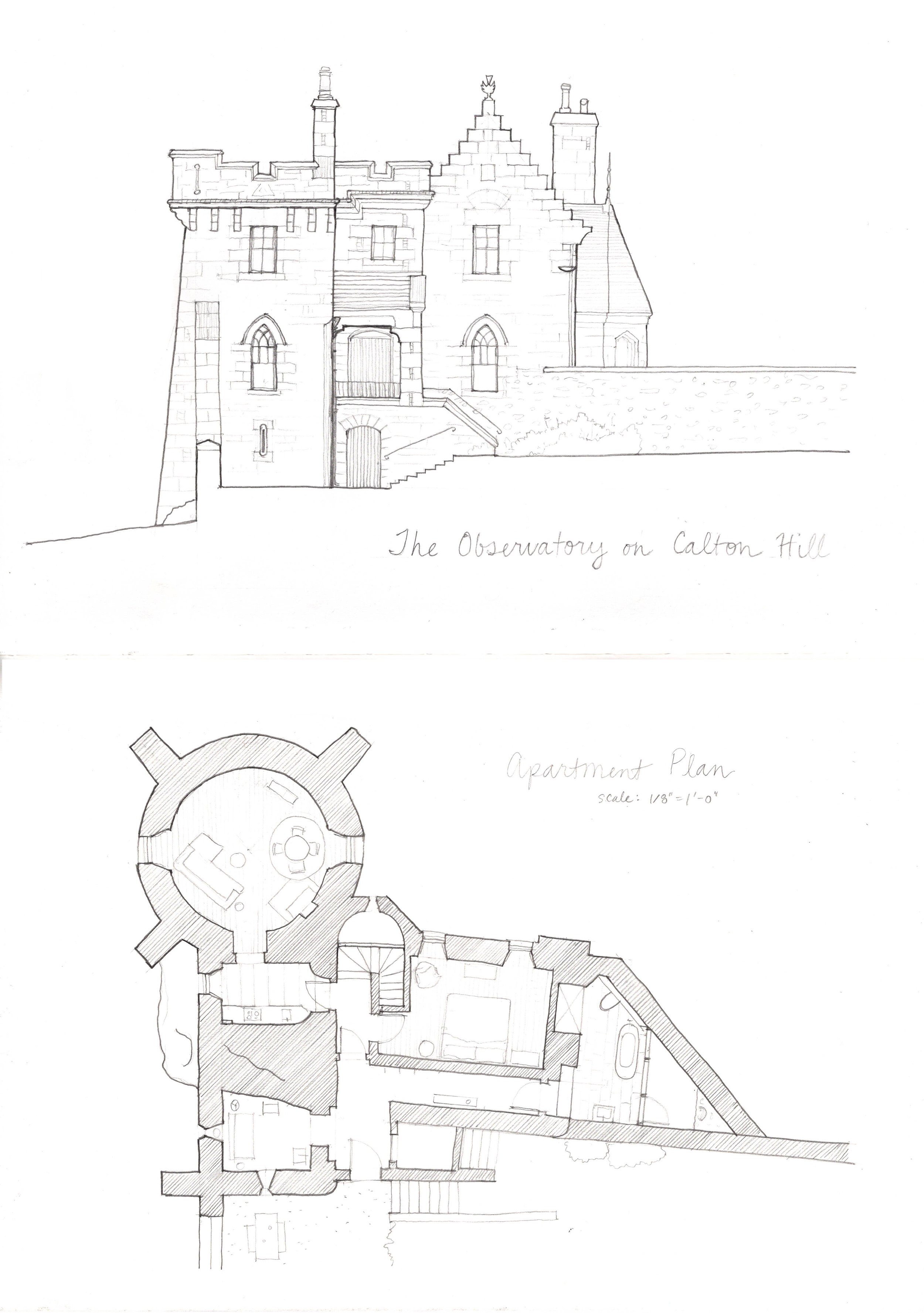
Measured Drawing of the Observatory House, Calton Hill, 2022
Day 4: Hollyrood Palace / Robert Burns Monument
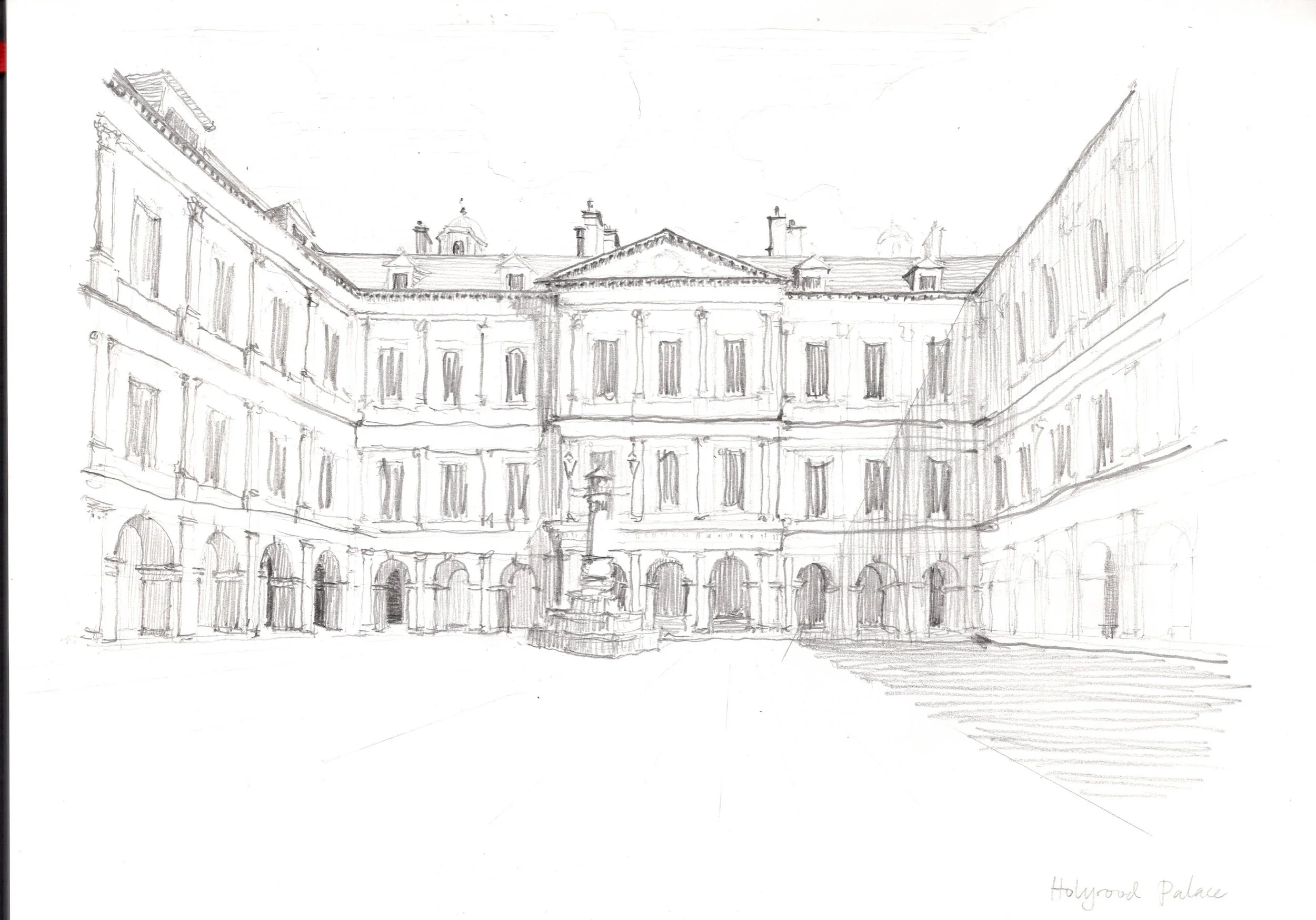
During a week of celebrations for the Queen’s Platinum Jubilee, we were fortunate to visit Edinburgh’s royal residence at Holyrood Palace. George gained special permission for us to draw in the courtyard of the Palace, one of the earliest classical works designed by Sir William Bruce in 1671-8.
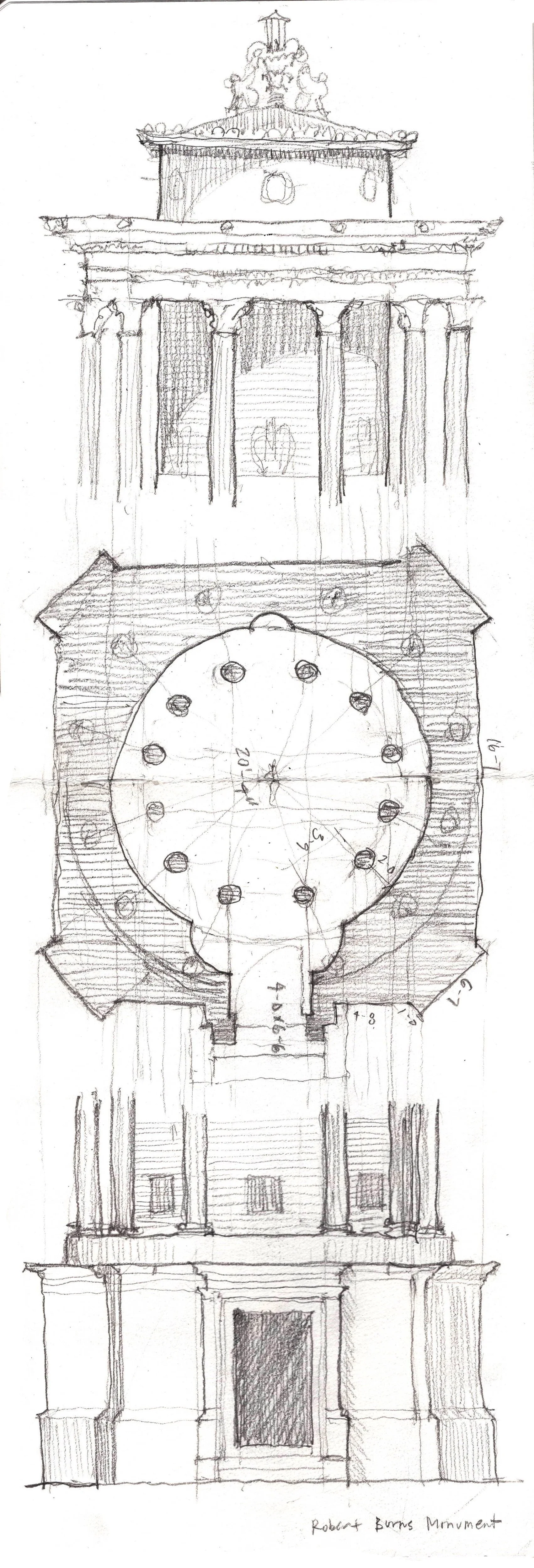
In the afternoon we revisited Calton Burial Ground to see the monument to Robert Burns designed by Thomas Hamilton. Based on the Choragic Monument of Lysicrates, the Burns Monument has an unusual interior built to house a statue of the poet which is now in the National Portrait Gallery.
We gained special permission to go inside which allowed us to take measurements of the circular interior space, columns, and door threshold.
Across the street from the Burns Monument is the Old High School, which drew my attention with its linear composition and grand pediment. I took advantage of the sunny afternoon to do a plein air watercolor sketch in my small sketchbook.
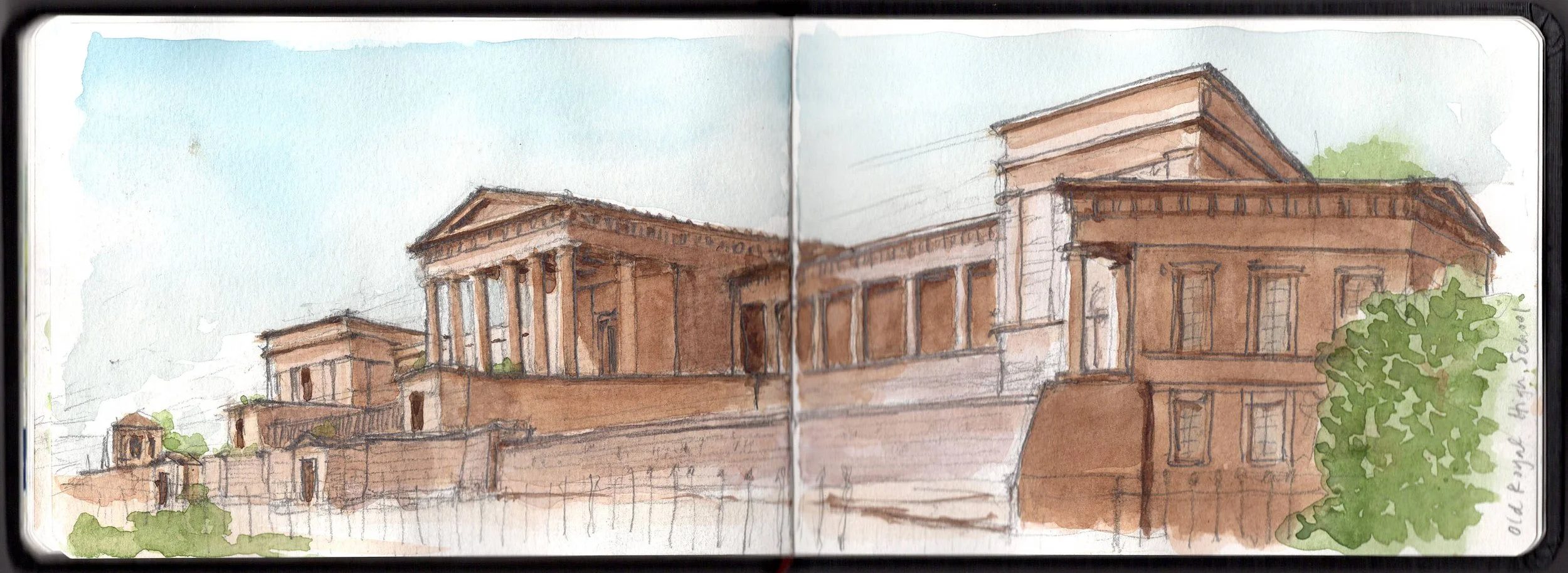
Old High School, Edinburgh, watercolor & pencil 2022
Day 6: National Gallery / Dean Gallery
Although the tour did not include any country houses or venturing outside the city during our week in Edinburgh, we did visit two buildings that resemble country houses in their scale and settings. The National Gallery of Modern Art, designed by the architect William Burn in 1822 and based on the Temple of Hephaestus in Athens, and the Dean Gallery, designed by Thomas Hamilton in 1831-3 and originally built as an orphanage.
We created a pair of plein air watercolor paintings using three colors: French Ultramarine, Burnt Sienna, and Yellow Ochre. Instructor Martin Burns led us through an example of blending these colors to create a palette suitable to Edinburgh’s stone buildings and landscape.
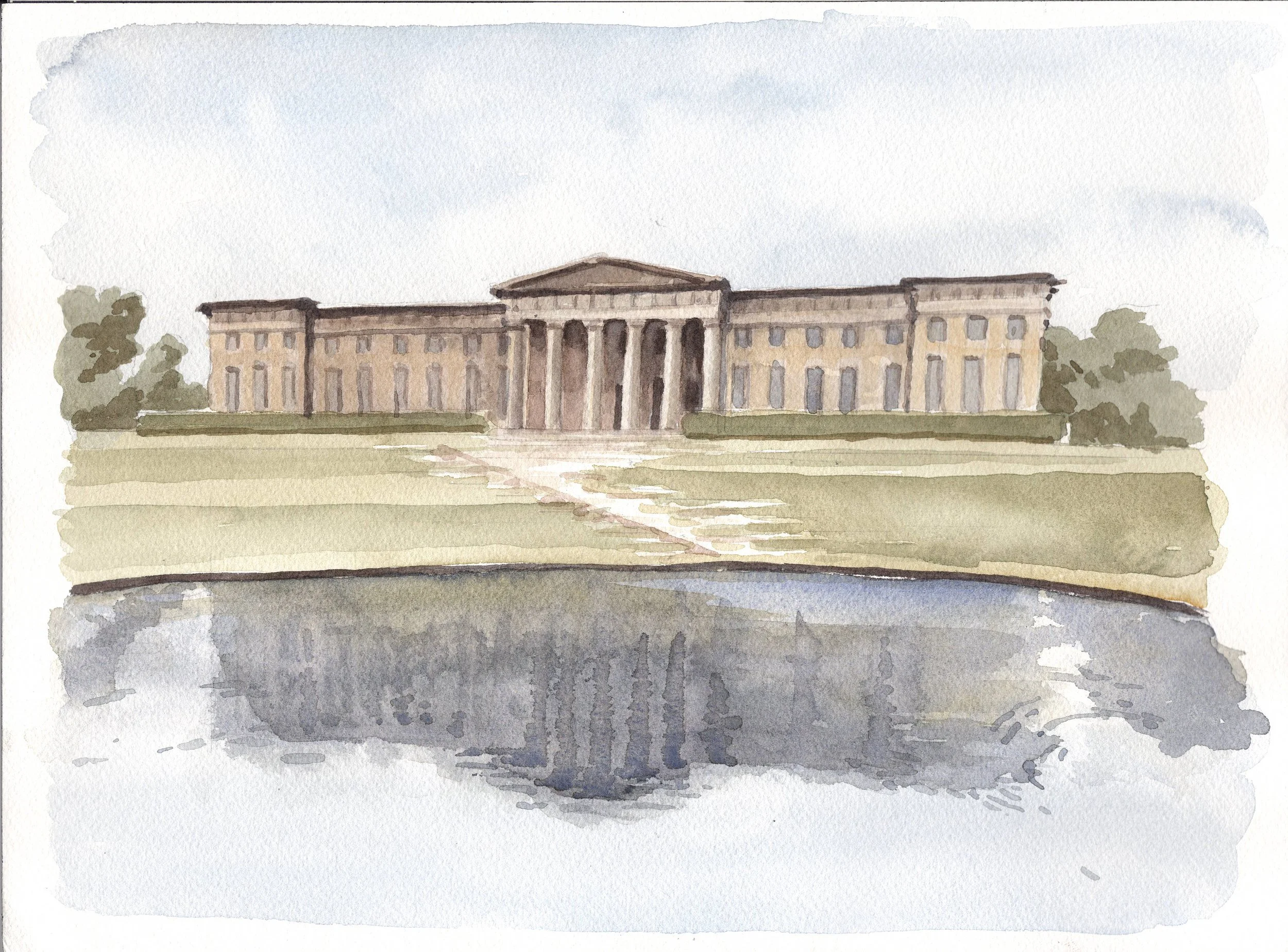
National Gallery of Modern Art, watercolor, 2022
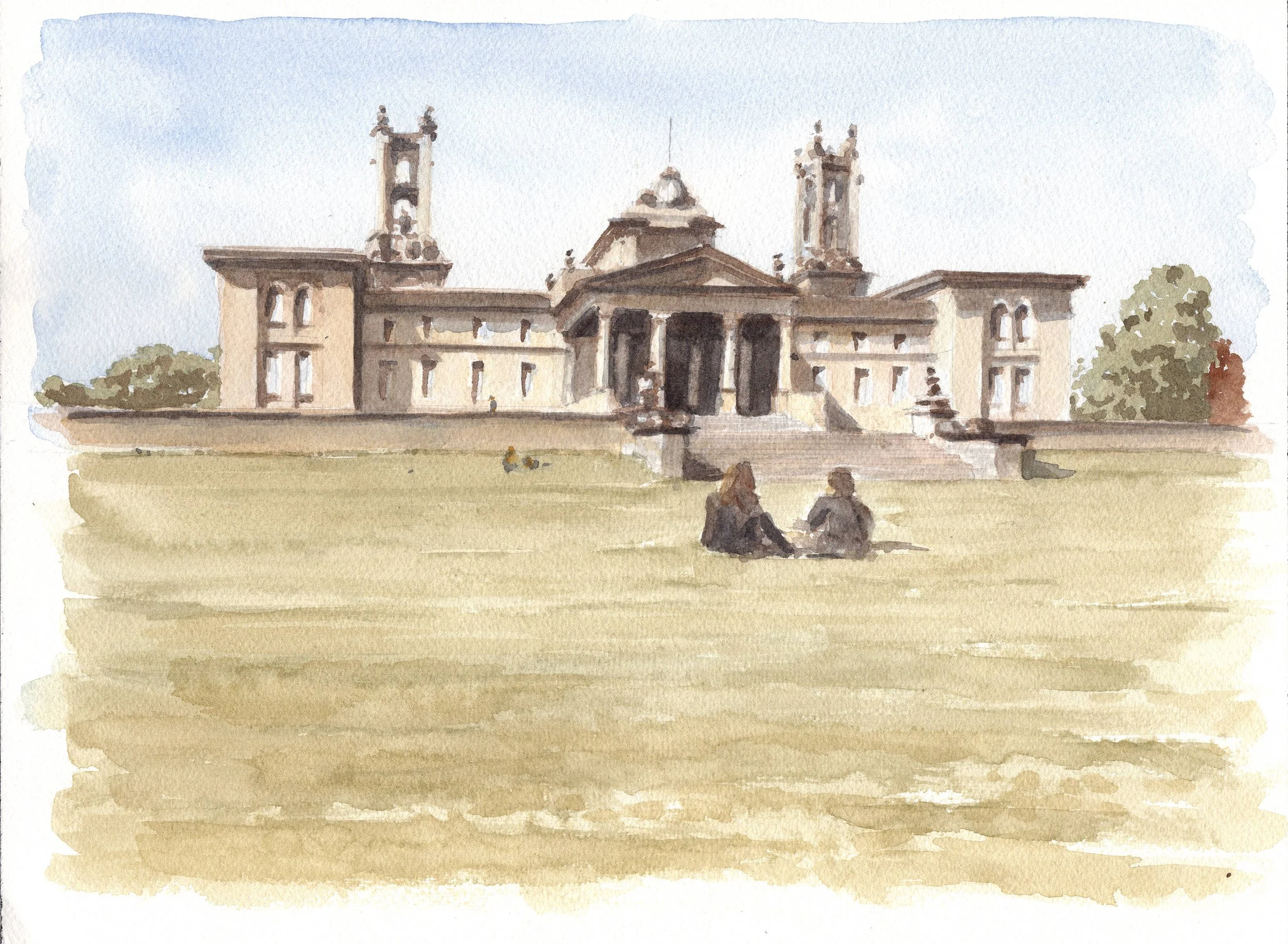
Dean Gallery, watercolor, 2022
Day 7: National Gallery / Stockbridge
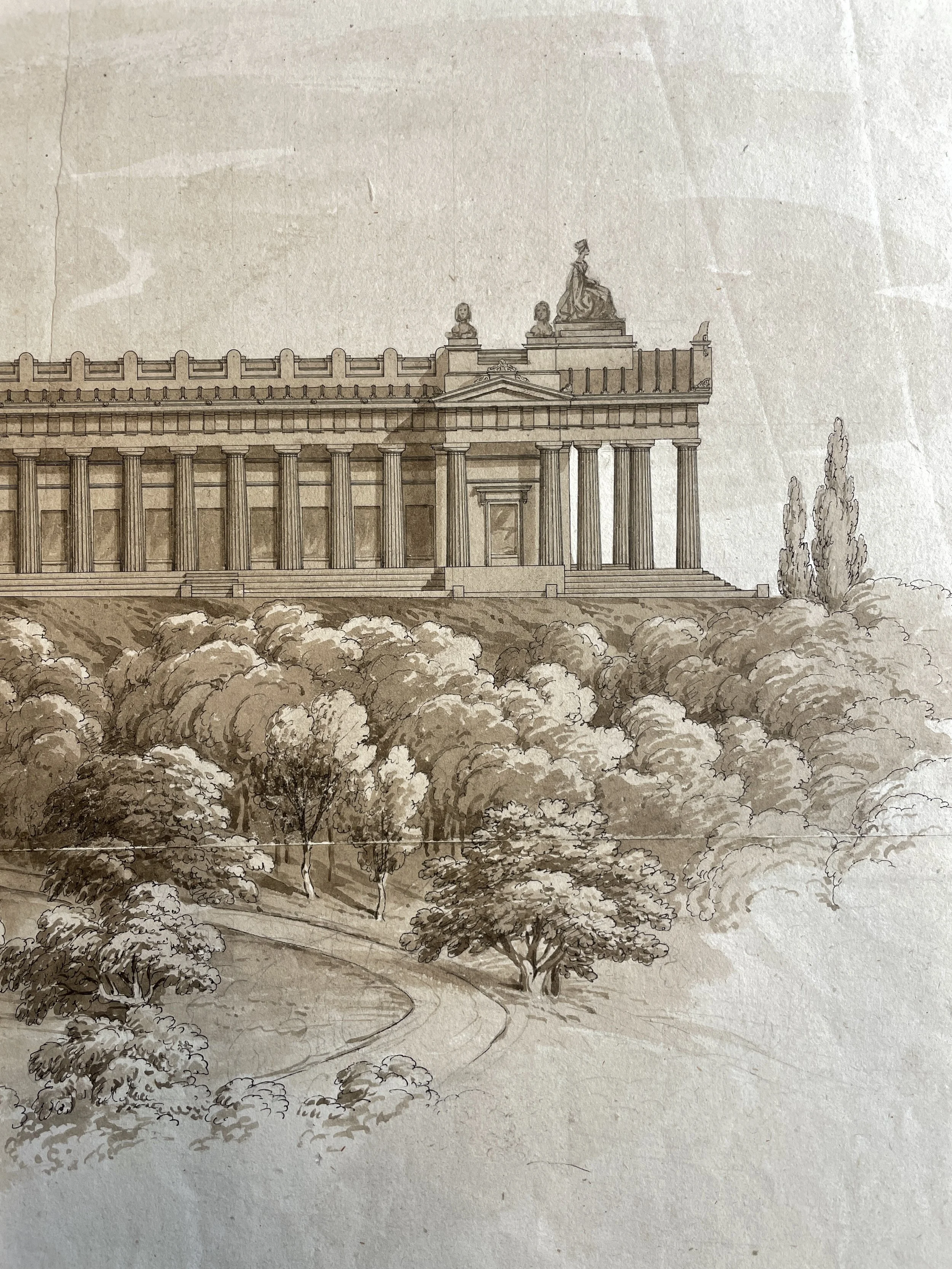
On the final day of our tour we made a ‘quick’ 90 minute watercolor sketch of the National Gallery of Scotland, Greek Revival buildings on The Mound, designed by William Playfair.
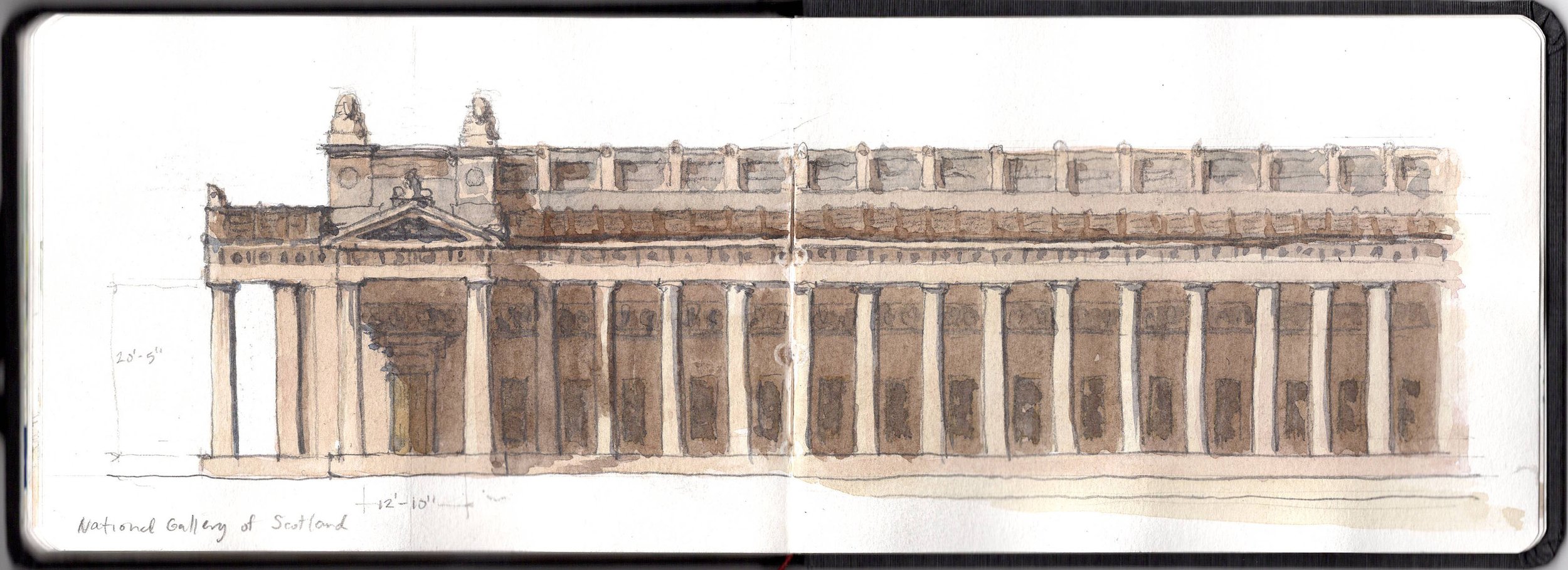
The experience recalled the detailed archival drawings made by William Playfair himself, which we were privileged to see under close observation at the University Library earlier in the week:
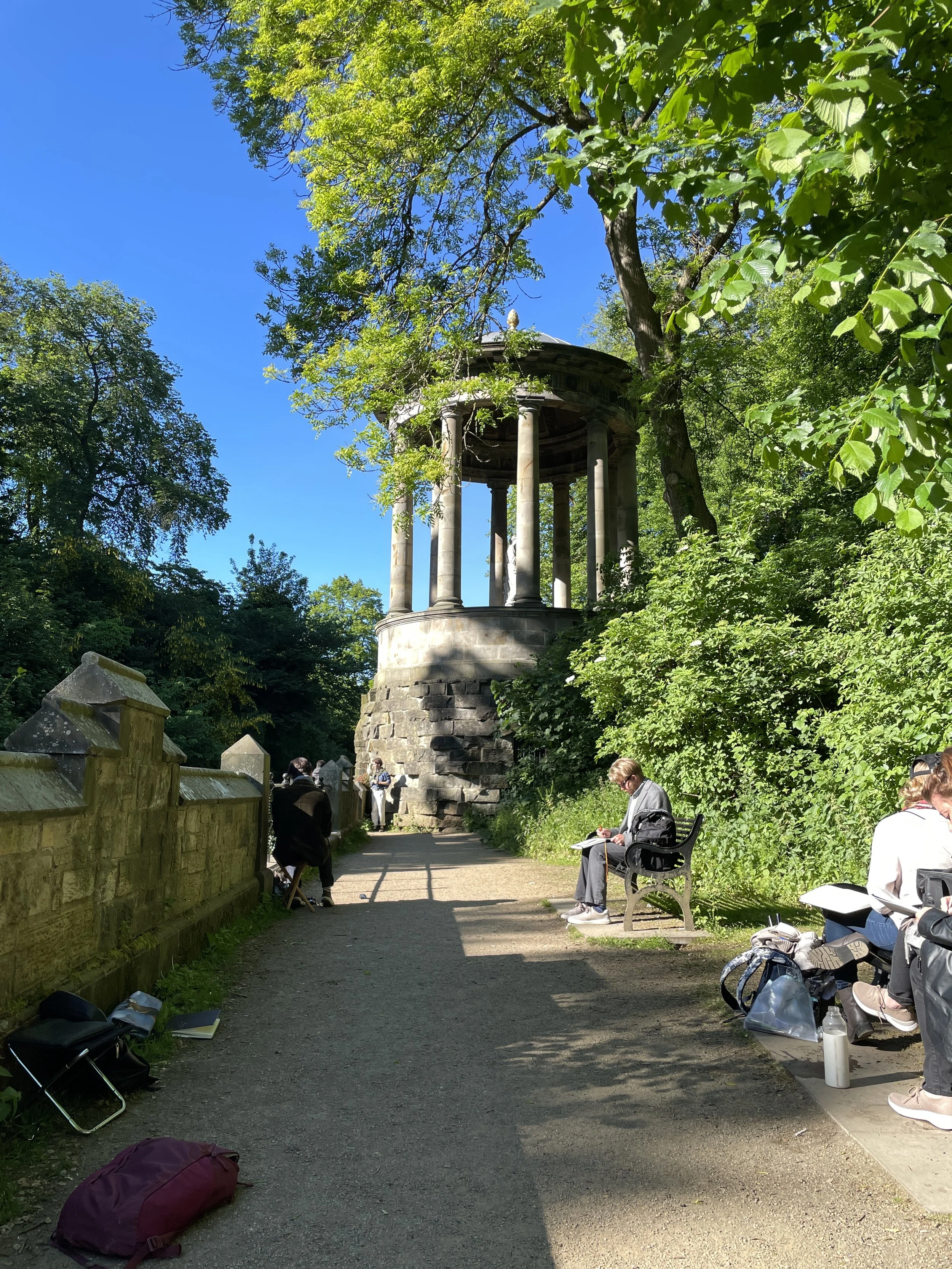
On our final afternoon together, we walked through Stockbridge to see St. Bernard’s Crescent with its impressive Greek Doric terraces, and on to St. Bernard’s Well. This is a charming Roman Dome circular temple by the side of the Water of Leith, which I drew in sanguine watercolor pencil.
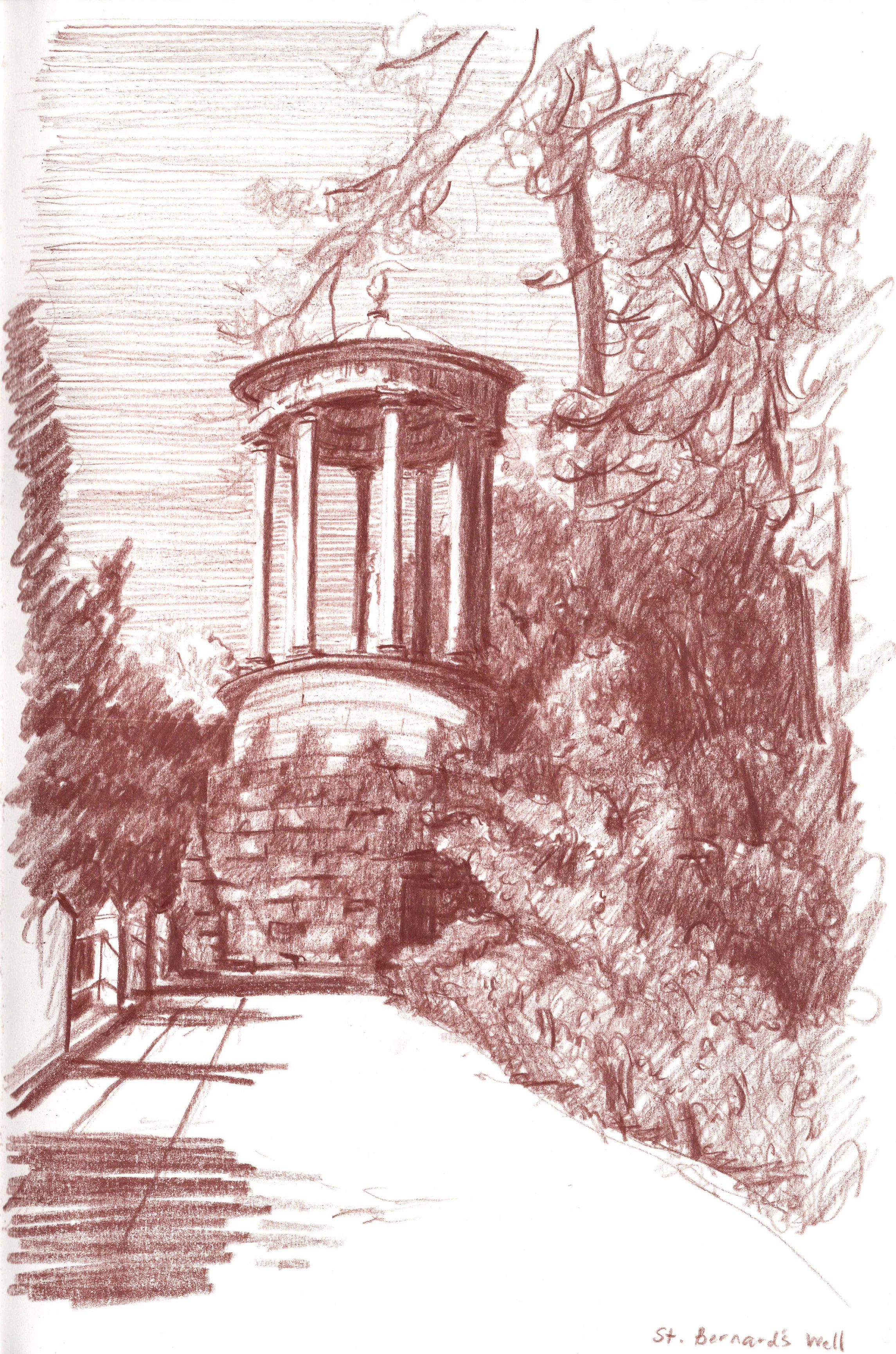
St Bernard’s Well, watercolor sanguine pencil, 2022
After hours during the tour, I found time for plein air watercolor. The sun didn’t go down until 10:30pm, so evenings were bright and the warmest part of the day. This watercolor captures Arthur’s Seat as seen from Calton Hill, with the Baltic sea in the distance.
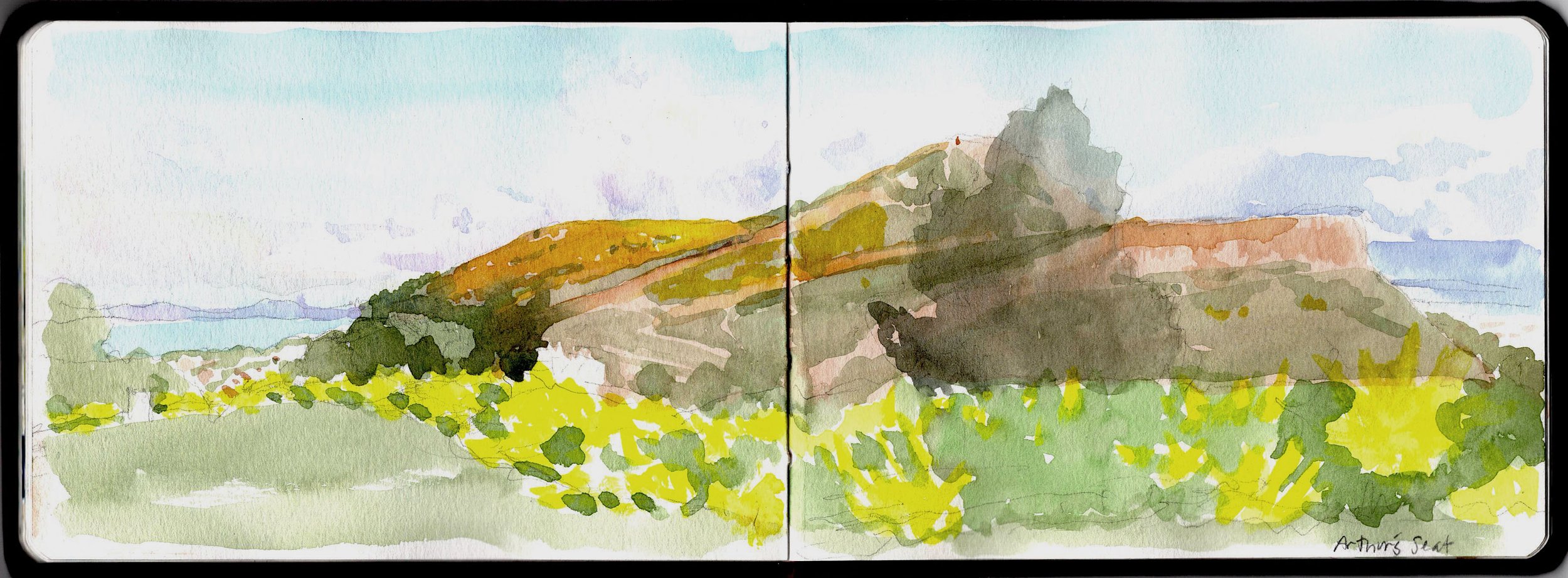
Arthur’s Seat, watercolor, 2022
Another opportunity to capture water with watercolor happened along the shore of Leith. I walked the beautiful pathways along the river’s edge toward the coast, which culminates in the port of Leith and urban canal system. I sat with a cappuccino and palmier from a local coffee shop and finished this watercolor.
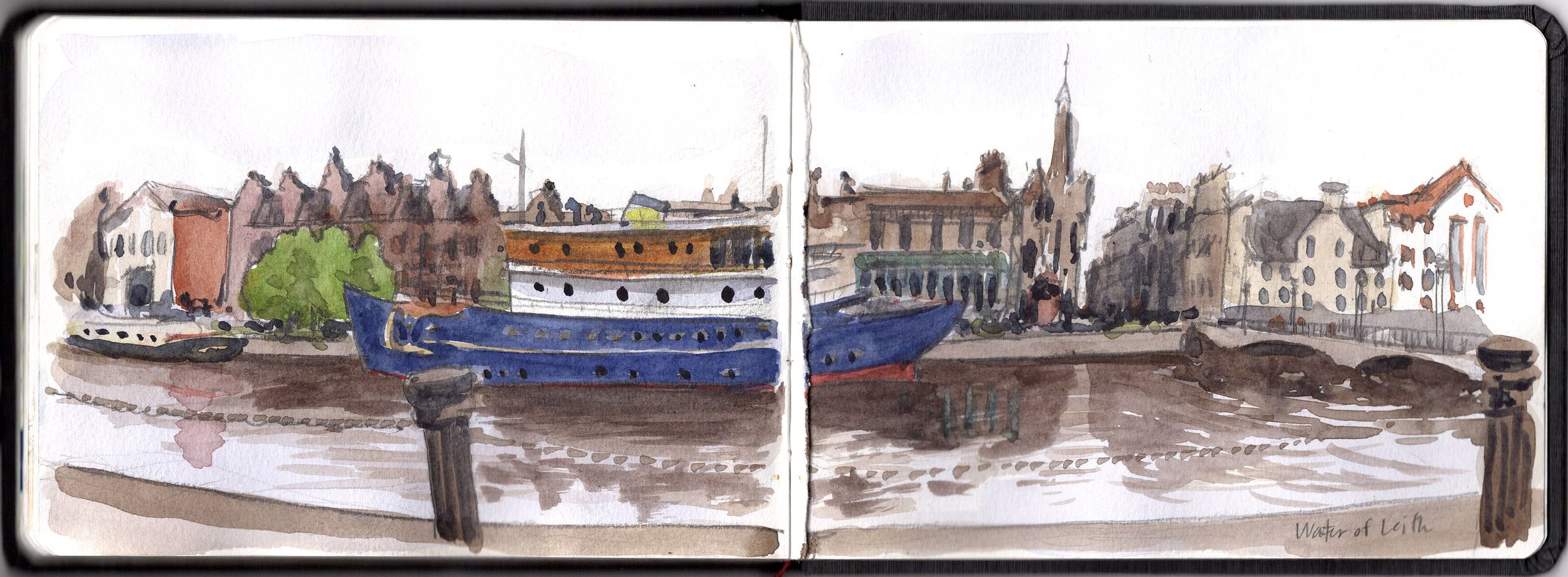
Shore of Leith, watercolor & pencil, 2022
Lastly, I traveled on my own to Melrose to experience the countryside, rolling hills and benefit from the fresh air. Melrose Abbey is an incredible ruin from Cistercian times, where exposed buttresses still support the towering walls of rose-colored stone. The strand of wheat preserved in my sketchbook is a sentimental reminder of Scotland’s stunning integration of nature and classical architecture.
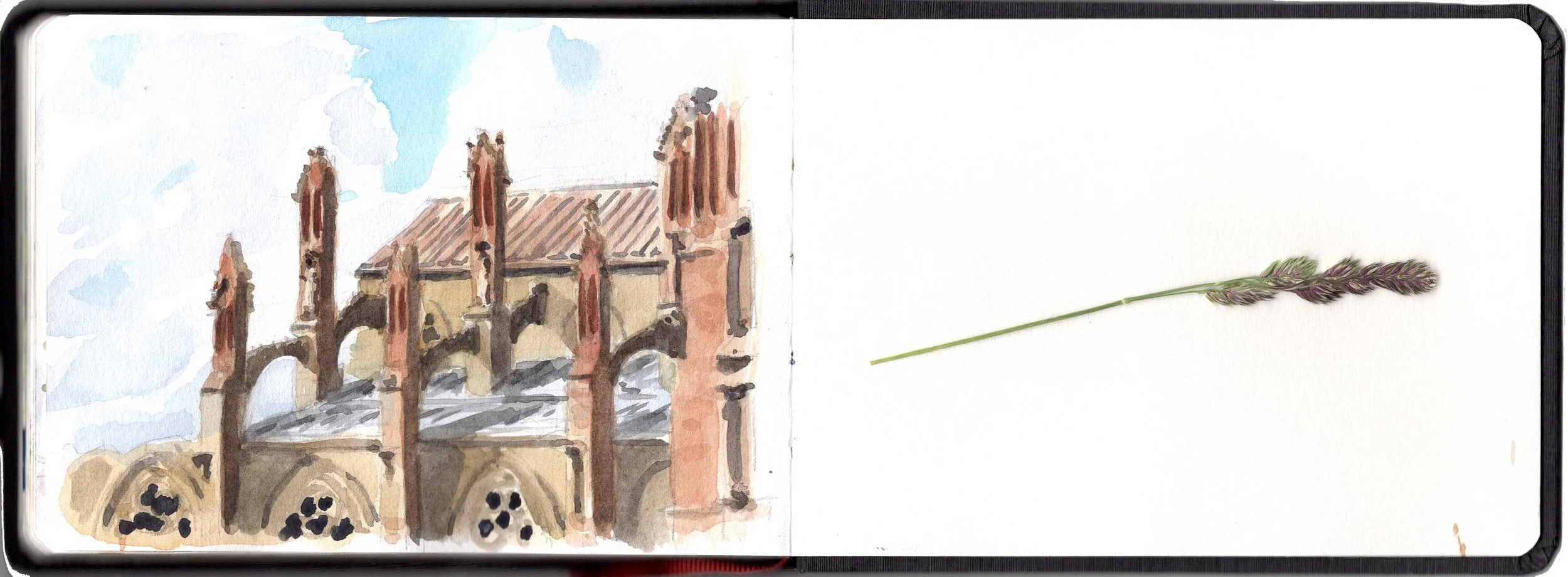
Melrose Abbey, watercolor, 2022

France 2019
We visited France for the month of June in 2019, traveling from Paris to the southeastern-most corner of the Cote d’Azur, near the border of Italy. I chose a small 3” x 5” watercolor sketchbook to document the our experience of the architecture through color, proportion and light. Here is my travelogue described through drawings and a few photos.
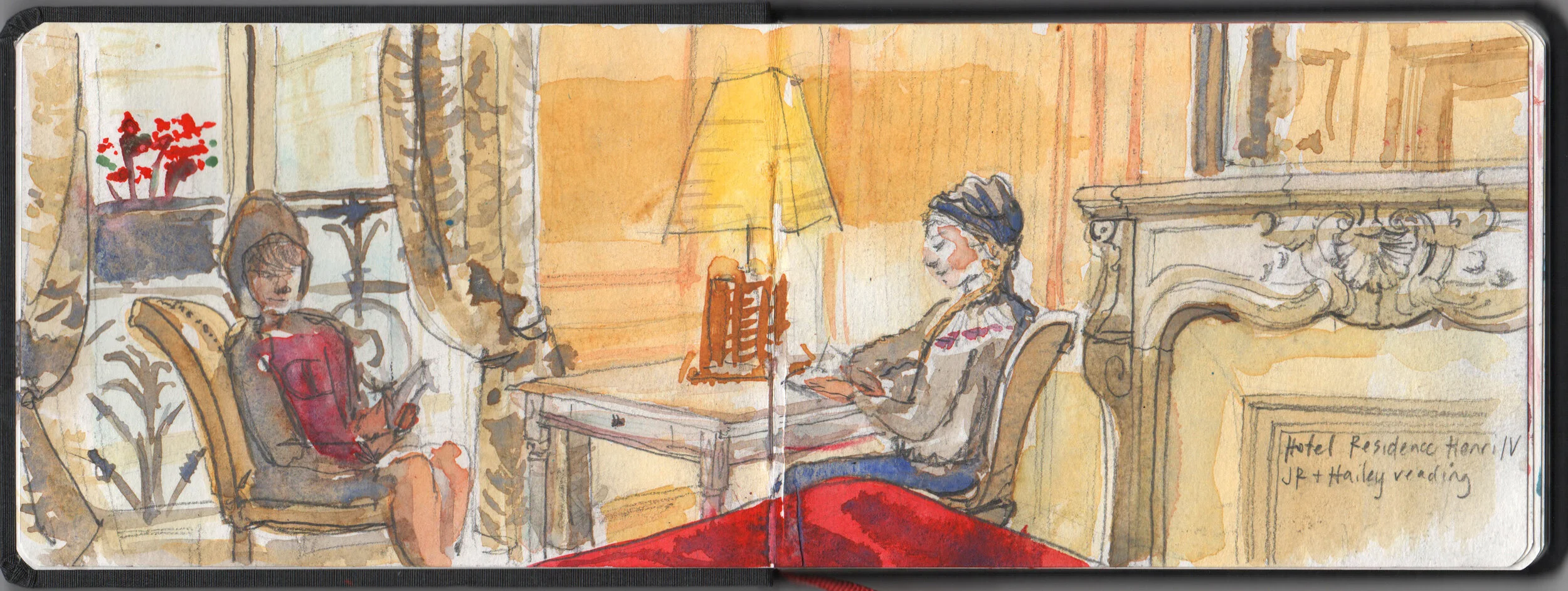
Our first day / night in Paris: we spent our time at the Residence Henri IV, a boutique hotel in the Latin Quarter near the Panthéon. The hotel fronts a dead end street facing a tranquil pocket park, with Haussmann-style balconies decorated with red geraniums. This was the scene after we had unpacked our bags and got settled in, the kids reading before we headed out for dinner.
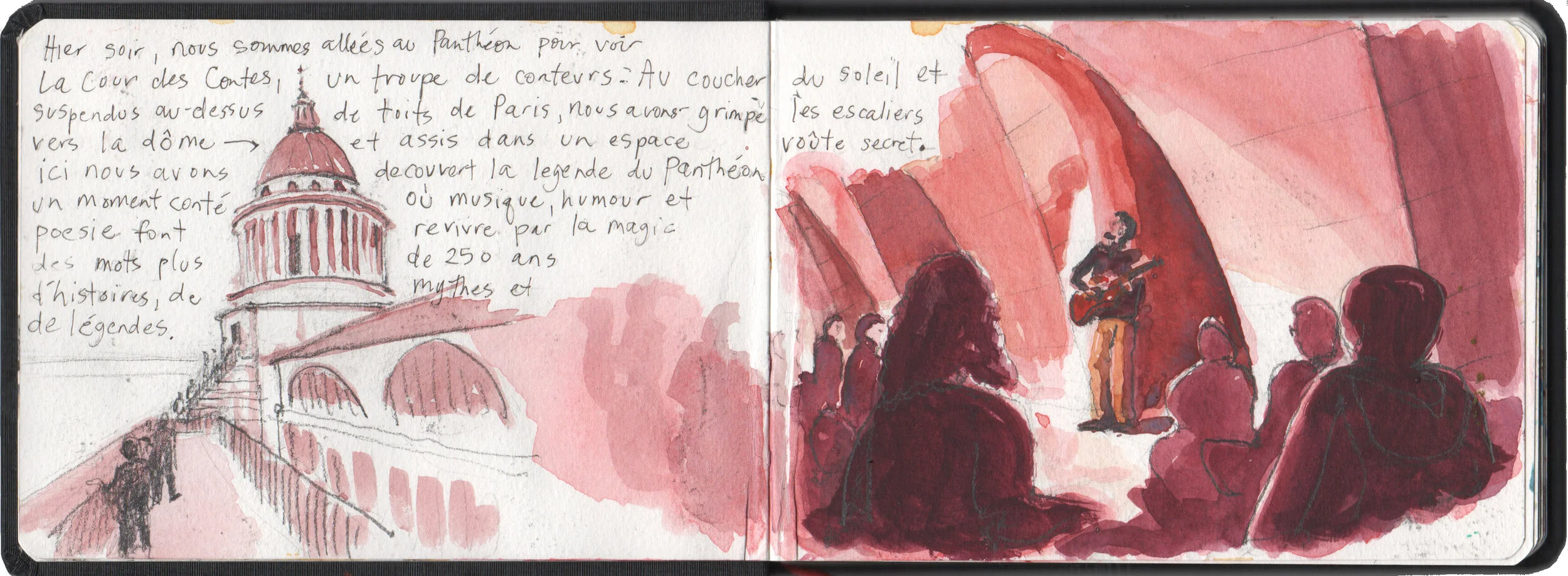
Later that night, we went to the Panthéon to see La Cour des Contes, a troupe of storytellers. At sunset and suspended above the rooftops of Paris, we climbed the stairs toward the dome and sat in a secret vaulted space. Here we discovered the legend of the Panthéon during a moment of storytelling, where music, humor and poetry and enchantment of these wordsmiths revived more than 250 years of history, myths and legends.
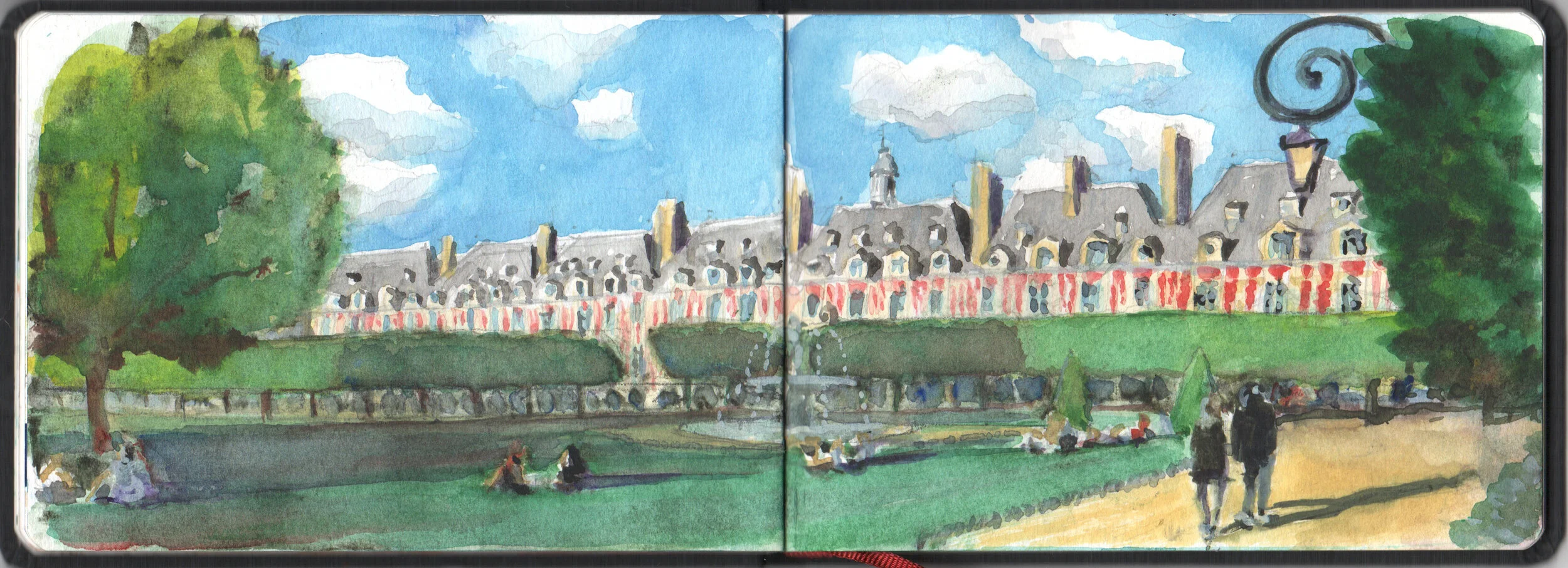
Our favorite public space in Paris is the Place des Vosges, where we ended up as the sun was casting long end-of-day shadows. Commissioned by Henri IV in 1605, the perfectly square, symmetrical courtyard has matching facades of red brick, stone quoins, and steep blue slate roofs with alternating dormers of round and rectangular windows. We took a stroll around the granite paths to the sound of the fountains, playgrounds and birds.
We took the TGV from Paris to Aix-en-Provence, ready for our next leg of the trip on the Côte d’Azur! We stayed in the small town of Roquefort-Les-Pins, conveniently located between the coast and the small medieval villages dotting the southern tip of the Alps. As we drove onto the rental property, the gravel crunching under tires and hum of bees encouraged us to slow down to the pace of the surroundings.
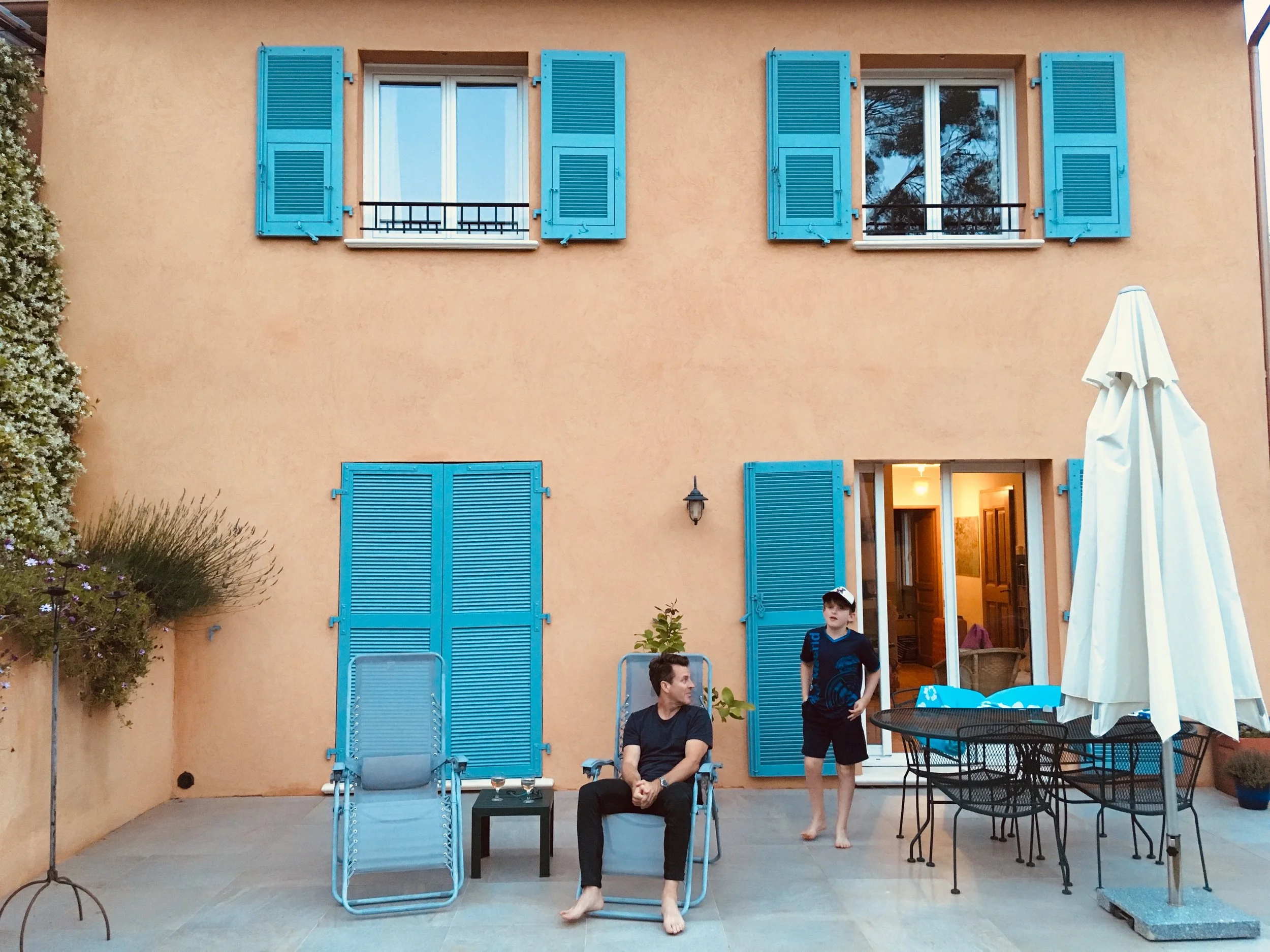
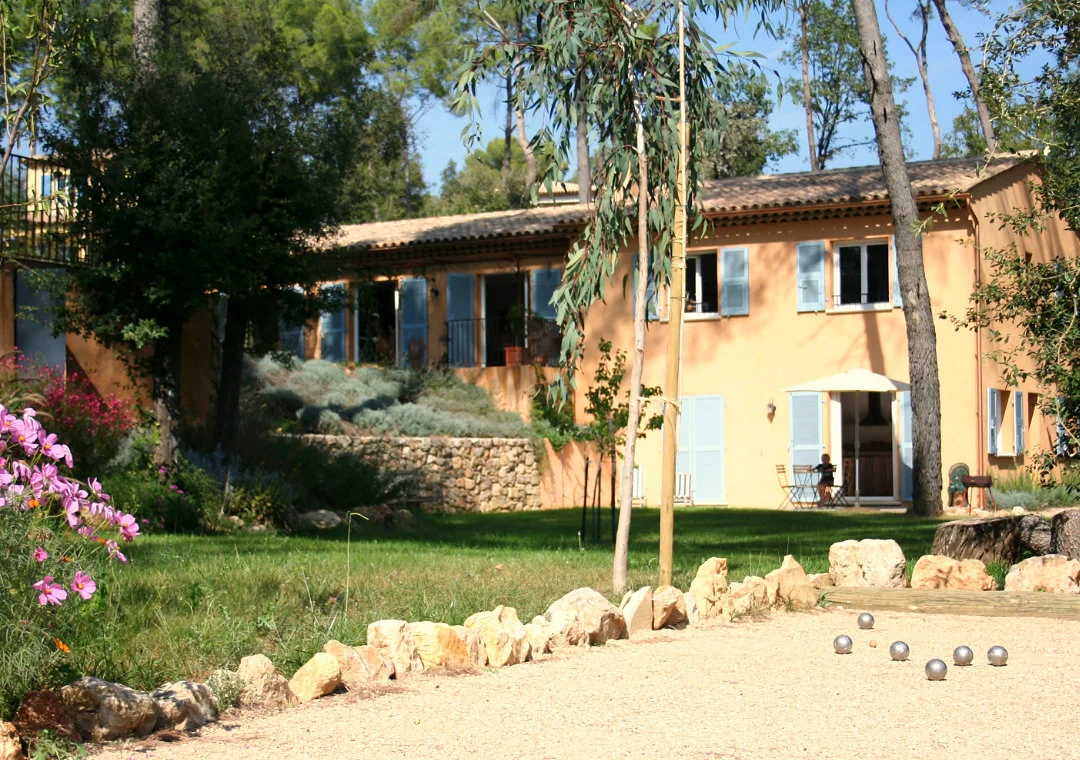
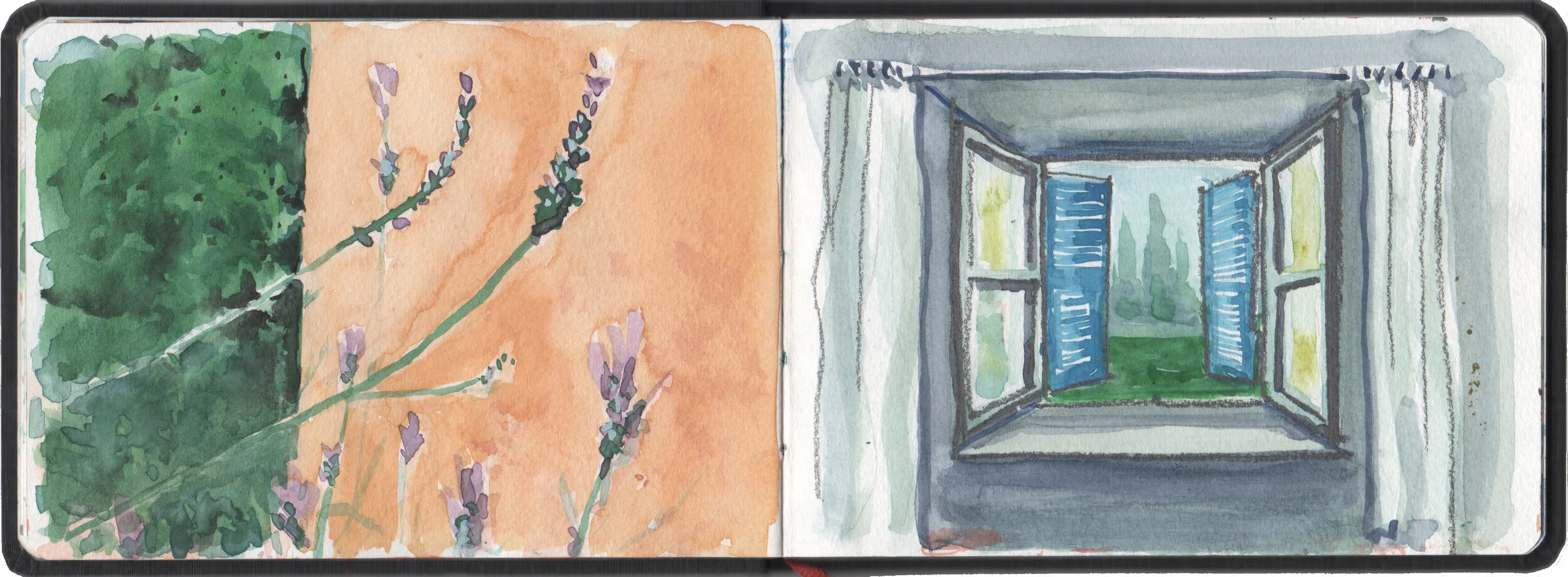
We stayed in a gîte named ‘Lou Messougo,’ a great example of vernacular architecture featuring a three-tiered stepped tile ‘Genoise’ eave, apricot-hued stucco, and periwinkle blue shutters. The simplicity of the building sets off the garden blooms: lavender, mimosa, pine trees, cistus, jasmine, vivid red bottlebrush. At bedtime we opened the windows and closed the shutters to let in the cool air as well as the sound of croaking frogs.
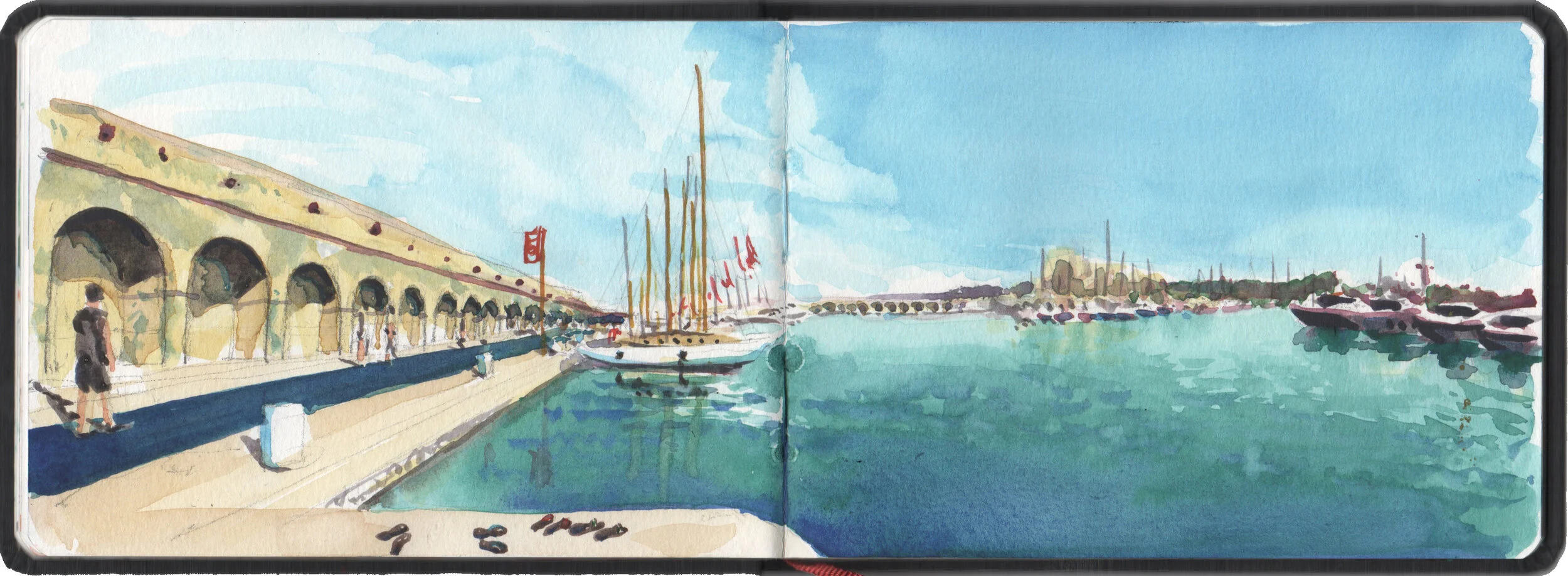
Our host tipped us off to a few fun events going on that weekend in Antibes: Les Voiles d’Antibes (yacht show) and Déantibulations (acrobatic performers). We wandered along the fortress like sea wall to find the beautiful classic sailing boats and yachts, many of them antiques that had meticulously cared for by their owners and set out to sail for the weekend.
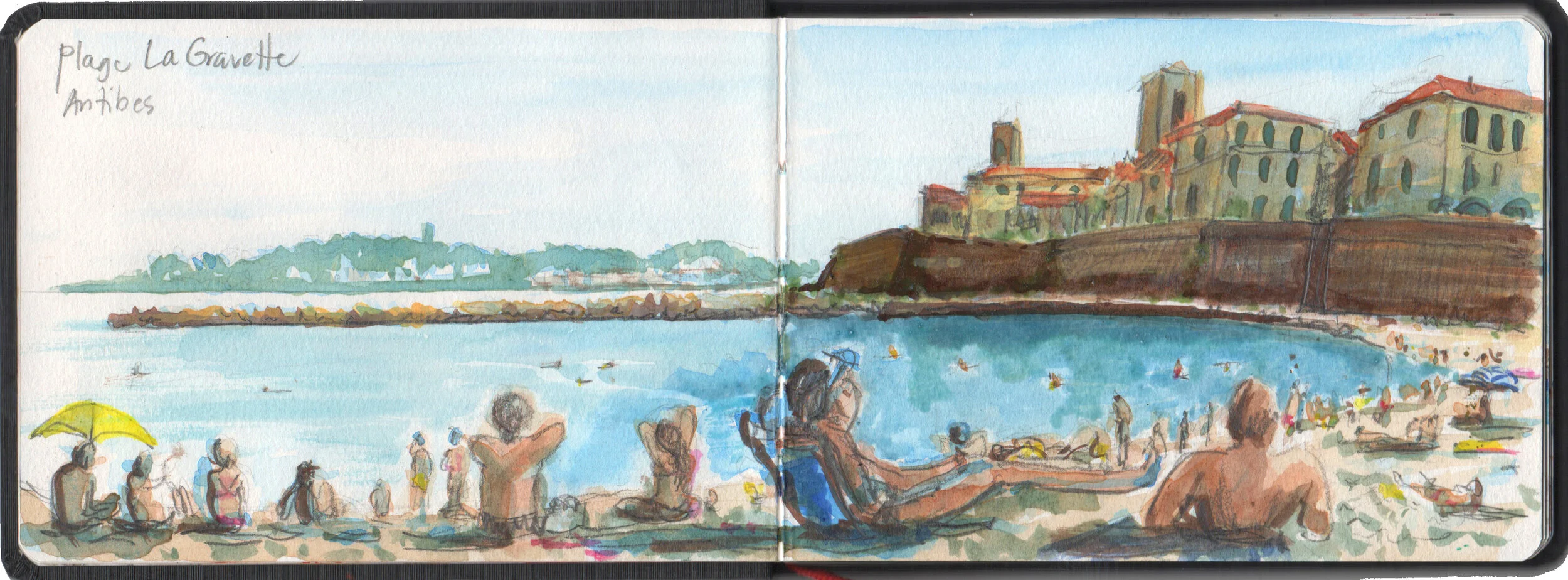
At last, we reached the Mediterranean Sea! We passed through the fortress wall to the Plage de la Gravette, a fun urban beach located right next to the medieval ramparts of the old town. We swam and sunned (or not, if you wear a huge hat like me) and painted till dinner.
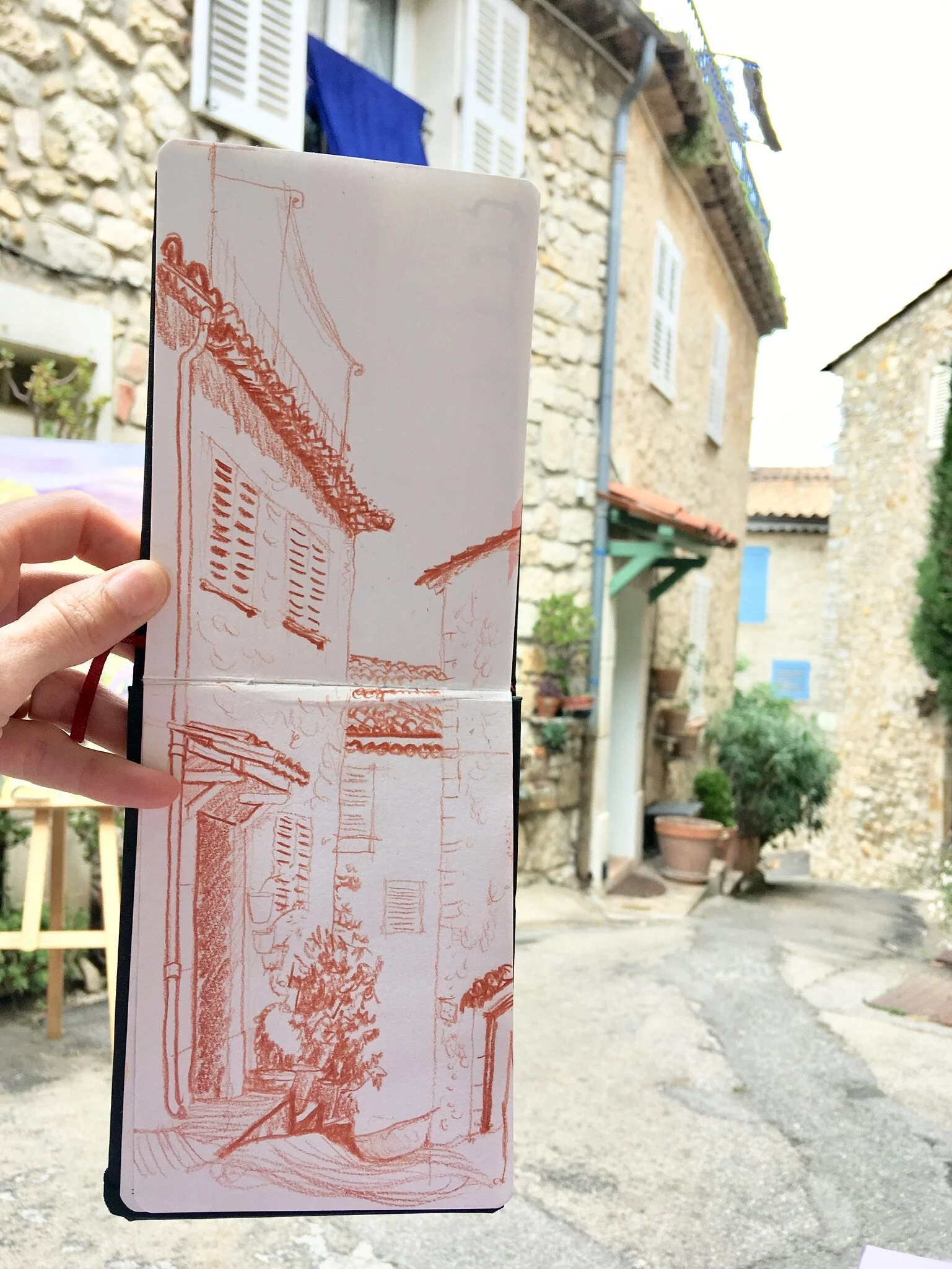
Another day, we visited the hilltop village of Mougins, where Picasso lived and painted for some years. The streets wind spiral-like toward the top, all made of gorgeous native stone accented by shutters and doors painted in lively colors of periwinkle, lavender grey, duck egg blue, or glossy black. The kids loved finding local cats to follow around.
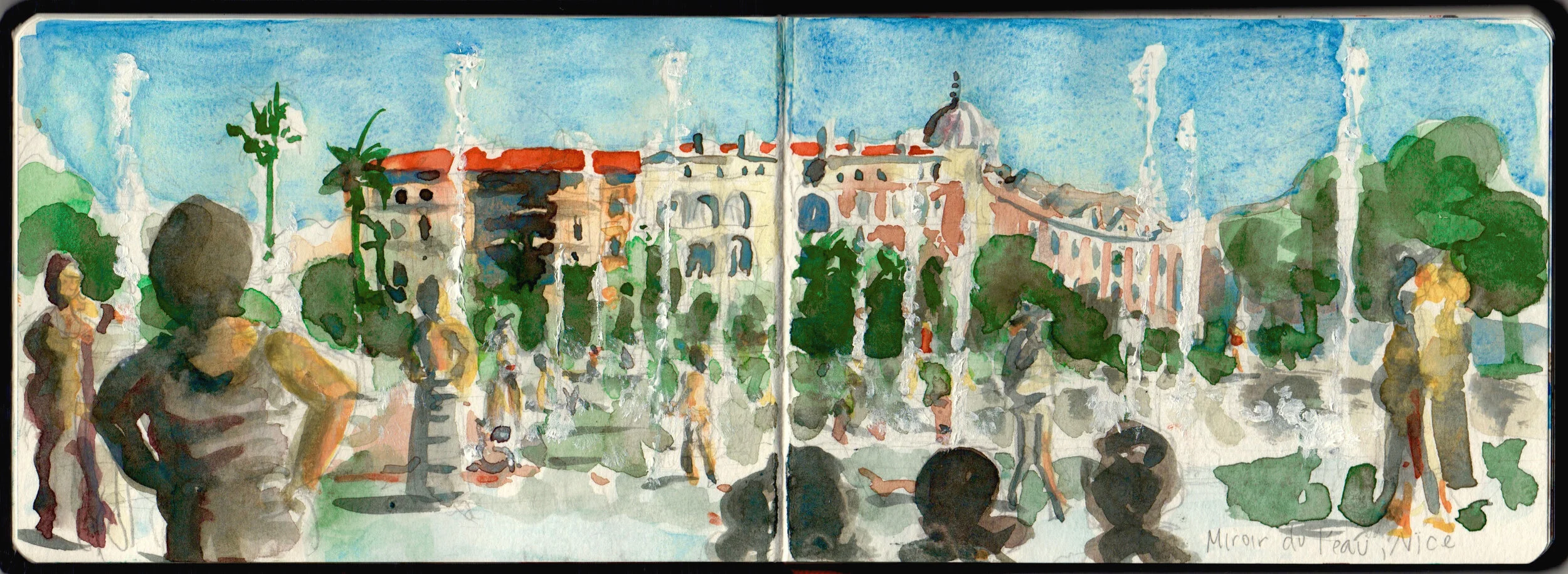
Our day trip to Nice did not disappoint! The largest city on the Côte d’Azur, with so much life, color and action. The kids loved cooling off in the water playground of Miroir d’eau, with the colorful buildings of Place Massena beyond.
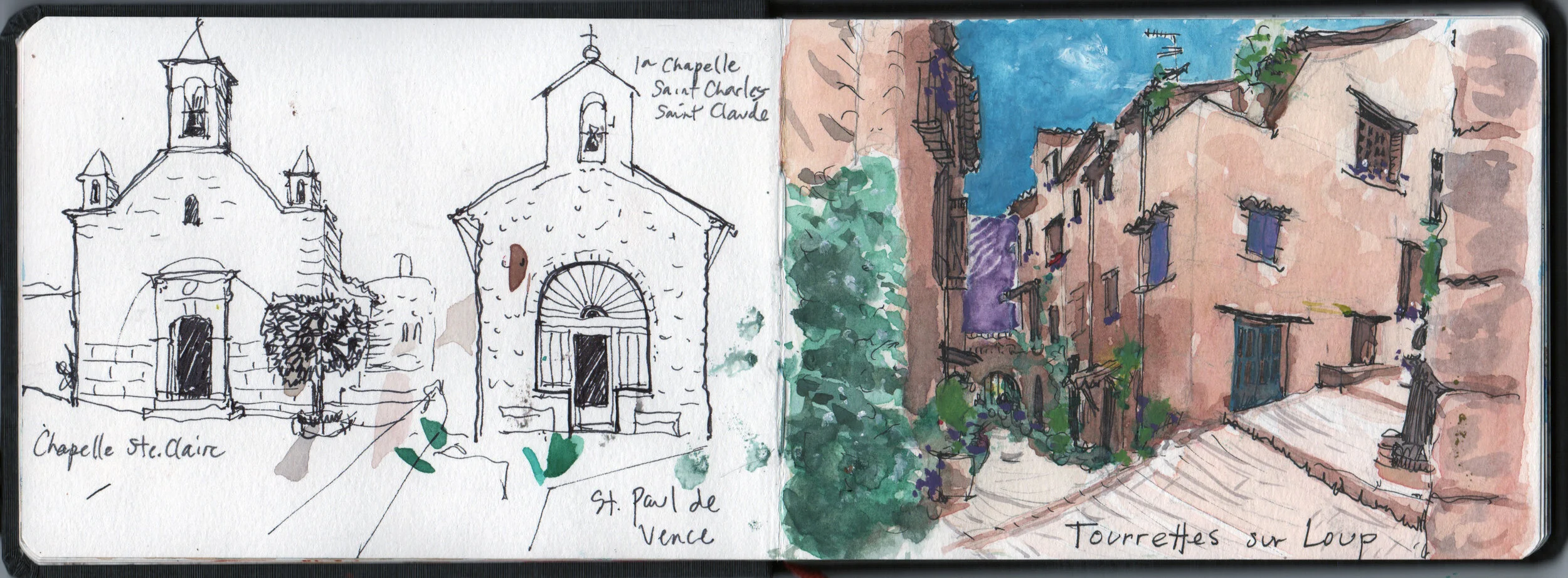
During our second week, we visited the town of St. Paul de Vence, which was mostly overrun with tourists by the time we got there. But we detoured off on our modern art pilgrimage to Maeght Foundation, and along the way found these two small chapels built of native stone and tiny bell towers. On the way back to our gîte, the curving, perilously steep roads demanded another impromptu stop! We toured the hillside village of Tourrettes-sur-Loup, where we sketched and then shopped for violet soaps, vintage books and postcards.
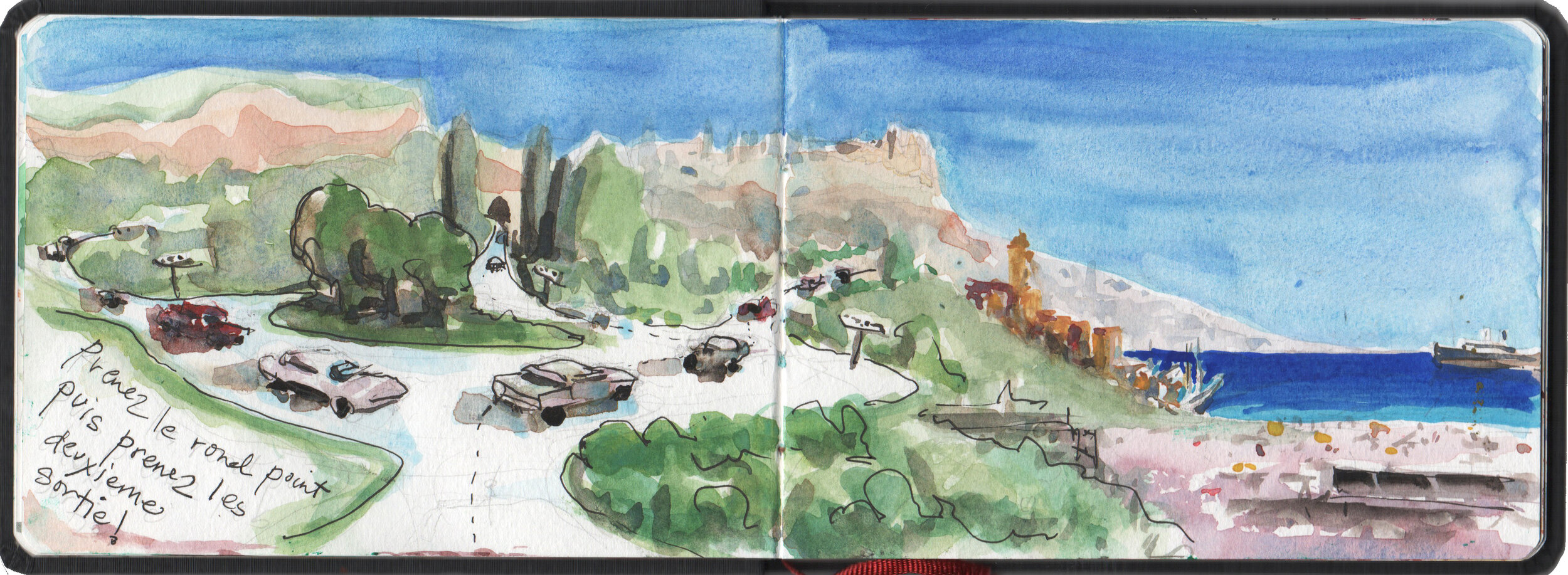
Our next stay was at Villefranche-sur-Mer, the most beautiful coastal village at the head of a very deep bay off the sea, between the Cap of Nice and Cap Ferrat. The water here is so deep that cruise ships can anchor overnight, but the real benefit is the depth of the azure sea contrasted with the gold, ochres and reds of the hillside houses and village. I should mention the rond-point, a traffic round-about that was a tricky but fun thing to learn in our French rental car!
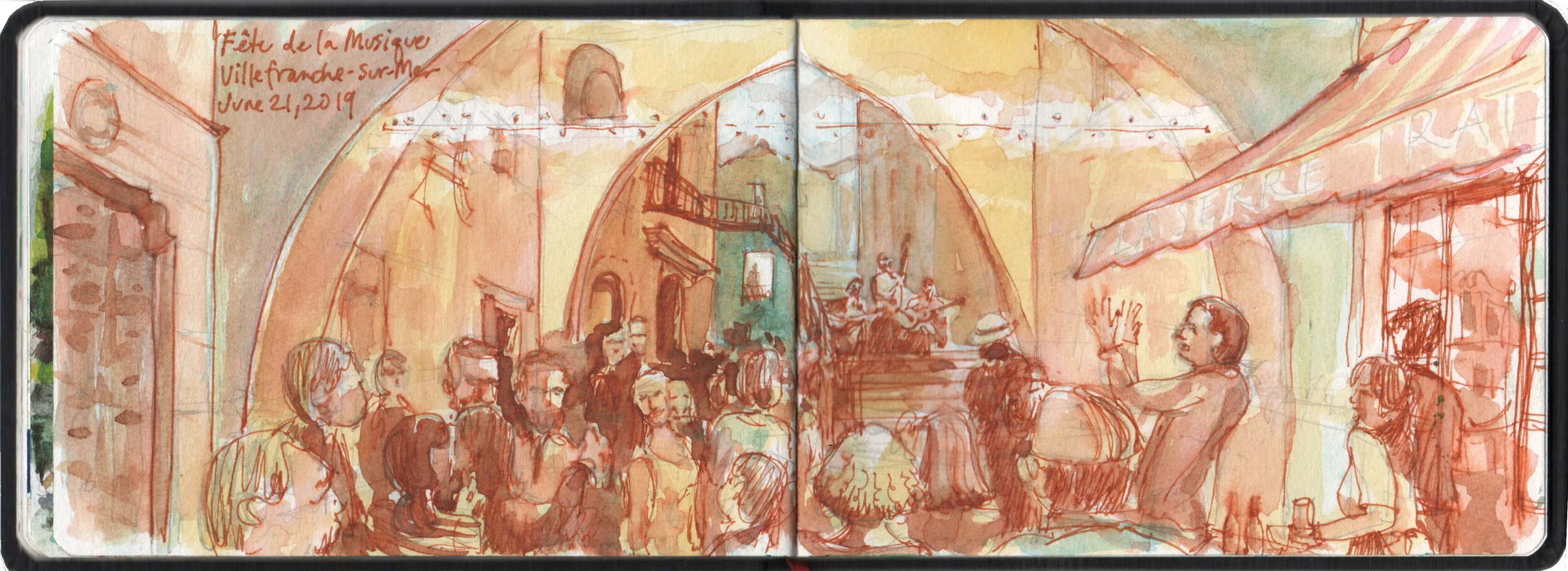
Our stay at Villefranche-sur-Mer overlapped with the Fête de la Musique, a night of music and dancing celebrated throughout all of France. The event highlights both pros and amateurs of all types of music, playing in public squares and free to all, and we were lucky to have this jazz trio playing just steps away from our apartment.
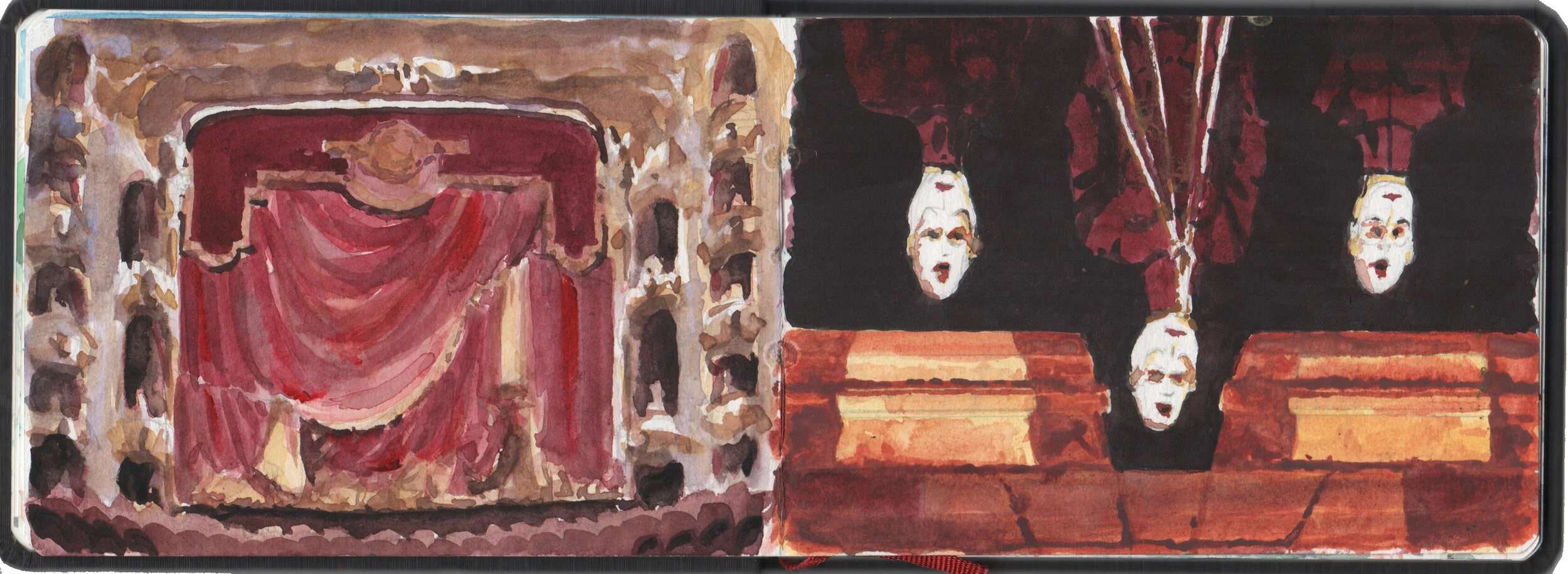
Back to Paris for our final four nights! One highlight of our Parisian experience was a tour and ballet at the Garnier Opera house. An exhibition on the history of opera showed this staging of prisoners appearing to hang from scaffolding while singing, but they had been cleverly disguised with black suits and white makeup.
Playing while we were in town was Mats Ek, a modern Swedish choreographer. Even the 12-year-olds loved his modern renditions of Maurice Ravel’s Boléro and Liszt’s Sonata in B minor, danced by the incredible Garnier Opera ballerina and director Aurélie Dupont. The performance ended as Aurélie and Stéphane drifted away from the audience toward the backstage wall, which lifted to reveal the golden mirrored Foyer de la Danse, seemingly into an endless horizon.

ICAA Rome Drawing Tour 2018
Cecilia Metella, watercolor by Cindy, 2018
The practice of architecture, in its essence, is describing an idea that eventually becomes an assembly of real objects and volumes. Most architects are not also builders; only in very rare cases do architects actually become the hands-on makers of their designs. So, good work will come from inspired thinking and accurate representation. The primary way we achieve this is through drawing, and generally, better drawings yield better buildings.
The benefits of this practice led me and Rick to attend the ICAA Rome Drawing Tour together in 2018. The focus on this tour was toward plein air perspective drawing in sanguine pencil and measured drawings of architectural details.
Day 1: Fundamentals of Form in Light
Our first day of drawing began with a walk down the via Appia, Rome’s ancient boulevard, toward the ruin of Cecilia Metella and passing through the Arch of Drusus along the way. Drawing these ruins presented a whole new sort of challenge - how to capture the comprehensive form of the original structure and representing the interesting texture of decay.

ICAA Rome Drawing Tour - sketching the Arch of Drusus along the via Appia
Instructor David Mayernik led us through the basic steps of composing the page, drawing in perspective, and creating the illusion of depth through diagonal shading. In the final drawing, lines are used not to outline the form, but underline the shadows.

Arch of Drusus, sanguine pencil sketch by Cindy, 2018
Day 2: Measured Drawing and Perspective
We began the next day at Villa Farnesina, a handsome 16th century Renaissance building designed by Baldassarre Peruzzi. The rich interior decoration boasts frescos by great masters such as Raphael, Sebastiano del Piombo, Sodoma, and Peruzzi himself. Our assignment was to study the window surrounds and pediment details through measured drawings, led by our instructor George Samaurez Smith, a leading classical architect in England.


Measured drawing by Rick, 2018
After a delicious lunch in Trastevere, we ambled over to the Cancellaria, Rome’s seat of government and a fine example of early Renaissance built between 1489–1513. We sketched the beautiful courtyard of the palazzo, noting the repeating array of patera (circular rose stamps) between the columns of the double-height loggia. The sun gradually made its way toward the west which created a dramatic shading affect across the south-facing facade.

Cancellaria courtyard, pencil & sanguine sketch by Cindy, 2018
Day 3: Measured Drawing
The next day was focused on Bramante’s Tempietto, a brilliant miniature temple believed to mark the place where St. Peter was crucified, set in the courtyard of San Pietro church. Instructor George led us through another measured drawing exercise with the direction to use 1/2” or 1” architectural scale to apply the dimensions to page. I found the pattern on the floor and corresponding interior columns really interesting, and started out with a few assumptions in a sketch.

measuring and drawing at the Tempietto at San Pietro in Montorio, Rome, 2018
Measuring the space revealed a highly rigorous mathematical structure that resolved down to the smallest mosaic tile. We needed about 8 more hours on site to document the details, but alas, we had to move on.
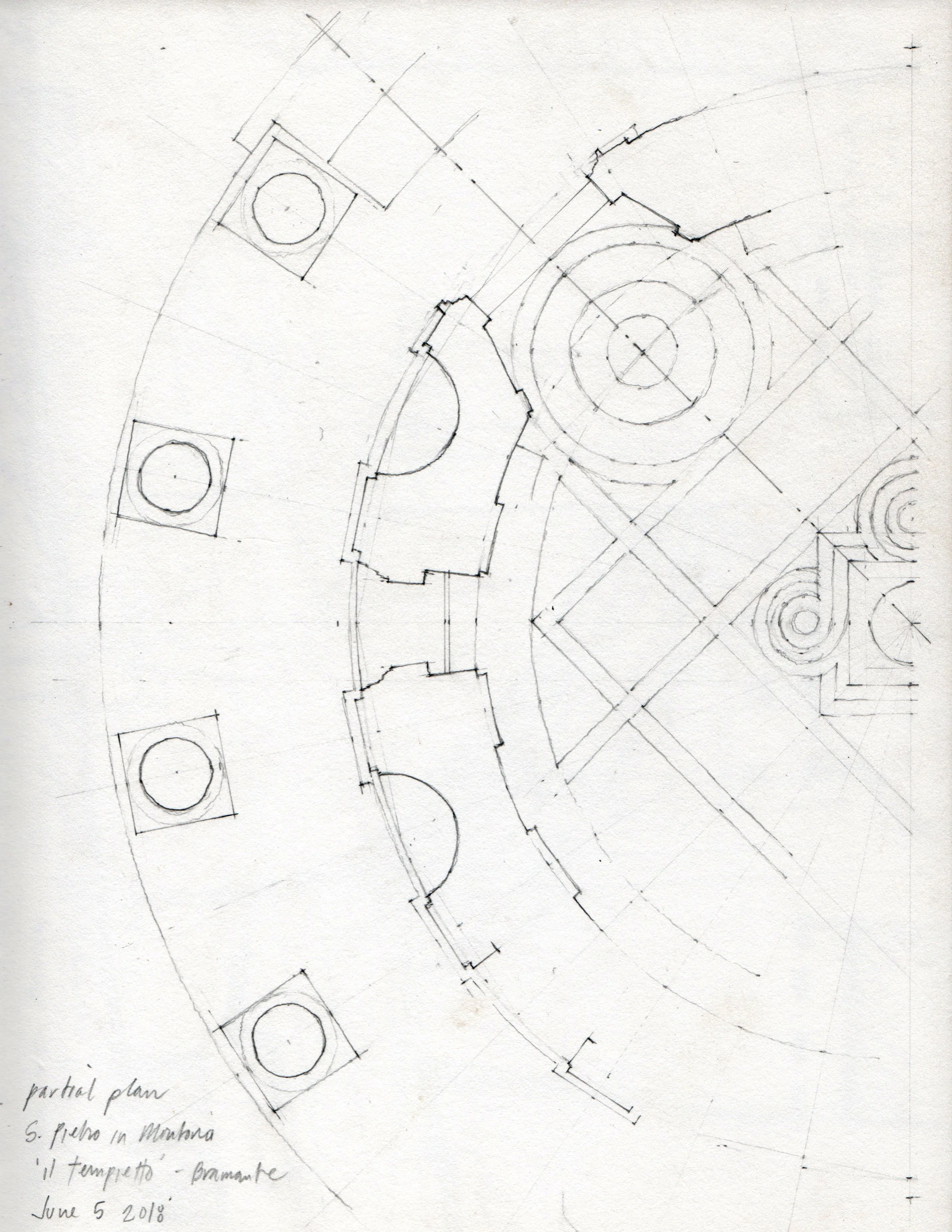
Tempietto at San Pietro in Montorio, Rome, measured drawing by Rick, 2018

Tempietto at San Pietro in Montorio, Rome, measured drawing by Cindy, 2018
We returned to the site of the Tempietto that afternoon to capture the elegant building in perspective - a challenge exercise given its repeating circular structure and close proximity.

Tempietto, sanguine sketch by Cindy, 2018
Day 4: Architecture of the Renaissance Villa Gate; Perspectival Space
We walked to the Vignola gate entrance to the Palatine to practice watercolor, led by instructor Richard Piccolo. Richard taught us how to achieve the proper color tones of shadows, and how the underside of a surface will have a lighter shade from the reflection of the ground.

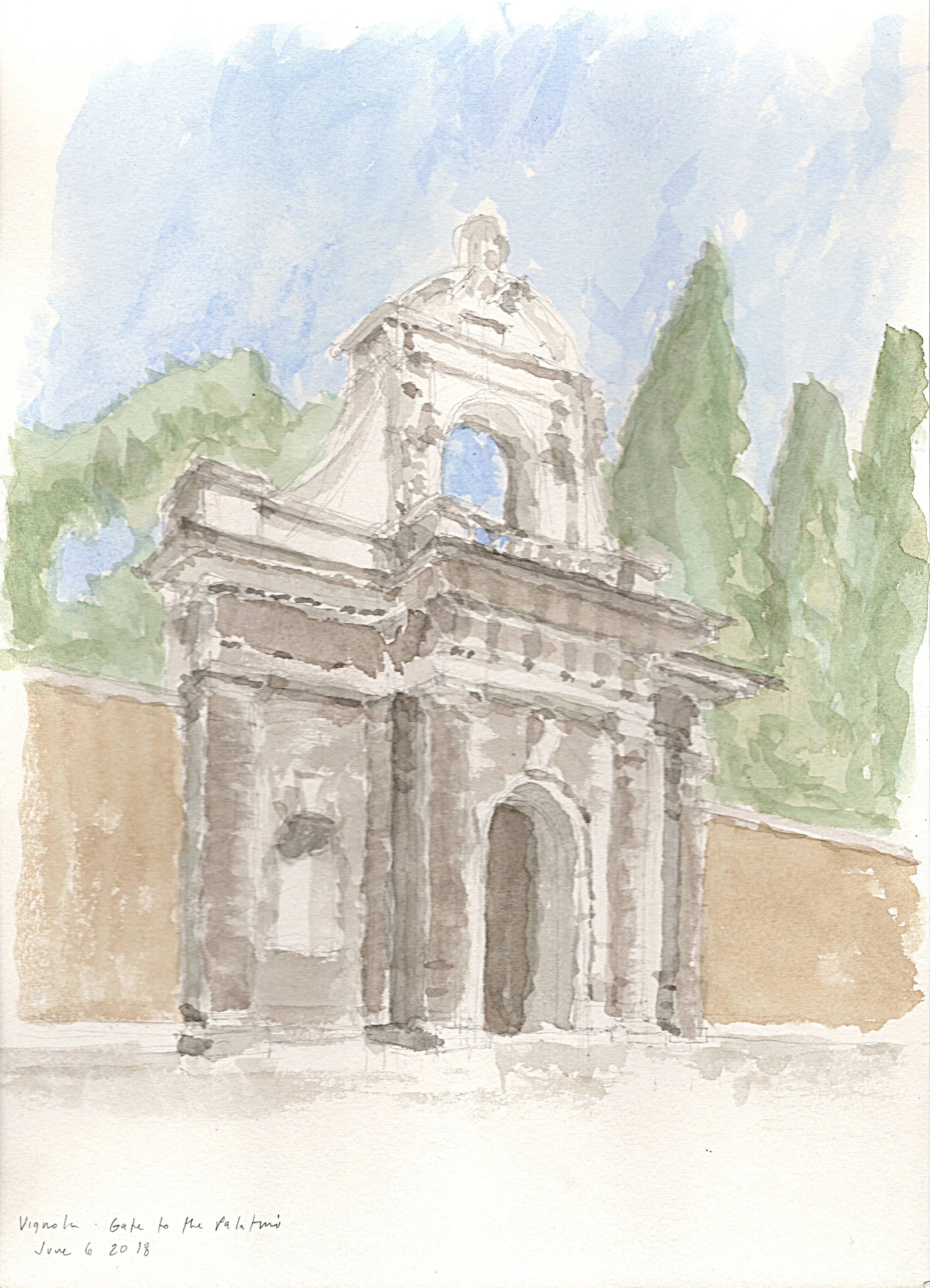
Vignola Gate at the Palatine, watercolor by Rick, 2018
That afternoon we visited the Atrium of San Clemente or S. Gregorio Magno and drew in pencil and white Gouache.

Atrium of Gregorio Magno, goache and pencil sketch by Cindy, 2018
Day 5: Figural Building and Figural Space
We traveled to the countryside to explore the Castelli Romani, the towns of the Alban Hills that overlook the valley of Rome. In ancient times, the hills provided a respite of fresh air from the valley and were believed to be favored by the gods. We followed in the tradition of escaping to the villages and traveled to Ariccia to see Bernini’s Church of Santa Maria Assunta.
Our instructor, David Mayernik, guided us up along the ascent through a forest trail and into the hillside town - this pilgrimage offered us the opportunity to see Bernini’s dome and bell tower framed by the narrow streets of Ariccia. Bernini designed the church as well as the surrounding buildings to form both the building and space around the curved form. The result is a powerful object that composes the space of Piazza della Repubblica, with a view of the hills beyond, and at the same time has a delicate integration with the context of the village buildings. We spent time drawing in the piazza and enjoying a coffee before heading out.

Bernini’s Church of Santa Maria Assunta, pen & marker sketch by Cindy, 2018
Villa Aldobrandini commands a view like no other - it sits high above the piazza of Frascati below, with a view of Rome beyond that.

Villa Aldobrandini, pen & ink sketch by Cindy, 2018
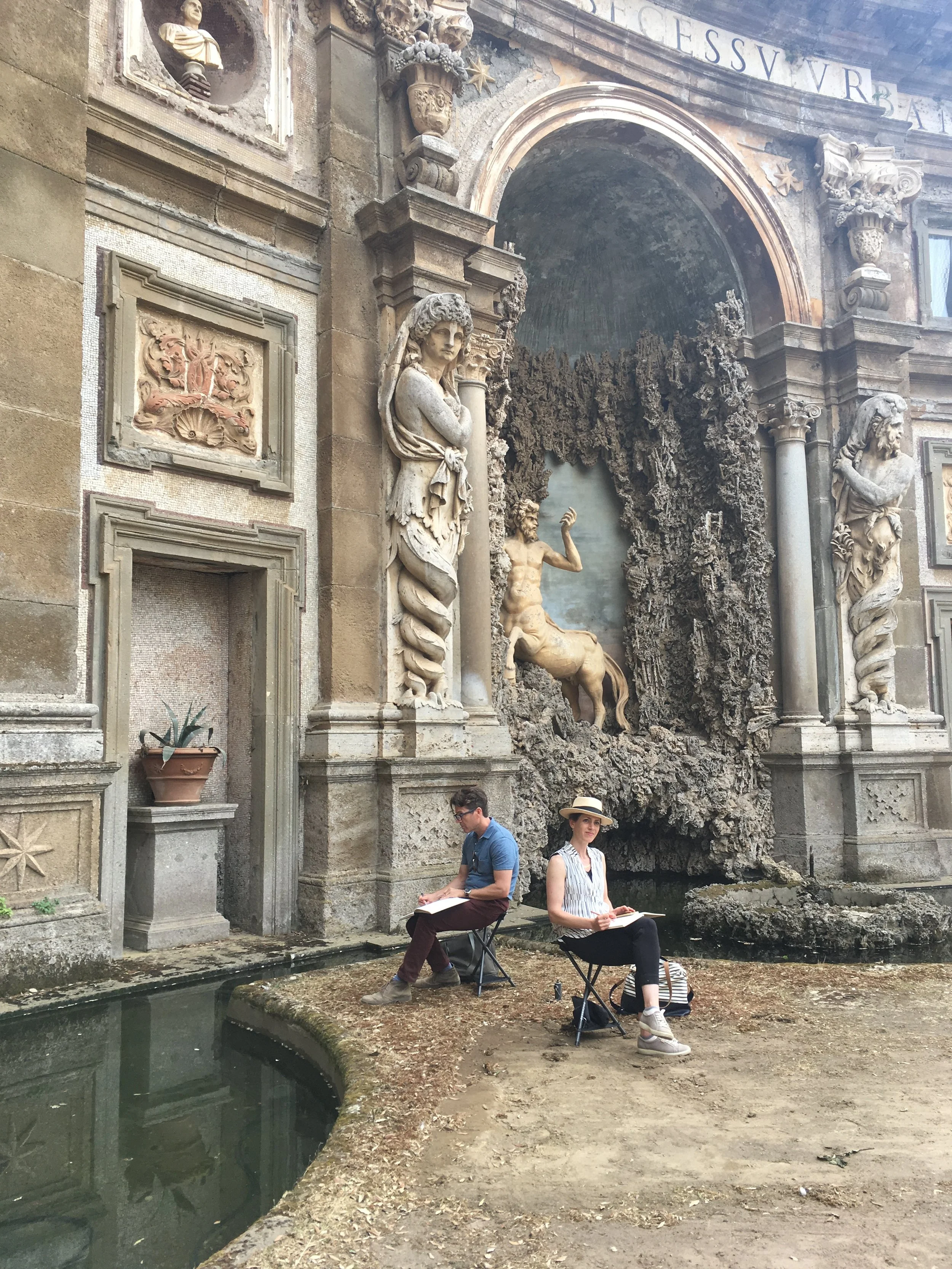
The focus of our visit, however, was in the back of this building to see the gardens and fountain. The Teatro d'Acqua, designed by Carlo Moderno, is a wonderfully elaborate fountain with the central focus being a depiction of Atlas bearing the world on his shoulders. This sculpture represents the battle between reason and passion, and certainly challenged our sketching abilities with its abundant figural detail.
Day 6: Triumphal Arches and the Roman Forum: Type and Variation
We visited the Forum to capture in drawing the three triumphal arches; Septimius Severus, Titus, and Constantine. David Mayernik explained to us how the base of the Septimius Severus was buried beneath layers of sediment before it was uncovered by archaeologists. It was interesting thinking about this fact while drawing the details and proportions.
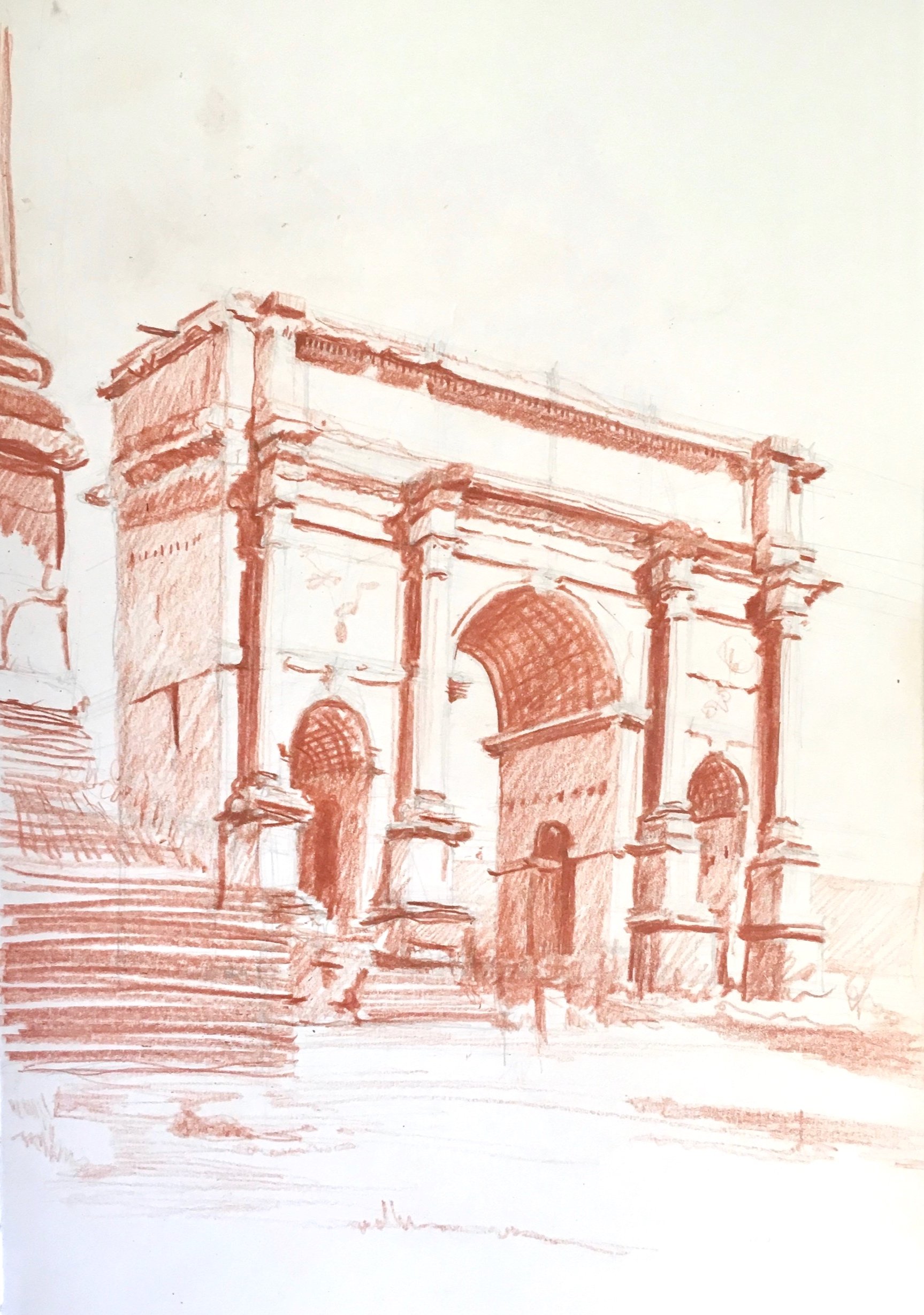
Arch of Septimius Severus, sanguine sketch by Cindy, 2018
After lunch, we painted the Arch of Constantine, where Instructor Richard Piccolo reminded us to observe the vivid effects of light on form. We sought to capture the play of warm and cool colors in light and shadow.
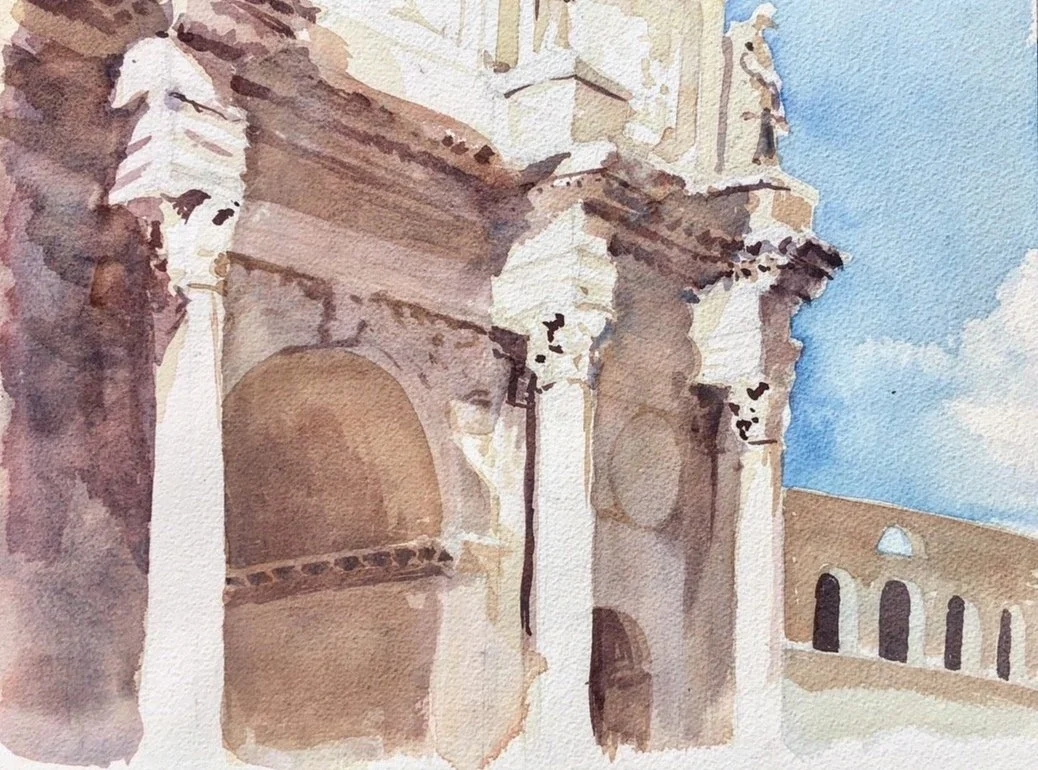
Arch of Constantine, watercolor by Cindy, 2018
Day 7: The Classical Building in the Landscape
We’d returned to the onetime bustling cattle market of the Forum Borarium to study the round Temple of Hercules Victor. This drawing session in sanguine pencil built on the week’s education in light and form, while also adding a new focus, rendering trees. Framed by picturesque umbrella pines, the temple served as a focal point against the trees’ darker range of values in the background.
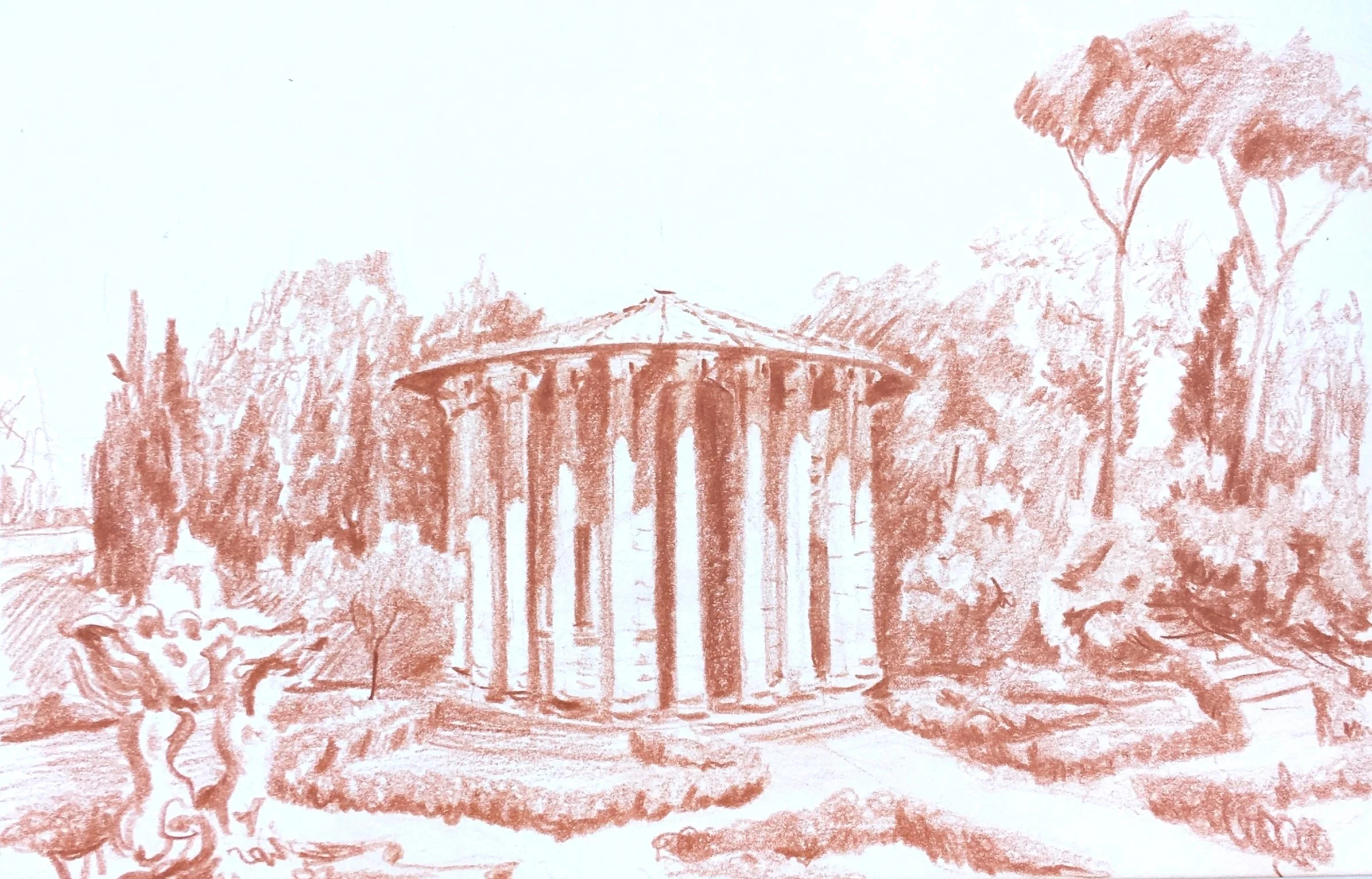
Temple Hercules, sanguine sketch by Cindy, 2018
The drawing tour concluded with a sitting at the terrace adjacent to the Campidoglio, overlooking the whole of Rome with its domes, tile roofs and hillsides beyond. This was just a pure joy to paint under the bright beautiful Italian sun.

watercolor of Rome from the Campidoglio, by Cindy 2018
After the tour concluded, Rick and I ventured on to Tivoli to see the famous fountains at Villa d’Este. The garden proved to be a perfect setting for watercolor… this one below was painted using water from the fountain itself!

fountains at Villa d’Este, watercolor by Cindy, 2018
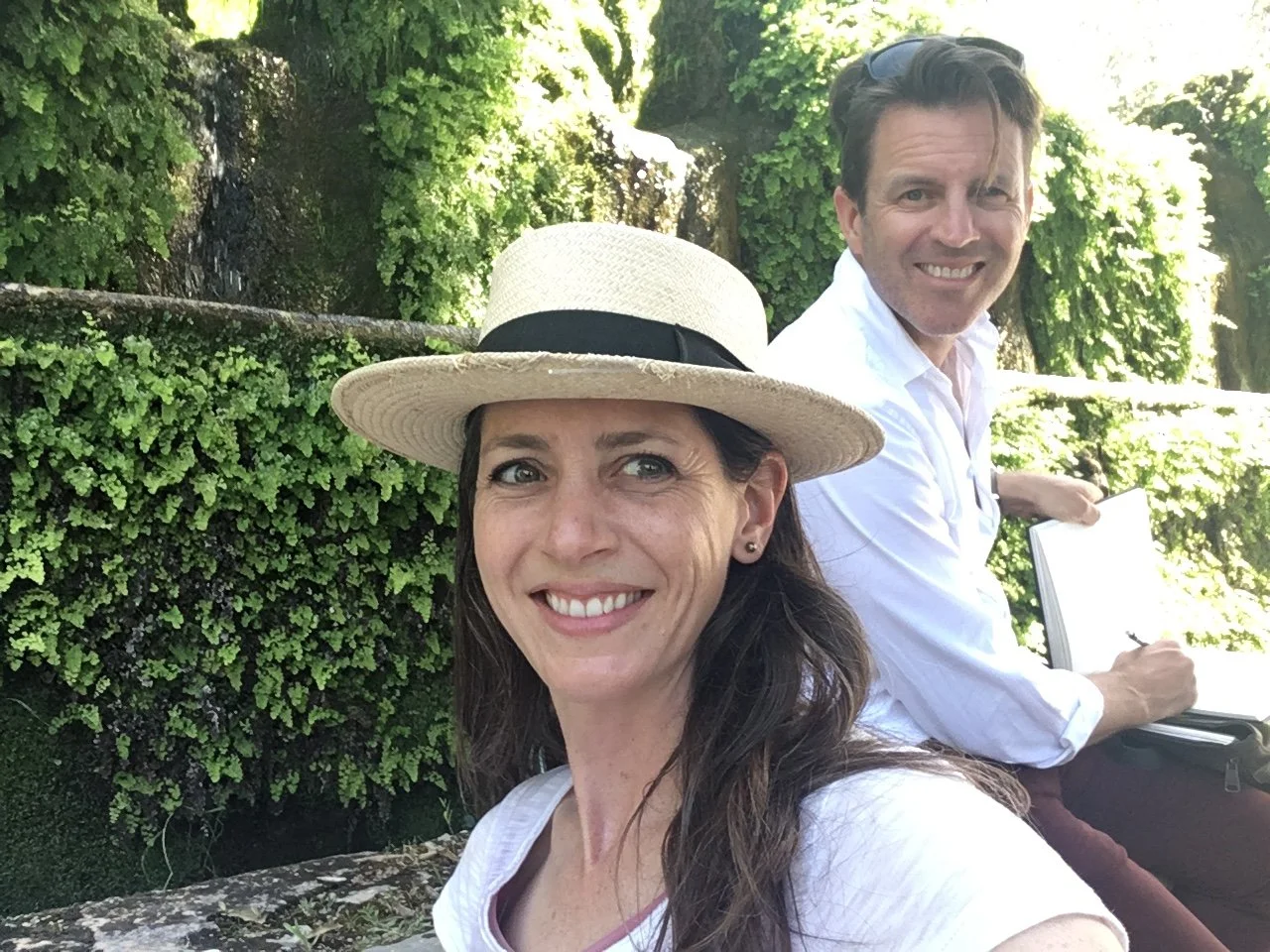
at Villa d’Este in Tivoli

ICAA Paris Drawing Tour 2017
The ICAA Christopher H Browne Paris Drawing Tour is a seven day drawing course taught by classically-trained architects, with opportunities to visit Versailles, Fondation de Coubertin, Bibliotheque Ste. Geneviève, the Louvre and watercolor and plein air sittings at neoclassical Parisian sites. I had the pleasure of joining the trip in 2017.
Studio Zega + Dams served as our home base for the week. Our instructors, Andrew Zega and Berndt Dams, are masters of their craft in watercolor and architectural drafting, respectively. They collaborated on highly detailed watercolors of the palaces at Versailles for their book ‘Palaces of The Sun King’ and instructed us through their methodology.
We spent two full days in the studio, and the rest out and around Paris, instructed by architects Kahlil Hamady and Leslie-Jon Vickery of Hamady Architects.
Our first evening out was spent in the most grandiose of places to sketch: the sculpture gallery at the Louvre. Kahlil directed us toward the statue of La Compagne de Diane by Simon Mazière, sculpted from marble around 1700.

gesture sketch of La Compagne de Diane by Simon Mazière, 2017

pencil drawing of La Compagne de Diane by Simon Mazière, 2017
Back in the studio, we referenced the work of Hubert Robert, a French artist of the 18th century. Robert’s plein air watercolor and ink sketches served as studies for highly detailed landscape oil paintings later created in his studio. In a particularly liberating exercise, we copied several of Robert’s smaller sketches to learn his ink and layered wash technique. This was one of my favorites, with Robert’s original on the right:

study after Hubert Robert, watercolor & ink, 2017

Hubert Robert
The next day we took this exercise out into the real world: Place Des Vosges in Paris. Kahlil and Leslie-Jon showed us how to see values and work quickly, so as to preserve the gesture. Monochromatic watercolor washes were added in successive layers from light to dark; I chose a color similar to the fallen leaves and granite paths.

watercolor at Place Des Vosges, 2017

a sketch at Place des Vosges in the Hubert Robert method, 2017
This ink sketch captures more detail of the facade of the Place des Vosges and the energy of the crowd below.

Place des Vosges pen & marker sketch, 2017
Tuesday we had a truly incredible private tour experience at the Petite Trianon at Versailles, exploring every room and then having a bit of time for a watercolor study outside from the garden perspective. The goal was to create a small study of the elevation and shadows which would inform a larger-scale rendering.

Petite Trianon at Versailles, watercolor & ink, 2017
The study provided the foundation and understanding of shadows for this much more detailed watercolor of the Petite Trianon. Kahlil & Leslie drafted this particular drawing for us, and printed onto watercolor paper so we could jump right into the color exercise.. Andrew Zega led us through a precise application of paint and a relatively dry brush to achieve the golden tones of the French limestone, including details of shadows, texture and aging. I love how the black windows turned out - no reflections here!

Petite Trianon detailed watercolor study, 2017
Thursday we had an incredible visit to Fondation Coubertin / Atelier Saint Jacques, a technical school, museum and foundry dedicated to cultural arts and traditional craft. Set in 15th century Chateau de Coubertin in Saint-Rémy-lès-Chevreuse, the foundation has thoroughly modern workshops and sculpture gardens alongside centuries-old buildings and reference material.
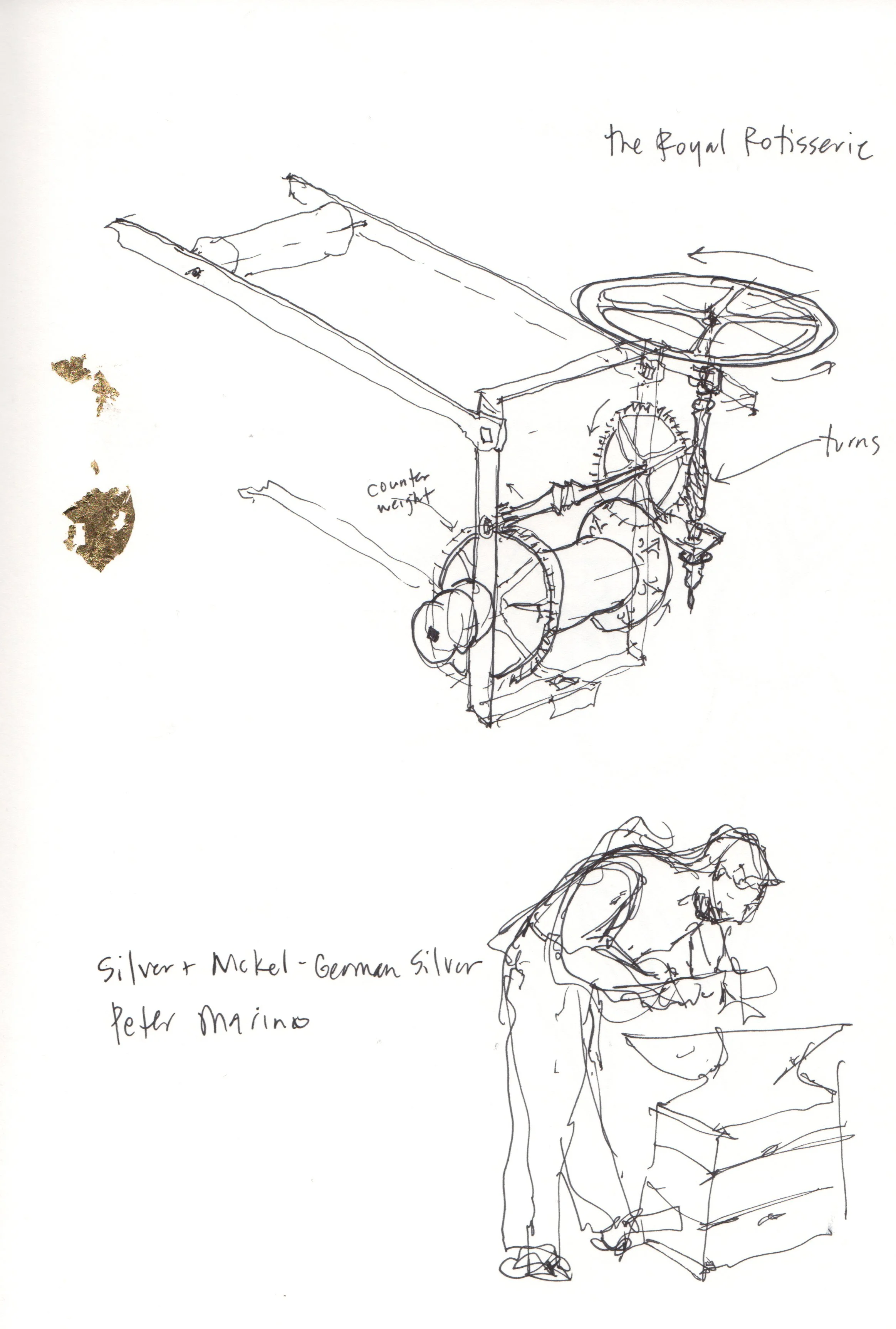
sketch of ‘the Royal Rotisserie’ at Fondation Coubertin, 2017

The final day of the tour was spent at three of Paris’ most beautiful libraries: Bibliothèque Ste. Geneviève, Bibliothèque Richelieu and Bibliothèque Mazarine. The instruction of the week came together in the small painting I did at Bibliothèque Ste. Geneviève, with five successive washes that went from white to almost black. I finished the drawing later in my hotel room with the ink sketched on top.

Drawing & watercolor at Bibliothèque Mazarine

viewing the original drawings of Bibliothèque Ste. Geneviève by architect Soufflot

Bibliothèque Richelieu
On our last day, the group was given time to practice sketching techniques learned throughout the week in a location of their choice. I wandered around the Marais on my own and came across this beautiful courtyard. I wanted to practice rendering trees and their different types of leaves, as well as the railings, chimney caps, and cornice details which are just so fun to draw.

Marais courtyard, pencil sketch, 2017